
Whitespace Map: The Questions Nobody in Your Category Has Answered Yet

Every competitive report you have ever read starts from the same assumption: somebody is winning. Pick a topic, and one of the brands on the list has more of it than the others. The work is to catch up.
AI search breaks that assumption more often than anyone expects. Ask the engines the questions your buyers ask, all of them, not just the ones your sales team already knows, and a meaningful share come back with an answer that names nobody. Not you. Not the incumbent. Not the challenger who has been outspending everyone on content. The engine composes a competent paragraph from reference sites and moves on.
Those rows are whitespace, and they are the only part of a visibility report where the competition has not started yet.
This post covers what a whitespace map measures, why unclaimed questions exist at all, how whitespace differs from the Absent rows you already know about, the three kinds of whitespace you will find and the one that is not real, and how to qualify a row before you spend a quarter on it.
What a whitespace map is
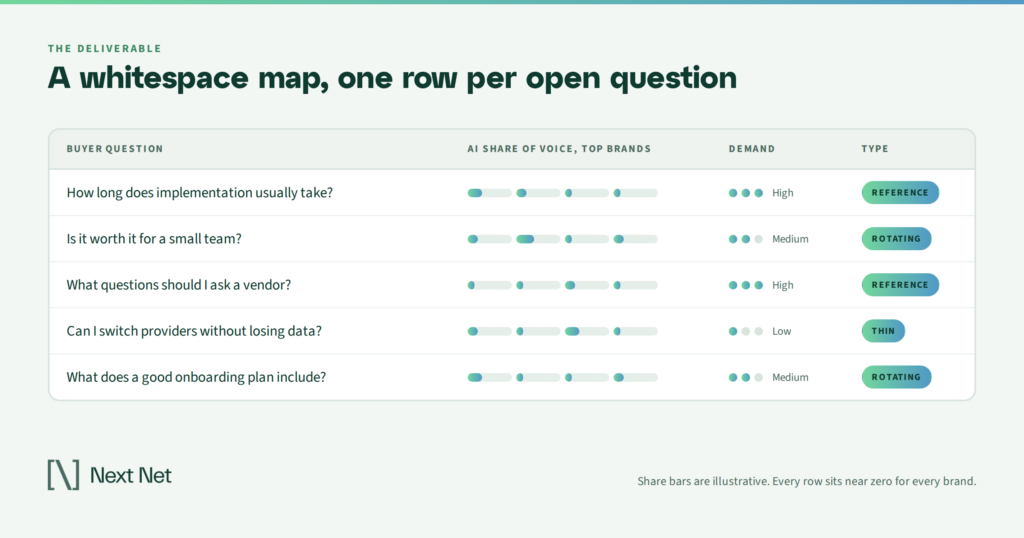
A whitespace map is the list of buyer questions in your category where AI share of voice is unclaimed: the engines answer the question, but no tracked brand is named or recommended consistently enough to hold the slot. AI share of voice, at the topic level, is the percentage of AI answers on a given question that name a particular brand. Most topics have an owner, a brand with the largest share. Whitespace is the set of topics where every brand’s share sits at or near zero, so the answer is being written without any of you in it.
Two things in that definition do the work. First, whitespace is a category-level reading, not a brand-level one. It is not about where you are missing. It is about where everyone is missing. Second, the engines are still answering. Whitespace is not silence. It is a question with a live answer and no vendor attached to it.
That combination is rare in traditional search, where a page with the top ranking always exists and someone owns it. In AI search it is common, for reasons worth understanding before you act on any of it.
Why unclaimed questions exist at all
The short version is that AI engines answer more questions than anyone has written for.
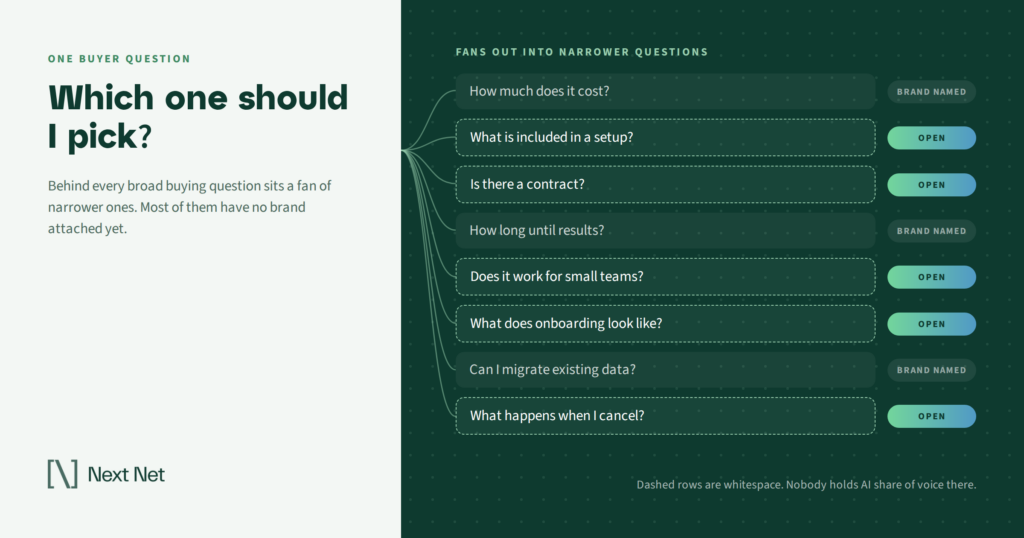
Google’s documentation on AI features and your website describes a query fan-out technique used by both AI Overviews and AI Mode, which issues multiple related searches across subtopics before composing a response. One question from a buyer becomes a spread of narrower questions underneath it, and the engine goes looking for material on each one.
Your category’s content was not built for that spread. It was built for the head terms, the phrases with volume in a keyword tool. The fan-out reaches sideways into qualifiers, comparisons, and edge cases that no one prioritized because no one could see the demand. When the engine reaches for those and finds nothing from any vendor, it builds the answer from whatever is there.
What is there tends to be reference material. In its analysis of Google AI summaries, Pew Research Center found that Wikipedia, YouTube, and Reddit were the most frequently cited sources, and that government sites appeared in AI summaries at three times the rate they appeared in standard results. None of those are brands in your category. When an answer leans on them, it is because no brand gave the engine a better option.
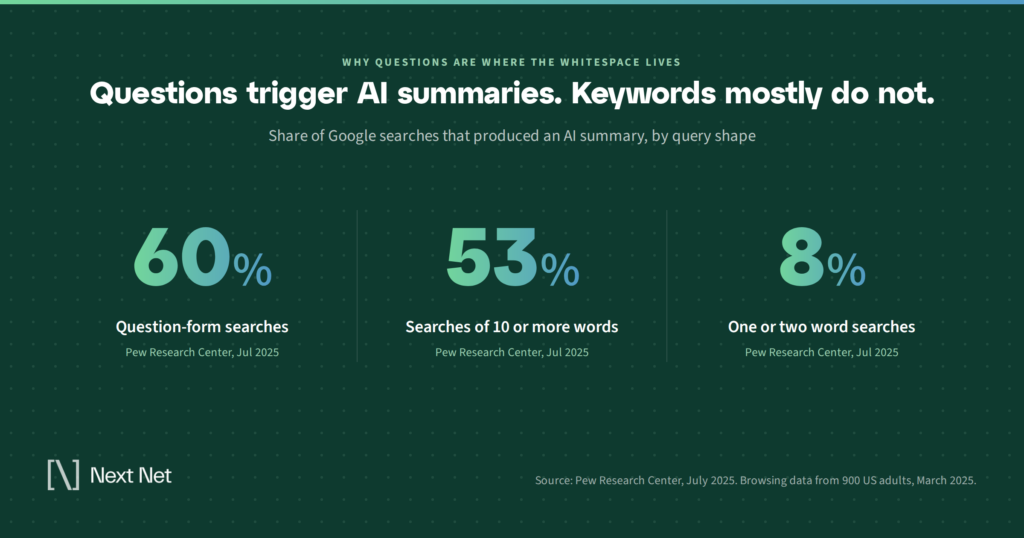
The same Pew analysis explains why the whitespace is full of questions specifically. Searches phrased as questions produced an AI summary 60 percent of the time, and searches of ten words or more did so 53 percent of the time, against 8 percent for one- or two-word queries. The engines lean hardest into exactly the long, specific, question-shaped queries that keyword tools undercount and content calendars skip.
So whitespace is not a measurement quirk. It is the predictable result of engines answering the whole buyer conversation while the category has only written for the loud parts of it.
Whitespace is not the same as Absent
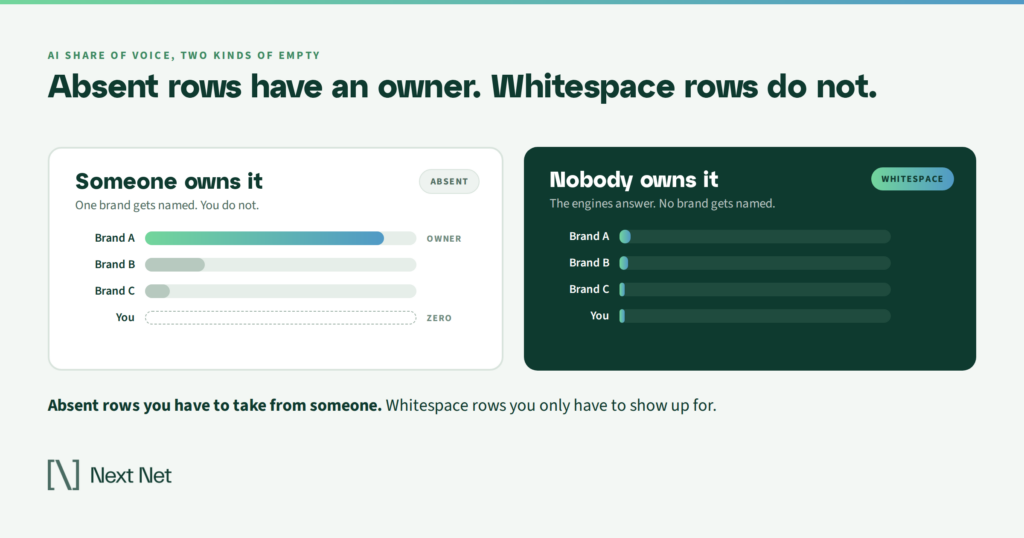
If you have read the topical map post, you know the Own, Contested, and Absent sort. Absent rows are topics with real demand where engines never surface you. Whitespace can look similar on your own row, since your share is zero in both. The difference is what is happening on everyone else’s row.
An Absent topic has an owner. Someone else holds the slot, and the engines reach for them reliably. To move on that row you have to displace an incumbent, which means producing a materially better answer than one that already works.
A whitespace topic has no owner. The engines have no habit to break. There is nothing to displace, only a vacancy to fill.
Absent rows you have to take from someone. Whitespace rows you only have to show up for.
That distinction changes the economics of the row completely, which is why whitespace deserves its own map instead of being folded into the Absent list. Two rows with identical zeros for your brand can carry entirely different costs to win, and a report that does not separate them will send your budget toward the expensive one half the time.
It also changes how the scenery problem shows up. Across this series, scenery means a brand that gets named in passing while another gets the recommendation, present in the answer and absent from the decision. On Own and Contested rows, scenery is the main risk. On whitespace rows there is no scenery at all, because there is no stage. Nobody is being named, in passing or otherwise. That empty stage is the opportunity.
The three kinds of whitespace, and the one that is not real
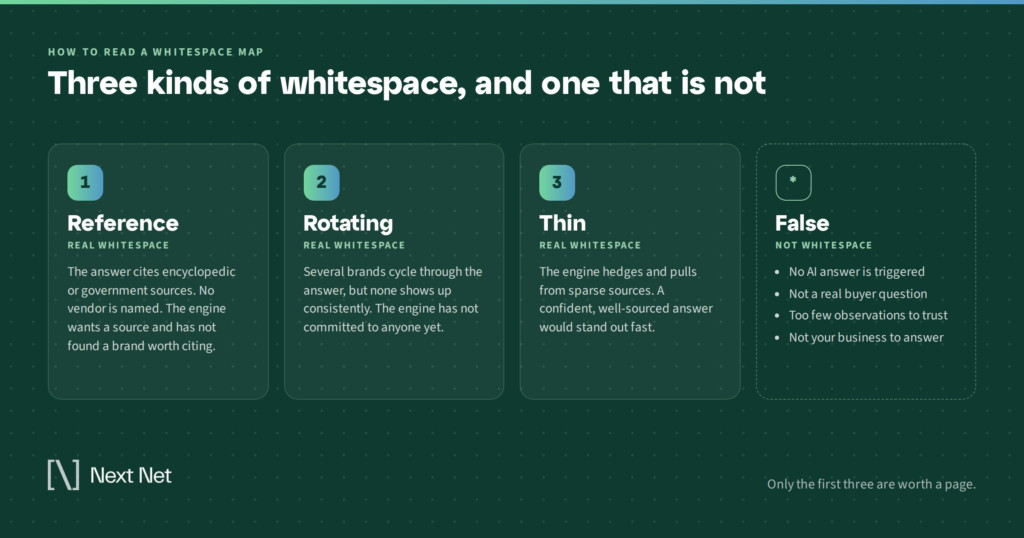
Whitespace rows do not all look alike in the underlying answers, and the differences tell you what kind of answer would fill them.
Reference whitespace
The engine answers confidently and cites encyclopedic, governmental, or community sources rather than any vendor. The question is being answered well by nobody in the category. This is the cleanest kind, because the answer already exists in the engine’s mind and the only thing missing is a brand attached to it. A first-hand, specific treatment from a practitioner usually outcompetes a general reference on a buyer question, since the reference was never written for buyers.
Rotating whitespace
Brands do appear, but no single brand appears often enough to register as an owner. Three or four names cycle through across repeated observations, each at a few percent. The engines have not settled on anyone. This is the kind most likely to close on its own, because the first brand to show up consistently tends to become the habit. It is also the kind where speed matters most.
Thin whitespace
The engine hedges. The answer is short, generic, and heavy on qualifiers, and the source list is sparse. The question is being asked and the engines do not have much to say about it. These rows want depth more than presence: the missing thing is not a brand name but a real answer, and whoever provides one is likely to be cited for it rather than merely mentioned.
False whitespace
Some empty rows are empty for reasons that have nothing to do with the category. Google states in its documentation that AI Overviews are shown only when its systems judge them additive to classic search and often do not trigger, so a row can read as unclaimed because no AI answer was generated on that surface at all. Other rows are questions no buyer asks, generated by a category map that included adjacent subjects. Others sit on too few observations to read. The dimensions footprint post walks through the four readings of a zero in detail, and every one of them applies here. Sort the false rows out first, or the whitespace map becomes a list of tasks nobody should do.
How to qualify a whitespace row
A clean whitespace row is a candidate, not a decision. Four checks turn candidates into a plan, and the first two are borrowed from the rest of the series because whitespace does not exempt you from them.
Check the demand. A question nobody has answered may be a question nobody asks. Pair the whitespace row with the demand data on the topical map before it goes anywhere near a calendar. Reference whitespace with real search volume behind it is the strongest signal this data set produces. Reference whitespace with no demand is trivia.
Check the fit. The engines do not know your business, and a category map will surface unclaimed questions about services you do not offer and buyers you do not want. Zero brands on a question you would never answer is not an opportunity. Strike those rows before anyone gets attached to the count.
Check whether you can bring something the reference cannot. Google’s guide to optimizing for generative AI features draws a line between commodity content, which restates common knowledge anyone could produce, and non-commodity content built on a unique viewpoint or first-hand experience. Its own example contrasts a generic homebuyer tips piece with a specific account of why one buyer waived an inspection. Whitespace is filled by the second kind. If the only answer you could write is the one the reference site already gave, the row is not yours to win, whoever else is missing from it.
Check the row across engines. Run the same question through ChatGPT, Gemini, Perplexity, Copilot, and Google AI Overviews. A row that reads as whitespace on one engine and owned on three others is not whitespace, it is one engine’s retrieval on one day. The rows worth building for are unclaimed across most of the surfaces at once. Consistency across independent systems is the closest thing to confirmation this kind of measurement offers.
What survives the four checks is usually a short list. That is correct. A whitespace map with forty qualified rows was not qualified.
What to publish against a whitespace row
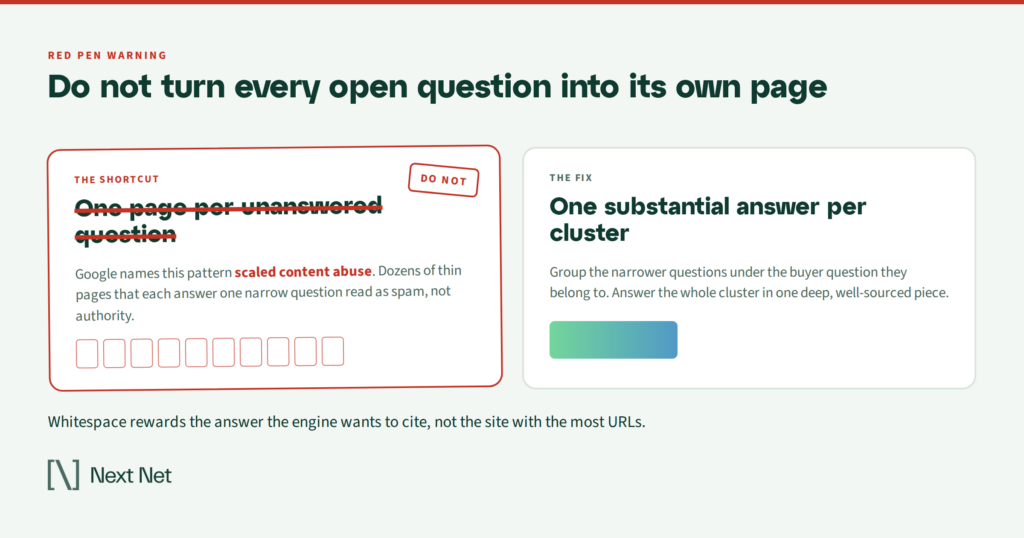
The instinct, once you can see a list of questions nobody has answered, is to answer all of them, one page each, as fast as possible. Resist it for two reasons.
The first is that Google names that move and warns against it. Its generative AI guidance says that creating separate content for every variation of how people might search, including fan-out queries, primarily to influence rankings or AI responses violates its scaled content abuse policy, and adds that a high quantity of pages does not make a site more relevant. The same guidance notes that its systems understand synonyms and general meaning, so you do not need to capture every phrasing to be matched to it.
The second is that it does not work on whitespace specifically. Thin pages against thin questions produce thin answers, and the engine already has one of those. Rotating whitespace closes for the brand that shows up consistently and substantively, not the one that shows up first with the least.
So the unit of work is one substantial answer per cluster of related whitespace questions, not one page per question. Group the qualified rows by the underlying subject. Write the piece a practitioner would write: the specific claim in the first sentence of each section, the reasoning behind it, the edge cases, the numbers you can defend, and the situations where the standard advice is wrong. Give the engine something it can lift cleanly and cannot get from a reference site.
Then leave it alone long enough to be found. Movement in AI answers is uneven and rarely fast, and a whitespace row that has not moved in ninety days has not failed yet.
Whitespace does not stay open
The defining property of whitespace is that it is temporary. Every unclaimed question is one competitor’s decent blog post away from having an owner, at which point it leaves this map and lands on your Absent list, where it costs more to win.
This is why the whitespace map should be pulled on the same cadence as the topical map and read for movement rather than as a static inventory. Three things to watch between pulls.
Rows that closed. A question that was reference whitespace last quarter and now has an owner tells you who in your category is reading the same data, and what they think is worth answering.
Rows that opened. New whitespace usually means the buyer conversation has shifted, a new qualifier or comparison has entered the fan-out, and nobody has caught up. These are the freshest opportunities on the map and the least likely to appear in any keyword tool yet.
Rows you claimed. When a whitespace row turns into an Own row for you, it is the cleanest before-and-after this series can show a client, because there was no incumbent to muddy the attribution. You were not there, nobody was there, and now the engines reach for you. Record the baseline before you publish or you lose the ability to tell that story.
Using whitespace in a client conversation
For agencies and partners, whitespace is the easiest part of an AI visibility report to explain and the hardest for a client to argue with.
Most of a visibility report is bad news with a competitor’s name on it. Here is the topic you lost, here is who took it. Whitespace has no competitor’s name. It is a list of questions the client’s buyers are asking where no one, including the client, has bothered to answer, and the reference sites are doing it for them. The reaction that gets is not defensiveness. It is usually a fast conversation about which of those questions the client is uniquely qualified to answer, which is the conversation you wanted anyway.
Report it as direction, not as a forecast. Say how many qualified rows exist, what kinds they are, and which two or three the client could credibly own. Do not attach a traffic number, a timeline, or a share you expect to reach. The rows are real; the outcome depends on what gets published and on retrieval decisions no third-party tool can see. Google is direct on that last point: no outside tool has access to its internal ranking or AI systems, and that holds for every engine. A whitespace map is an observation of published answers, and it should be presented as one.
What this map does not tell you
It does not tell you whether anyone is asking. Demand lives on the topical map, and a whitespace row without it is a curiosity.
It does not tell you your overall standing. The single figure for how much of the category conversation you hold is the aggregate AI share of voice, and whitespace is the part of the category where that number is nobody’s.
It does not tell you who you are being grouped with on the rows you do appear in. That is the market atlas.
And it does not tell you the answer will stick once you publish it. It tells you the slot is open. Whether you hold it is decided by the quality of what you put there and by engines you cannot inspect, which is the honest limit of the whole discipline and the reason this series reports direction rather than promises.
Frequently asked questions
What is AI share of voice?
AI share of voice is the percentage of AI-generated answers on a set of category questions that name a given brand. It can be read as one aggregate number across the whole category or as a per-topic figure, and the per-topic reading is what a whitespace map uses. A topic where every tracked brand’s share is at or near zero is whitespace.
What is a whitespace map in AI search?
A whitespace map is the subset of your category’s buyer questions where no brand holds AI share of voice. The engines are answering those questions, typically from reference or community sources, but they are not naming or recommending any vendor consistently. It is a category-level reading, distinct from the brand-level Absent rows that show only where you are missing.
How is whitespace different from a content gap?
A content gap is a topic competitors cover and you do not. Whitespace is a topic no one covers well enough for the engines to attach a brand to it. The first is a catch-up problem with an incumbent to displace. The second is a vacancy, and vacancies are cheaper to fill than slots are to take.
Can I find whitespace without a measurement platform?
Partly. Ask the five engines the questions your buyers ask in clean sessions, note which answers name no brand, and repeat over a few weeks to see whether that holds. That gives a usable spot check on a dozen questions. Covering a full category with its fan-out, across all five engines, repeatedly enough to separate rotating whitespace from a single odd retrieval, is where a platform earns its place.
How long does a whitespace row stay open?
There is no fixed window, and the honest answer is that it depends on how many competitors are reading the same data. Rotating whitespace tends to close fastest, because the engines are already sampling brands and only need one to become a habit. Reference whitespace with real demand behind it can stay open for a surprisingly long time, precisely because it never showed up in anyone’s keyword tool.
Start with the empty stage
Most visibility work is a contest. Whitespace is the part that is not, at least not yet.
Pull the map, throw out the false rows, run the four checks, and you will be left with a short list of questions your buyers ask that nobody in your category has answered. Pick the two or three you can answer better than an encyclopedia can, write them properly, and record where you stood before you did.
If you want to see how much of your own category is unclaimed before deciding what to do about it, the AI Visibility Report Card is the fastest way to find out, and the full whitespace view lives on the platform.
Related articles
The AI Buyer Journey: Where Engines Surface You, Stage by Stage
Your AI visibility number went up last quarter. Now answer the harder question. At what point in a buying decision…

Dimensions: Your Topic and Facet Footprint, Ranked
A client looks at a single AI visibility number and asks the only question that matters. Where does that come…