
RSL, robots.txt, and SAIL: Three Layers of AI Content Control and Which One Does What

If you run a publishing site, you have probably been told that you need a robots.txt strategy for AI crawlers, that you should adopt Really Simple Licensing, and that a transaction layer is coming that will get you paid. All three claims are reasonable. The trouble is that they usually arrive as competing advice, as if you had to pick one.
You don’t. Each of these does a different job, and they were designed to stack. robots.txt decides who may fetch which paths. RSL describes what an AI system may do with what it fetches and on what terms. SAIL, which Next Net built, is where those terms get enforced on each request and where every use leaves a receipt.
This post walks through each layer, shows where one ends and the next begins, and answers the questions publishers ask most often about how they interact. By the end you should be able to look at your own setup and say which layer is doing which job, and which layer is missing.
What is Really Simple Licensing?
Really Simple Licensing (RSL) is an open, XML-based standard that lets publishers attach machine-readable licensing terms to their content: which automated uses are permitted or prohibited (such as AI training, AI grounding and generation, AI indexing, or traditional search), who may use it, where, and what that use costs. RSL 1.0 was published as an official specification on December 10, 2025. It extends robots.txt with a License directive that points crawlers to a license file, and it can also be attached through HTTP headers, HTML, RSS feeds, and metadata embedded in media files.
That definition already hints at the relationship. RSL does not replace robots.txt. It plugs into it. And on its own, RSL is a declaration: a clear, standardized statement of your terms that well-behaved clients are expected to read and follow. Turning that statement into something checked on every request is a separate job, and that is where the third layer comes in.
A simple way to picture the three layers
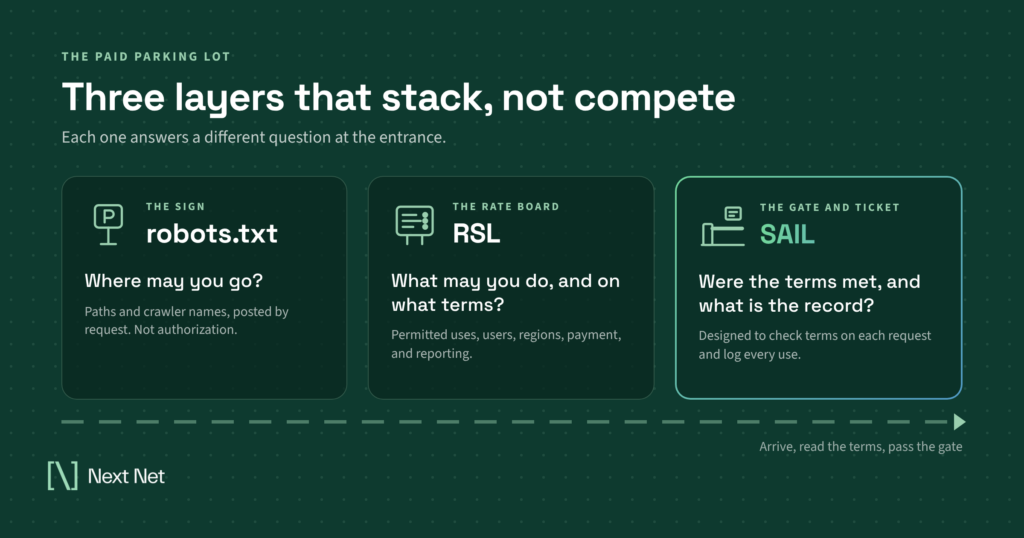
Think about a paid parking lot. There are three separate things at work, and you need all of them for the lot to function as a business.
First, there is the sign at the entrance: authorized vehicles only, no parking in the fire lane, this section reserved. That is robots.txt. It tells visitors where they may and may not go.
Second, there is the rate board: hourly parking here, monthly permits there, free for the first fifteen minutes, residents only after six. That is RSL. It tells visitors what each kind of use costs and who qualifies for which terms.
Third, there is the gate, the meter, and the ticket in your hand when you leave. That is the transaction and receipt layer. It is where the terms on the rate board get checked against the car in front of it, where payment happens, and where a record of the visit exists afterward.
A lot with only a sign is a polite request. A lot with a sign and a rate board is a polite request with prices. The lot only becomes a business when something at the gate checks the terms and issues the ticket.
Layer one: robots.txt controls access, and only by request
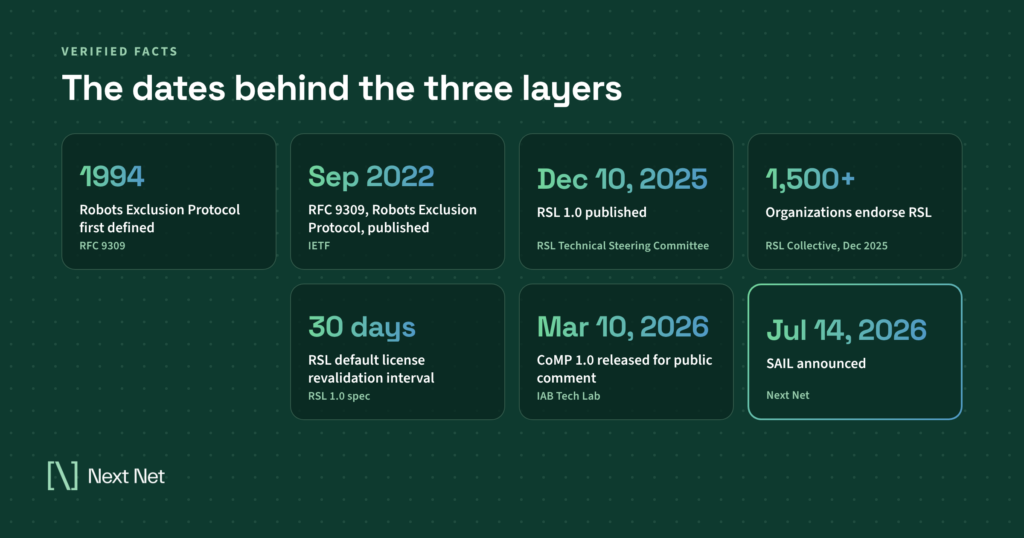
robots.txt is the oldest layer and the one every site already has. The protocol was first proposed in 1994 and was formalized by the IETF as RFC 9309, the Robots Exclusion Protocol, in September 2022. It is a plain text file at the root of your domain that groups rules by crawler name (the user agent) and lists which paths each crawler may or may not access.
For AI, that means you can write different rules for different bots. You might allow a search crawler everywhere, block a training crawler from your archive, and leave a section open to everyone. That is useful, and for many publishers it is the first and only AI control they have in place.
The limits are written into the standard itself. RFC 9309 describes its rules as instructions crawlers are requested to honor, and it states plainly that they are not a form of access authorization. Its security section goes further: the protocol is not a substitute for real content security, and listing a path in robots.txt makes that path publicly discoverable. If you need to keep something out of reach, the RFC points you to actual authentication at the server.
There is a second limit that matters more for AI. robots.txt speaks only in paths. It can say this crawler may fetch /news/ and may not fetch /archive/. It has no vocabulary for what happens after the fetch. It can’t say you may index this for search but not use it to ground a generated answer, or you may train on this if you pay, or you may quote this with attribution. Allow and disallow are the only verbs it has.
That is why so many publishers feel stuck with a binary choice: block an AI crawler and disappear from a growing discovery surface, or allow it and get nothing back. The protocol was never built to express anything in between. We covered how the four ways AI systems use your content differ, and robots.txt can only see the first of them, the crawl itself.
Layer two: RSL describes terms, built on top of robots.txt
RSL was introduced in September 2025 and reached its 1.0 release in December 2025, when the RSL Technical Steering Committee published the Really Simple Licensing 1.0 specification with the status of a Recommendation. The RSL Collective said at the time that more than 1,500 media organizations, brands, and technology companies had endorsed the standard.
The spec describes RSL as building on two older ideas: the syndication format behind RSS and the Robots Exclusion Protocol behind robots.txt. In practice, a publisher writes an RSL license file in XML and points to it. The most common pointer is a new robots.txt directive, a single line that reads License: followed by the full URL of the license file.
What an RSL license can say
This is where RSL fills the gap robots.txt leaves. The usage vocabulary separates the automated uses that matter to publishers: any automated processing, any AI use, AI training, AI input (which covers grounding, retrieval-augmented generation, and generated search summaries), inclusion in an AI system’s index, and traditional search. You can permit some and prohibit others on the same content. A common pattern the spec walks through is allowing search indexing and links while prohibiting every AI use, including generated summaries.
Beyond usage, a license can restrict who may use the content (commercial, non-commercial, educational, government, personal), where (by country or region code), and on what payment terms: a one-time purchase, a subscription, a payment per crawl, per training use, or per use in an AI-generated output, a good-faith contribution, attribution only, or free. It can also require reporting, so a licensed client has to send back telemetry, provenance, or audit information about how the content was used.
How RSL and robots.txt divide the work
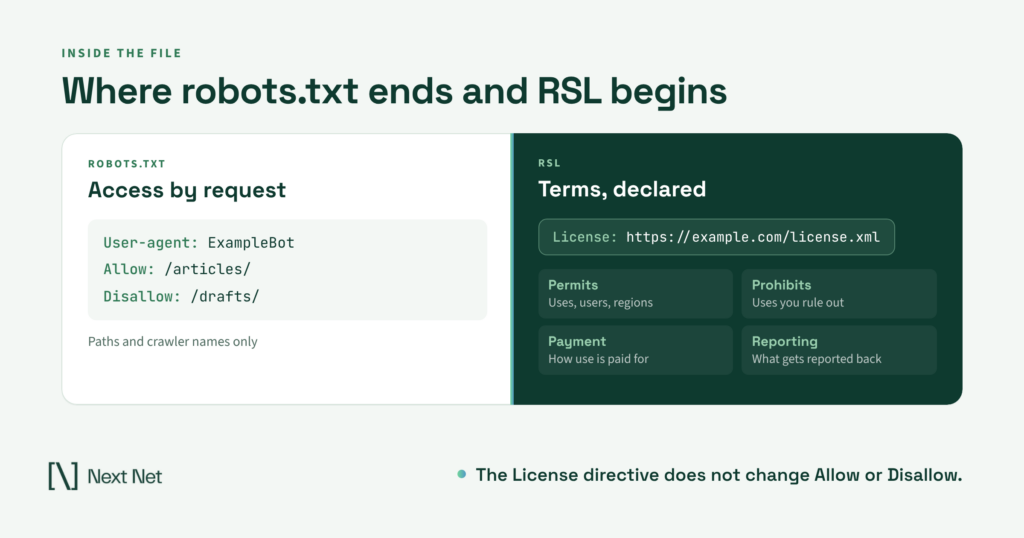
The specification is precise about the boundary between the two layers, and it is worth knowing because it answers the question publishers ask most. The License directive does not modify the access permissions in your Allow and Disallow rules. It only identifies the license that governs content under your control.
So the two layers combine in a predictable way. robots.txt still decides which paths a given crawler may reach. RSL decides the terms that apply to whatever it reaches. If robots.txt disallows a path for a crawler, an RSL license that permits AI use does not reopen that path. If robots.txt allows a path, the crawler is expected to retrieve and honor the license before it processes the content.
RSL also follows robots.txt’s own grouping logic. A License line can sit outside any user-agent group, where it applies to every client, or inside a specific group, where it applies only to that crawler. When a crawler’s group has its own License line, that one wins and the global one is ignored. That lets you offer one set of terms to a named AI crawler and another to everyone else, using the same file you already maintain.
When licenses overlap
Because RSL can be attached in several places (robots.txt, an HTTP Link header, an HTML link or embedded script, an RSS item, or metadata inside an image, PDF, audio, or ebook file), it is possible for more than one license to apply to the same article. The spec resolves this the way a careful lawyer would. The most specific license wins, so a page-level license beats a site-level one. If two licenses conflict, clients must honor the most restrictive combination. And if a client cannot obtain a valid RSL document for an asset at all, it must treat that asset as unlicensed.
This is the per-piece logic we explored in our guide to the rights-managed content object: terms set on an individual article override terms set for the section or the site. RSL gives that idea a concrete, standardized syntax.
What RSL does not do by itself
The core of RSL, the vocabulary and the discovery methods, is the required foundation of any conforming implementation. The network protocols that check licenses on each request are optional extensions: the Open License Protocol for acquiring and validating license tokens, the Crawler Authorization Protocol for presenting those tokens with each request, and the Encrypted Media Standard for content that should only be readable with a key. Publishers can adopt RSL as a licensing and discovery framework without implementing any of them.
The spec is candid about why those extensions exist. In its section on crawler authorization, it notes that many automated agents spoof trusted identities or ignore access restrictions, which makes it hard for publishers to tell licensed clients from unauthorized ones. A declaration is only as strong as the client reading it. That is not a flaw in RSL. It is the reason the stack needs a third layer.
Where CoMP fits alongside RSL
There is one more acronym worth placing, because SAIL is described as compatible with it. CoMP is the Content Monetization Protocol from IAB Tech Lab, the standards body behind ads.txt and OpenRTB. IAB Tech Lab released CoMP 1.0 for public comment in March 2026 as a standardized way for content owners and marketplaces to tell AI systems what they offer and make sure commercial terms are in place before any crawling or content use happens.
Where RSL focuses on expressing license terms in a format any crawler can read, CoMP focuses on the commercial handshake between content owners, marketplaces, and AI systems. The two point in the same direction. And IAB Tech Lab’s own release makes the same admission the robots.txt standard does: CoMP is not a replacement for strong access controls, and it assumes publishers already block unwanted bots at the edge or CDN.
Notice the pattern across all three standards. robots.txt requests. RSL declares. CoMP negotiates. Each one assumes that something else, somewhere, is doing the checking. It is the same pattern the IETF’s AI Preferences working group follows: its charter covers a vocabulary for expressing preferences and ways to attach them to content, and lists technical enforcement and the authentication of crawlers as out of scope.
Layer three: SAIL enforces terms and issues the receipt
Full disclosure: Next Net created SAIL, the Standardized Agentic Intelligence Ledger. We announced it in July 2026 with Sundial Media & Technology Group, home to ESSENCE, Refinery29, AFROPUNK, and Beautycon, as an inaugural media partner. The release describes SAIL as a CoMP and RSL compatible transaction, receipt, and market intelligence layer for AI content rights, and that phrase is the cleanest way to see where it sits in the stack.
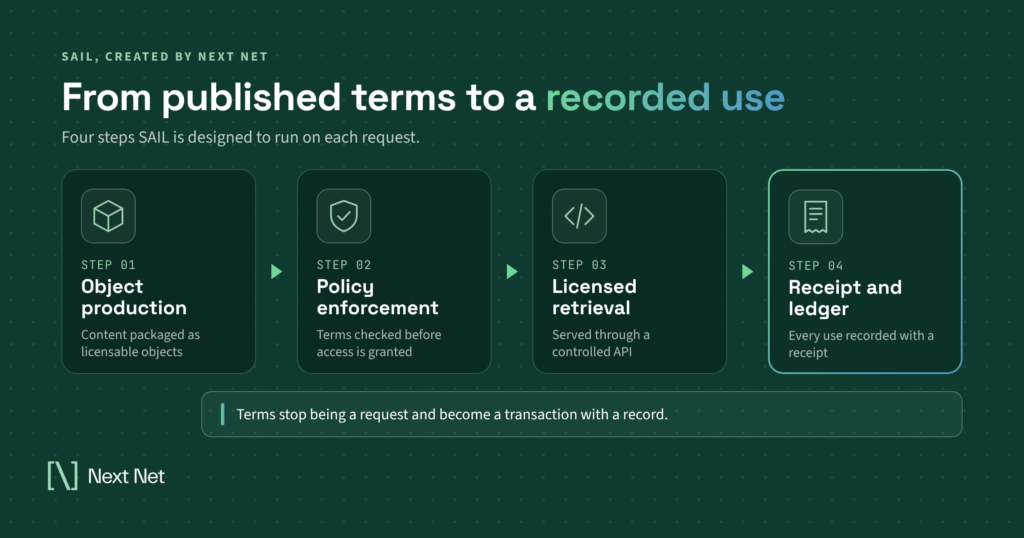
SAIL is built to do the jobs the first two layers leave to someone else. It converts a publisher’s content into rights-managed objects that each carry their own licensing terms. It checks the publisher’s policy on every incoming request. Authorized AI systems retrieve content through a controlled API rather than an open crawl, and before licensing they see metadata rather than the content itself. Every use is recorded in a verifiable ledger, which produces a receipt for that transaction and a record of what was retrieved, by whom, for what purpose, and under which terms.
Compatibility is the important design choice. SAIL works with RSL and robots.txt as they are. The terms a publisher expresses in RSL are the kind of terms SAIL is designed to enforce, and the commercial signals CoMP standardizes are the kind of signals SAIL is designed to record. You keep the sign and the rate board. SAIL is designed to be the gate and the ticket.
The receipt matters for more than billing. Licensing conversations, renewal negotiations, and copyright disputes all turn on evidence of use. A publisher with flat-fee deals and no usage data has very little to say at renewal. A publisher with a ledger of every licensed retrieval has a record to reconcile and bill against. We explored why that record is the real subject of most legal fights in what AI copyright lawsuits are really fighting over.
Which layer does what: a side-by-side view
If you only keep one section of this post, keep this one. Here is the division of labor in plain terms.
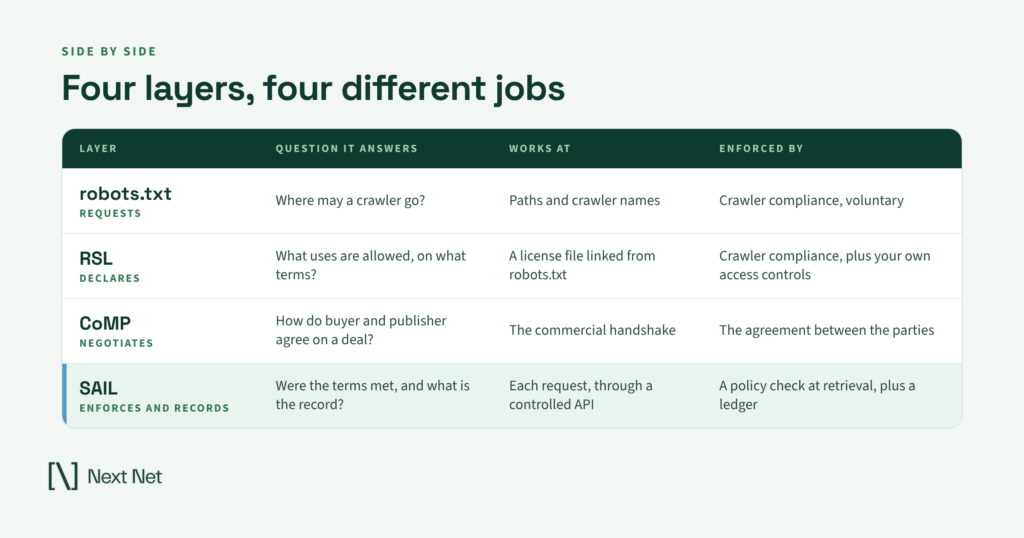
robots.txt answers the question of where a crawler may go. It works at the level of paths and crawler names. It is honored by convention, nothing in the protocol enforces it, and it has no vocabulary for what happens after a fetch.
RSL answers the question of what a client may do with your content and on what terms. It works at the level of sites, sections, and individual assets, with the most specific license winning. Its core is a declaration that conforming clients are required to honor. Optional protocols in the spec can check licenses per request, but adopting them is up to each implementer.
CoMP answers the question of how content owners and AI systems agree on commercial terms before any use. It is in public comment as a framework from IAB Tech Lab and assumes access controls are already in place.
SAIL answers the question of whether the terms were met on a given request and what the record shows. It is designed to enforce the publisher’s policy on every retrieval and to record each use in a ledger that both sides can check.
How to set up the stack in the right order
You do not need to do everything at once, and the order matters. Each layer depends on the one below it being clean.
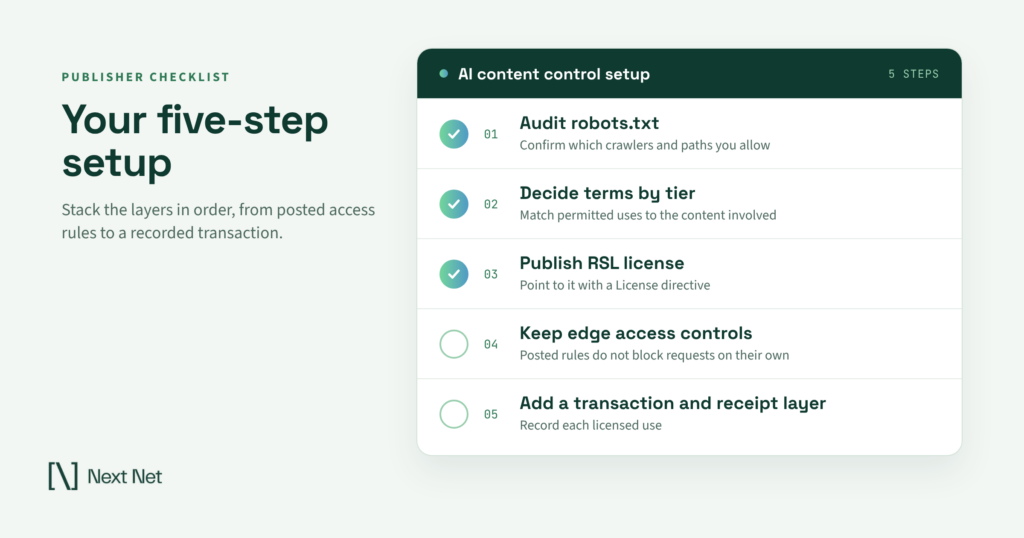
1. Audit your robots.txt for AI crawlers
Open the file and read it as a policy document. Which AI crawlers does it name? Which paths does each one reach? Are there rules nobody on the current team remembers writing? Many publishers find their file blocks crawlers they would now rather license, or allows crawlers they assumed were blocked. Pair the review with your logs; the crawl-to-referral ratio is a useful way to see which bots take far more than they send back.
2. Decide your terms by content tier
Before you write any XML, decide the policy in plain language. Which content is evergreen and benefits from being cited with attribution? Which is perishable and valuable enough to require payment per use? Which should never be used for training? Most publishers land on different answers for different sections, which is what RSL’s per-asset precedence is for.
3. Publish an RSL license and point to it
Write the license file to match the tiers you chose, serve it from your domain, and add the License line to robots.txt. If your CMS or CDN supports it, add the HTTP Link header as well, so the license travels with responses that are not HTML pages. Validate the file before you rely on it; a malformed license can lead a conforming client to treat your content as unlicensed. And note the revalidation rule: unless you set a different max-age, clients are expected to recheck the license every 30 days, so changes to your terms propagate on that cycle.
4. Keep access controls at the edge
None of the standards above replaces actual blocking for bots you do not want at all. Every one of them assumes you have it. Keep the bot management you already run, and treat robots.txt as a statement of intent.
5. Add a transaction and receipt layer for the content you license
Once your terms are written down and your access controls are in place, the remaining gap is the one this whole post has been building toward: checking terms on each request and keeping a record of every use. That is the layer that turns a published policy into licensed, receipted transactions. If you want to understand the economics before choosing a model, our guide to how AI systems will pay for content lays out the options.
Frequently asked questions
Does RSL replace robots.txt?
No. RSL extends robots.txt with a License directive and explicitly leaves your Allow and Disallow rules unchanged. robots.txt still controls which paths a crawler may reach; RSL controls the terms that apply to what it reaches. You keep both.
If robots.txt blocks a crawler but my RSL license permits AI use, which one wins?
The block. The License directive does not modify access permissions, so a disallowed path stays disallowed for that crawler. If you want a crawler to license a section, the robots.txt rules for that crawler have to let it reach the section first.
Is RSL legally binding?
RSL is a technical standard. It gives your terms a consistent, machine-readable form and defines what a conforming client must do, and the spec includes optional elements for legal statements such as warranties, disclaimers, and a contact for disputes. Whether specific terms are enforceable against a specific party is a legal question for your counsel, not something any file format settles.
Is SAIL an alternative to RSL?
No. SAIL is designed to be compatible with RSL and CoMP. RSL expresses your terms; SAIL is built to enforce them on each retrieval and record every use. A publisher can adopt RSL on its own today and add a transaction layer for the content it licenses.
Where does llms.txt fit in all this?
It doesn’t, really. llms.txt is a curated reading list for AI agents. It does not allow, block, or license anything. We covered what it does and whether engines read it in our guide to llms.txt for publishers.
Three layers, one stack
robots.txt, RSL, and SAIL answer three different questions in sequence: where may you go, what may you do and on what terms, and did that use meet the terms. Most publishers have the first layer already. Many are adding the second. The third is what turns the first two into a business with a record behind it.
If you want to see how SAIL enforces your licensing policy on every request and gives you a receipt for every use, explore SAIL for publishers.
Related articles
Google Preferred Sources and Search Profiles: The Publisher Setup Guide
Somewhere on your site right now, a loyal reader is finishing an article they liked. They will close the tab,…
The Crawl-to-Referral Ratio: The One Number Every Publisher Should Put in Front of Leadership
On September 15, 2026, Cloudflare flipped a default that touches a large slice of the web. Training and Agent crawlers…
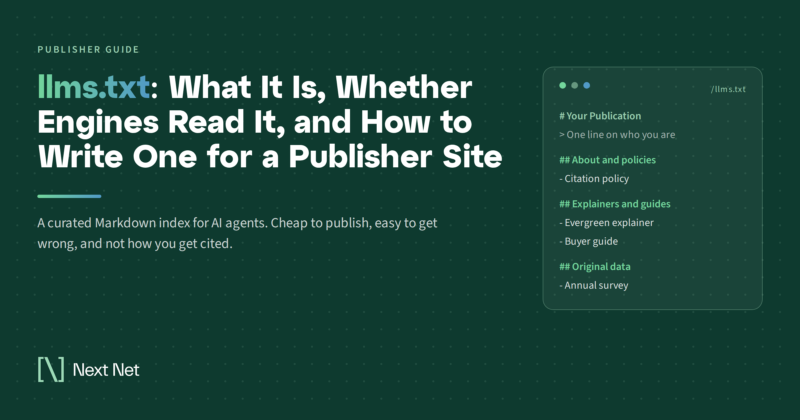
llms.txt: What It Is, Whether Engines Read It, and How to Write One for a Publisher Site
Every year or so a new file shows up at the root of publisher sites, and this cycle’s file is…