
Win the Pitch With an AI Visibility Report

Every agency pitch deck makes the same promise, and every prospect has already heard it. More traffic. More leads. A process, a team, a track record.
The prospect nods along, because they nodded along for the last three agencies too. What they have never seen is evidence about their own business that they could not have found themselves.
That is the entire job of the report you bring into the room.
An AI visibility report is a snapshot of how AI engines actually talk about a specific business: whether ChatGPT, Gemini, Perplexity, Copilot, and Google AI Overviews mention it when buyers ask relevant questions, whether they recommend it, and who they name instead. Agencies use it as a pitch and prospecting asset because it shows a prospect something concrete, current, and about them, before any contract is signed.
This post covers the sales motion: what the report shows, why it changes the psychology of a pitch, how to run the meeting around it, and how it becomes the spine of the proposal that follows. What happens after you win the account (packaging the ongoing service, keeping the client renewing) belongs to two companion posts, linked where they pick up the thread.
Why the Standard Pitch Is Losing Power
The traditional agency pitch rests on claims: our methodology, our results for other clients, our rankings promise. Claims made a certain kind of sense when the prospect could verify them later against a ranking report.
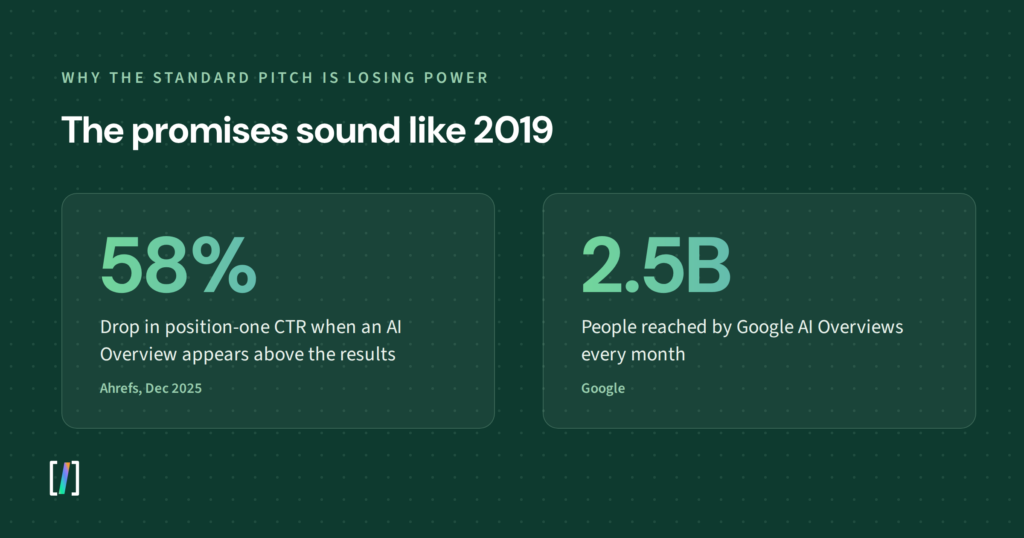
That verification layer is eroding. When an AI Overview sits above the results, Ahrefs found position-one CTR falls by roughly 58 percent, and Google reports AI Overviews reach over 2.5 billion people a month. Prospects feel this before they can explain it: the promises sound like 2019, and their gut says the game moved.
Which creates the opening. A business owner has usually never seen what ChatGPT says when a buyer asks for the best option in their category and city. Neither have their current agency, most of the time.
The agency that walks in holding that answer is not making a claim. It is holding evidence.
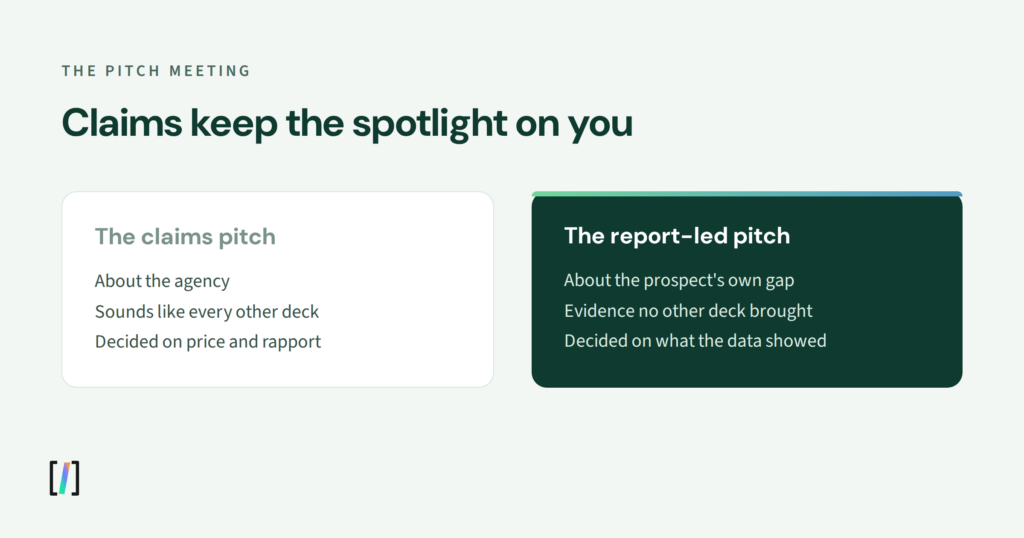
There is also simple fatigue. A prospect taking three agency meetings hears the same case studies, the same process diagrams, the same promises with different logos. When every deck is interchangeable, the decision defaults to price and rapport, and neither is a moat. The report breaks the tie by being the one thing in the stack no other agency thought to bring.
What an AI Visibility Report Actually Shows
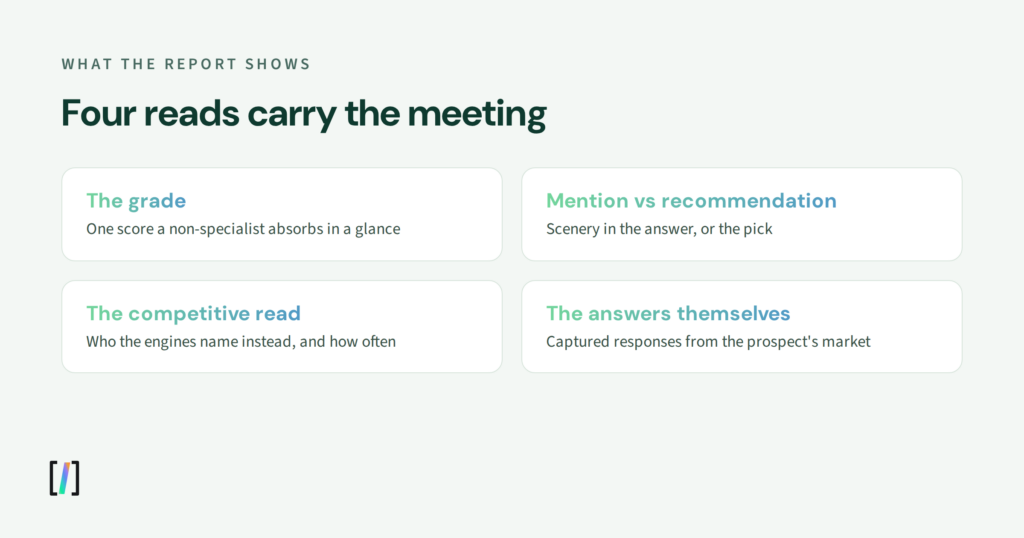
A useful report for a pitch context is short and legible, closer to a report card than an audit binder. Four reads carry the meeting.
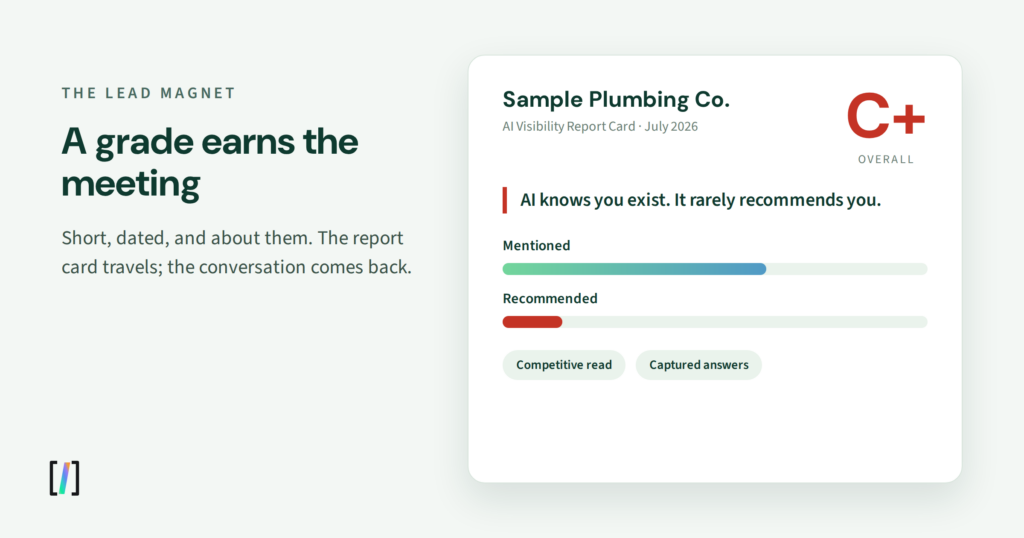
The grade. A single AI visibility score that compresses the whole picture into something a non-specialist absorbs in one glance. The grade is not the analysis; it is the headline that earns attention for the analysis.
The mention versus recommendation split. Plenty of businesses show up in AI answers the way extras show up in a crowd scene: technically there, never the point. Scenery. The report separates being mentioned from being recommended, because the first is set dressing and the second is what moves a buyer.
The competitive read. Who the engines name instead, and how often. Nothing lands harder in a pitch than a prospect watching a competitor get recommended by name for the exact question their buyers ask.
The answers themselves. Real captured responses, quoted from the engines, in the prospect’s own market. These are the receipts behind the grade, and the part of the report prospects photograph with their phones.
A fifth read earns its place with more sophisticated prospects: where the answers come from. Engines assemble responses from a finite set of citation sources, and showing a prospect which publications and profiles feed their category’s answers turns an abstract problem into a target list. Save it for second meetings; in a first pitch it competes with the grade for attention.
Note what the report is not: a promise, a projection, or a teardown of anyone’s past work. It reports where things stand today, which is exactly why it is believable.
Why It Wins Pitches
Three shifts happen the moment a specific report about their business hits the table.
The conversation moves from your ability to their situation. A claims-based pitch keeps the spotlight on the agency, where skepticism lives. A report-led pitch puts the spotlight on the prospect’s gap, where urgency lives. The prospect stops evaluating you and starts reacting to their own numbers.
You become the one who showed them the surface exists. Most prospects know AI search matters in the abstract; some have even asked an engine about themselves and felt reassured by a mention, not realizing a mention can mean standing in the scenery while a competitor gets the recommendation. You made the distinction concrete, in their category, with their competitors in the frame. That positioning survives the meeting: whoever revealed the problem holds first claim on solving it.
And the free report models the paid relationship. It quietly demonstrates the thing you are selling: measurement first, plain reading of the data, no inflated promises. A prospect who likes how you handled the free snapshot has already previewed what working with you feels like.
Timing amplifies all three. Business owners are hearing about AI search from trade press and peers right now, usually as anxiety without specifics. Arriving with specifics while the anxiety is fresh and the category is unclaimed is a window, and windows in agency positioning have a habit of closing once one competitor in a market starts pitching this way.
There is a discipline cost to this. The report has to be allowed to say good things about the prospect too. If every report somehow concludes that the business is in crisis, the asset stops being evidence and starts being a brochure, and prospects can tell the difference in about a minute.
Working It as a Lead Magnet
The report earns its keep before the pitch too, as the outbound asset that gets the meeting booked in the first place.
Start with a named list, not a blast. Pick the vertical where your fulfillment is strongest, list the twenty or fifty businesses you actually want, and run a report for each before any contact. The economics work because the snapshot is cheap to produce and expensive-feeling to receive.
Then lead the outreach with a finding, not an introduction. “When buyers ask Perplexity for the best options in your category, two of your competitors get named and you do not. I have the full snapshot if you want it” is a different email from “I run an agency and would love fifteen minutes.” One is about them; the other joins the pile.
Hand over the report without a toll. Gating a pitch asset behind a call protects nothing worth protecting; the report’s job is to travel, get forwarded to a partner or an owner, and come back as a meeting request. The follow-up conversation is where the value concentrates, because a snapshot raises questions only a practitioner can answer.
And date every report you send. Freshness is the credibility. An answer captured this month is evidence; the same answer three months old is trivia, and prospects sense the difference even when the engines have not changed their minds.
Treat the whole motion as a program with a funnel, not a series of favors. Track how many reports go out, how many turn into conversations, and how many conversations reach proposal. A vertical where snapshots keep coming back flat or unremarkable is telling you something about fit, and the fix is usually a sharper prompt set or a different vertical, not louder follow-up. The agencies that get compounding value from this treat the report list like a pipeline stage and review it monthly, the same way they will later review client trend lines.
Running the Report-Led Pitch Meeting
The report changes the meeting’s shape. You are no longer presenting the agency; you are walking someone through their own snapshot for the first time.
Preparation is most of the meeting. Build the report around the questions the prospect’s buyers actually ask (their services, their cities, their comparisons), not generic category prompts. Fifteen minutes tailoring the prompt set is the difference between a snapshot that feels like surveillance-grade insight and one that feels like a template with their name on it.
- Open with one question, not the deck. “When someone asks ChatGPT for the best option in your category here, do you know what it says?” Then show them. The captured answer does the first five minutes of selling on its own.
- Give the grade, then pause. Let them react. The questions a prospect asks about their own grade tell you exactly what the proposal needs to emphasize.
- Walk the mention versus recommendation split. Most prospects assume appearing in an answer is winning. Showing them they are scenery, while a named competitor gets the recommendation, reframes what visibility means in one slide.
- End on the path, lightly. One slide on how measurement becomes work becomes movement. Report direction, never promises: “here is what typically moves first” keeps you credible, while a delivery date on a number you do not control is a debt the account manager inherits.
Resist the urge to present all of it. A pitch meeting needs the four reads and nothing else; the full data belongs to the engagement, not the audition. Leave a printed copy behind, because the report that circulates the prospect’s office without you in the room is doing your best selling. And never use the report to disparage the incumbent agency by name or by implication. The data makes the point; piling on makes you look like every other vendor and invites the prospect to defend the choice they made.
From Report to SEO Proposal
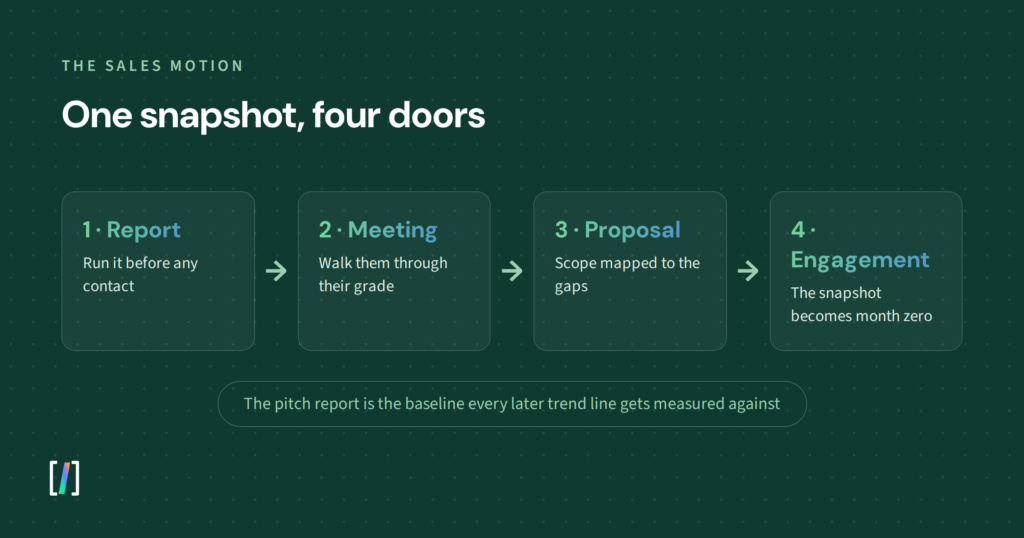
The report’s second life begins after the meeting, as the spine of the SEO proposal. Most proposals open with boilerplate about the agency. A report-led proposal opens with the prospect’s baseline, which makes it the only proposal in the stack that is about the reader.
The structure writes itself. The baseline section restates the grade and the four reads. The scope section maps each line of work to a gap the report surfaced, so nothing in the price looks arbitrary. The first-ninety-days section describes the re-measurement: when the prospect will see the snapshot again and what movement would show up first.
The report also does quiet work on price. A number floating free invites comparison shopping; a number sitting next to a list of named gaps, each mapped to a line of scope, invites a different question: which of these are we willing to leave open? Scope defended by evidence gets negotiated on scope. Scope defended by credentials gets negotiated on price.
That last section matters more than it looks. It converts the report from a one-time artifact into month zero of an ongoing rhythm: measure, do the work, prove it moved. Packaging that rhythm as a service line is covered in Making AI Visibility a Productized Service, and running it so clients renew is covered in The Measure, Do, Prove Loop That Keeps Clients Around. The pitch report is where both begin: the first snapshot every later trend line gets measured against.
Mistakes That Blunt the Report
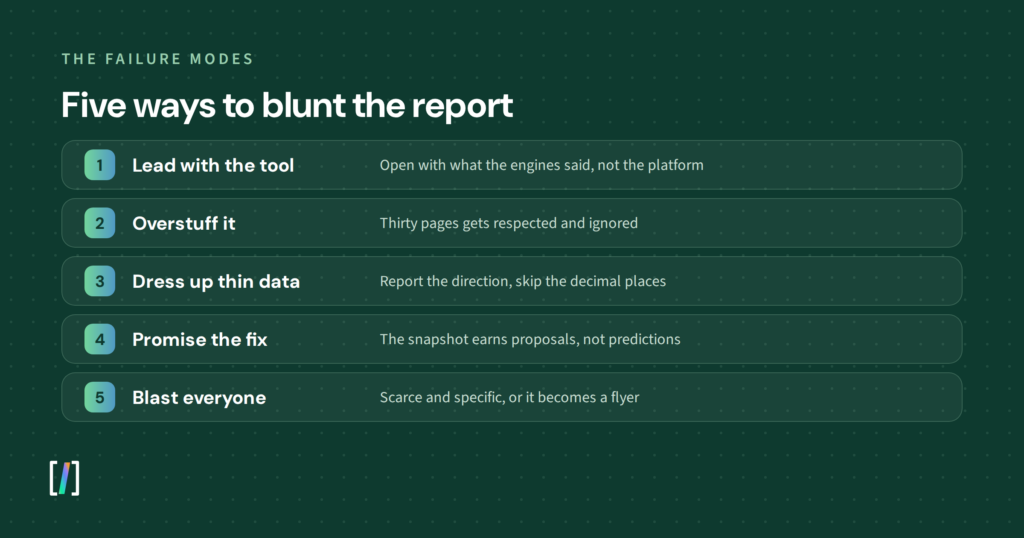
Leading with the tool instead of the finding. Prospects do not care what generated the report. Open with what the engines said, not with a platform walkthrough; the machinery can surface later, in the proposal.
Overstuffing it. An ai visibility audit that runs thirty pages gets respected and ignored. The pitch version is a snapshot; depth is what the engagement is for.
Dressing up thin data. Some categories and smaller markets return sparse answers. Say so, plainly, and report the direction without decimal-point precision. False confidence in a free report poisons trust in everything you charge for later.
Promising the fix in the pitch. The report earns the right to propose work, not the right to promise outcomes. The moment the snapshot becomes a promise, you have rebuilt the exact pitch that stopped working.
Sitting on it. A visibility snapshot ages. Send the report while the answers in it are still what the engines say this month, and date it so the prospect knows it is fresh.
Running it for everyone. The report is persuasive because it is scarce and specific. Blasting an unqualified list turns a diagnostic into a flyer, and the flyer version trains your market to ignore the diagnostic. Reserve it for prospects you can actually serve well, in verticals where your fulfillment has proof behind it.
Frequently Asked Questions
What is an AI visibility report?
An AI visibility report is a point-in-time snapshot of how AI engines represent a specific business: whether ChatGPT, Gemini, Perplexity, Copilot, and Google AI Overviews mention it for relevant buyer questions, whether they recommend it, and which competitors they name instead. In agency use it doubles as a lead magnet and pitch asset, because it gives prospects concrete evidence about their own market.
What should an AI visibility report include?
Four things carry a pitch: an overall AI visibility score or grade, the split between mentions and recommendations, a competitive comparison showing who the engines name, and real captured answers from the prospect’s market. Anything beyond that belongs in the paid engagement, not the pitch version.
How is an AI visibility audit different from an SEO audit?
An SEO audit examines a website’s rankings, technical health, and content against search engine results, while an AI visibility audit examines how generative engines answer buyer questions: who gets mentioned, who gets recommended, and from which sources. They overlap in inputs but measure different surfaces, and a business can score well on one while being nearly absent from the other.
How do agencies use AI visibility reports to win clients?
As the opener rather than the leave-behind: run the report before the first meeting, lead the conversation with the prospect’s own grade and captured answers, then map the proposal’s scope directly to the gaps the report surfaced. The report shifts the pitch from claims about the agency to evidence about the prospect, which is a conversation incumbents and competing decks cannot join.
Bring Evidence to the Next Pitch
Every agency arrives with claims. Very few arrive with a graded, dated snapshot of the prospect’s own market, which is why the one that does tends to be the meeting the prospect remembers.
You can run a free AI visibility report card for any prospect on your list, and when the report opens the door, the Next Net platform and our fulfillment services turn that first snapshot into the ongoing loop the proposal promises.