
What to Say When a Client Asks If They Show Up in ChatGPT

It arrives as a Slack message on a Tuesday, or as an aside in the last five minutes of a quarterly review. “Quick question. Do we show up in ChatGPT?”
The client isn’t trying to test you. Their CEO asked them at a board dinner, or a prospect mentioned it on a sales call, or they typed a question into ChatGPT last night and didn’t see their own company anywhere in the answer. Now they’re asking you, because you’re the person they pay to know.
What you say in the next sixty seconds matters more than most agencies realize. Answer it well and you’ve opened a new line of work inside an existing relationship. Answer it badly and the client quietly starts wondering who else they should ask.
Here’s the definition worth keeping in your back pocket: when a client asks whether they show up in ChatGPT, they are really asking whether AI assistants mention and recommend their brand when buyers ask for solutions in their category. Answering it accurately means measuring brand mentions in ChatGPT, Gemini, Perplexity, Copilot, and Google AI Overviews, then separating the passing mentions from the actual recommendations, because those two outcomes do very different things for the business.
This post gives you the talk track. Not the concept lecture (we’ve covered AI share of voice as a metric in depth already), but the words to say out loud when the question lands and the account is listening.
Why clients are asking right now
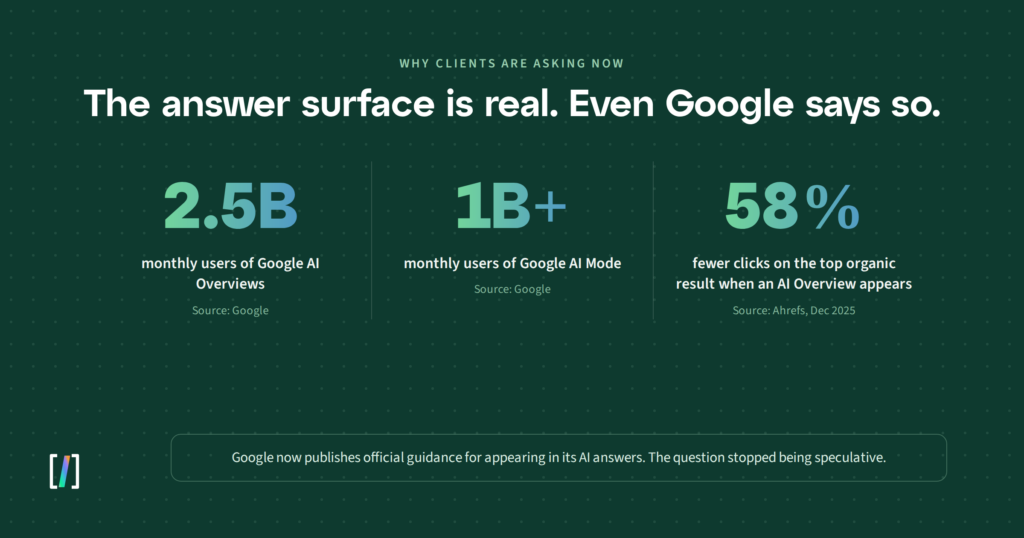
For a couple of years, “will AI mention us” felt like a question an agency could politely defer. Then Google published an official guide to appearing in its AI features, with documentation-grade advice on making your content legible to AI-generated answers. When the company that runs the world’s largest search engine writes a how-to for this surface, the debate about whether the surface is real is over.
The behavior data points the same direction. Google reports 2.5 billion monthly users of AI Overviews. Your client’s buyers are inside these answer surfaces every day, asking the kinds of questions that used to return ten blue links and now return a paragraph with a handful of brand names in it.
Clients feel this shift before they can articulate it. A peer at an industry event says their agency runs an AI visibility report. A nephew shows them Perplexity over the holidays. A competitor’s name comes up in an answer where theirs doesn’t.
There’s also a simple professional dynamic at work. When leadership asks a marketing manager about AI and the manager has no answer, the discomfort rolls downhill to the agency within a day or two. The Slack message you receive is often the echo of a harder question your client just fielded upstairs.
Which is why the question arrives casually, framed as small. It isn’t small.
The five questions hiding inside the question
“Do we show up in ChatGPT?” sounds like one question. It’s five, stacked on top of each other, and the client will judge your answer by how many of them it reaches.
Am I in there? The literal question, and the only one the client thinks they’re asking. They assume the answer is binary: yes or no.
Is that good or bad? If the answer is yes, is it a flattering appearance or a lukewarm one? If no, how alarmed should they be, and how alarmed are you?
Compared to whom? The unspoken competitive anxiety. Absent while everyone else is absent is a curiosity. Absent while their nearest competitor is being recommended by name is a fire.
Why or why not? Clients suspect there’s a mechanism behind which brands get surfaced. They want to know whether anyone actually understands it, and whether it can be influenced.
What do we do about it? The budget question, arriving disguised as curiosity. This is the one they may not even admit to themselves yet.
An account manager who answers only the first question leaves the other four hanging. Clients don’t sit with unanswered anxieties. They take them to whoever seems ready to answer.

The three wrong answers
Before the script, the three responses agencies reach for under pressure. Each one costs something specific.
The deflection
“AI search is still early. Let’s stay focused on your Google rankings.”
This felt safe in 2024. Today it tells the client their question wasn’t worth engaging, at the exact moment their own leadership is asking it. Deflection just reroutes the question to another vendor, one who will happily treat it as the opening it is.
The overclaim
“Yes, we’ve got that covered. Good SEO takes care of AI too.”
There’s a version of this that’s directionally true: strong organic foundations do feed the sources AI engines read. But delivered as a blanket yes, it’s a claim you haven’t measured and can’t defend. The first time the client asks ChatGPT about their category and doesn’t see themselves, your credibility takes the hit, not the model’s.
The jargon dump
“Well, it depends on the retrieval layer. The models blend training data with live citation sources, so your embedding presence across the source graph is really what determines…”
Every word may be accurate. None of it helps. The client walked in with one anxiety and walks out with six, plus a new suspicion that you use complexity as cover. Expertise that can’t be translated into client language reads as its opposite.
The right answer, scripted
The honest answer has three parts: what you know, what you don’t, and how you’ll find out. Here’s the sixty-second version, in words you can actually say out loud.

TALK TRACK: THE FIRST SIXTY SECONDS
“Really good question, and it’s the right time to be asking it. Here’s what I know today: buyers in your category are getting AI-generated answers, and brands are appearing in them unevenly. Here’s what I can’t tell you off the top of my head: how often you specifically come up, in what context, and whether the AI actually recommends you or just names you in passing. Those are different things, and the difference matters. Give me a week and I’ll bring you a measured answer instead of a guess.”
Notice what this does. It validates the question, draws a clean line between knowledge and speculation, and converts the moment into a deliverable with a date on it. No promises about outcomes. Just a commitment to measurement, which is the only promise this channel currently supports.
The client’s follow-up is almost always some version of “what do you mean, recommends versus names?” That’s the door. Walk through it.
TALK TRACK: MENTIONED VS RECOMMENDED, IN CLIENT LANGUAGE
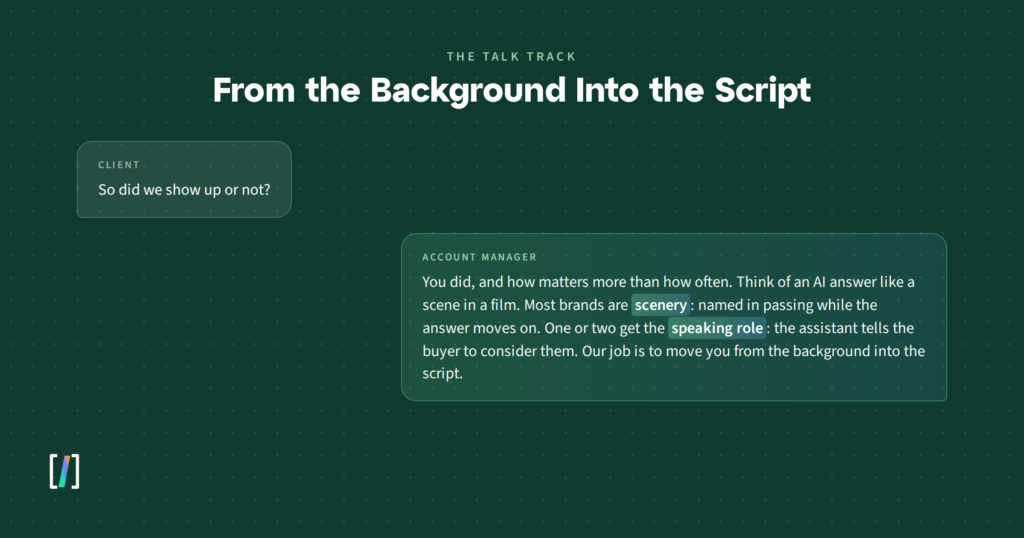
“There are two ways to appear in an AI answer. You can be mentioned, which means your name shows up somewhere in the response, usually as one of five or six names in a list. Or you can be recommended, which means the AI points the buyer at you specifically: here’s who fits your situation, here’s who to call first. Think of it like a film. A mention puts you in the scenery, somewhere in the background of the shot. A recommendation gives you a speaking part. Buyers act on recommendations. Scenery doesn’t get the call.”
That distinction, delivered plainly, is usually the moment the client leans in. It reframes their binary question (am I in there or not) into a quality question (how am I in there), and the quality question is the one worth paying to answer.
One more script, because this scenario is common enough to prepare for. The client says: “I actually asked ChatGPT last night and we didn’t come up at all.”

TALK TRACK: WHEN THE CLIENT RAN THEIR OWN TEST
“That’s useful, and also: one conversation is one sample. These engines answer differently depending on how the question is phrased, what happened earlier in the session, even which day you ask. Before we conclude anything from one screenshot, let’s ask the questions your actual buyers ask, phrased the way they’d phrase them, and run them clean across every major engine. Then we’re looking at a pattern instead of a moment.”
Delivery note on all three: slow down. The instinct under a surprise question is to talk fast and fill silence with qualifiers. The account managers who handle this moment best treat it the way a good doctor treats a scary-sounding symptom: seriously, calmly, and with a plan to get real data before anyone draws conclusions.
The question says ChatGPT. The answer shouldn’t stop there.
Clients name ChatGPT because it’s the AI brand they know, the way an earlier generation said Google when they meant search. But their buyers are spread across five engines: ChatGPT, Gemini, Perplexity, Copilot, and Google AI Overviews. Each one draws on different sources, weights them differently, and answers the same buyer question in its own way.
Which means a single-engine answer can mislead. A brand can appear regularly in one engine and be absent from another, and nothing about the ChatGPT result predicts the Gemini result. Measure one engine, report it as “your AI visibility,” and you’ve handed the client a conclusion their next Perplexity search can contradict.
The differences between engines are structural, not cosmetic. Google AI Overviews sits on top of Google’s index and behaves the most like search. Perplexity cites its sources inline and leans heavily on live retrieval. Copilot inherits Bing’s view of the web. ChatGPT and Gemini blend model knowledge with browsing in proportions that shift from release to release. Your client doesn’t need that taxonomy. You do, because it explains why coverage varies engine to engine and why the fix usually lives in the source layer rather than in any single engine.
The stakes are widest on the Google side of the list. Ahrefs’ December 2025 study found that the presence of an AI Overview cuts click-through on the top organic result by 58 percent. For a growing share of buyer questions, the answer box is where the decision starts forming, whether or not a click ever happens.
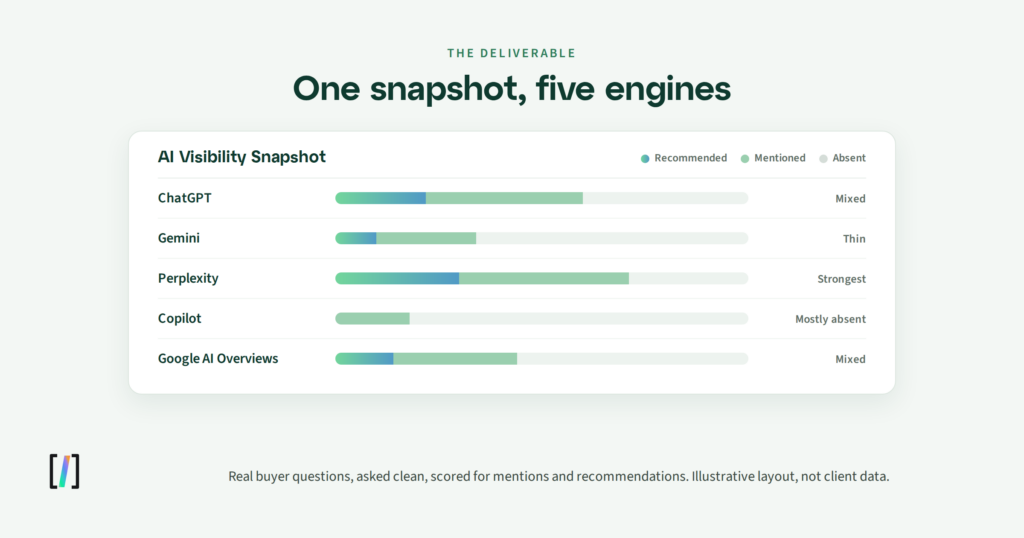
So when you come back to the client with a measured answer, bring the five-engine picture: where they’re mentioned, where they’re recommended, where they’re absent, and how each of those compares to the competitors they actually lose deals to.
Turning the question into the measurement moment
Here’s the reframe worth internalizing: “do we show up in ChatGPT” is a buying signal wearing the costume of small talk. The client has budget-holder anxiety about a channel they can’t see into. The account manager who catches that signal becomes the person who owns AI visibility for the account.
Catching it looks like this:
- Deliver the sixty-second answer above, ending with the commitment to measure and a date.
- Run the snapshot: real buyer questions, asked clean, across all five engines, scoring mentions and recommendations separately. (Our platform automates exactly this pass; see how the measurement works.)
- Bring back a written answer to all five hidden questions: presence, quality, competitive position, likely causes, and a recommended next step.
When you present the results, keep the same honesty that earned you the assignment. A useful template, with brackets where the client’s real numbers go:
TALK TRACK: DELIVERING THE RESULTS
“Here’s what we found. Across the five engines, you were mentioned in [X] of the [Y] buyer questions we tested, and recommended in [Z]. You’re strongest in [engine] and close to invisible in [engine]. [Competitor] shows up more often in two of the five. That’s the baseline, and a baseline is what everyone in your category should be establishing right now. The useful part is what it tells us: we can see which sources the engines lean on for these questions, we can see where your footprint is thin, and we can build presence there and measure whether the pattern moves.”
The snapshot artifact itself doesn’t need to be elaborate. One page per engine: the questions asked, the outcome for each (recommended, mentioned, or absent), and the competitor names that appeared alongside yours. Clients trust a document they can read in three minutes more than a dashboard they need a login for, at least at this stage of the relationship.
Report direction, never certainty. This channel is too young and too volatile for anyone to promise positions, and the client has usually heard enough overpromising to find the restraint refreshing.
If you’re running this play for prospects rather than existing clients, the same measurement works as an outbound door-opener; we’ve written up that version of the play separately. Inside an existing account, the question tends to become a standing answer: a recurring visibility report that does quiet retention work every month it lands. Some agencies go further and package the whole loop as a productized service.
All of it starts with the same moment, though. The question, asked casually. Answered well.
FAQ
Does my brand show up in ChatGPT?
The only way to know is to ask the engines the questions your buyers actually ask. Take ten real buyer questions (the ones that come up in sales calls and support tickets), open a clean session with no chat history, and ask them one at a time. Repeat the same set across ChatGPT, Gemini, Perplexity, Copilot, and Google AI Overviews. For each answer, record one of three outcomes: recommended by name, mentioned in passing, or absent. One pass gives you a rough snapshot. Repeated passes over time give you a trend you can act on, which is where the real signal lives.
Why doesn’t my business show up in ChatGPT?
Usually because the sources AI engines read don’t establish your brand strongly enough in your category. These systems lean on third-party evidence: industry publications, review platforms, directories, comparison content, and authoritative coverage that associates your brand with the problems you solve. A business can have an excellent website and still be invisible in AI answers, because the engines are reading the wider public record, not just your own pages. Thin third-party footprint, thin AI presence.
How does ChatGPT decide which businesses to mention?
ChatGPT composes answers from its training data and, increasingly, from live web retrieval, and it tends to surface brands that appear consistently across sources it treats as credible. There’s no submission form and no direct placement. The practical lever is the source layer: earning presence in the publications, listings, and content that engines cite when they answer questions in your category. Google’s own AI optimization guide points in the same direction for its answer surfaces: make your brand legible and well-evidenced in the places machines read.
Do brand mentions in ChatGPT matter?
Yes, as a baseline. Mentions tell you the engines know your brand exists in the category, and tracking brand mentions in ChatGPT and the other four engines over time is the first measurement worth standing up. But a mention only puts you in the scenery of the answer. The metric to manage toward is recommendation rate: how often an engine actively points buyers at you. Frequent mentions with no recommendations usually signal weak category association in the sources, which is a fixable problem once it’s measured.
The next time the question lands
Somewhere in your book of business, a client is about to type the question into Slack. When it comes, you’ll have the script: validate, separate what you know from what you don’t, explain mentioned versus recommended in plain terms, and commit to a measurement with a date on it.
Then run the measurement. Our AI visibility report card scores a brand’s presence across all five engines and separates the mentions from the recommendations, which turns your sixty-second answer into a documented one. Run a report card for the account most likely to ask, before they ask.
Your client wants to know whether they’re in the shot. Go find out whether they have a speaking part.
Related Articles
The request rarely arrives as a request. It arrives as a forwarded screenshot, or a line at the end of…

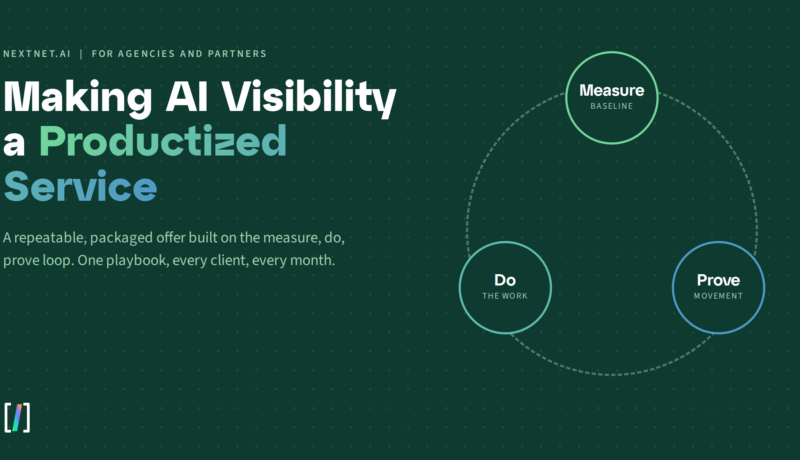
Your clients have started asking whether they show up in ChatGPT. Most agencies answer with a one-time audit: run the…