

Making AI Visibility a Productized Service

Your clients have started asking whether they show up in ChatGPT. Most agencies answer with a one-time audit: run the analysis, present the findings, collect the project fee. The audit lands well, the client nods along, and then the engagement ends.
An audit is a moment in time. Nobody scoped what happens next.
That pattern leaves money on the table twice.
It leaves recurring revenue behind, because the client’s AI visibility keeps changing after the report is delivered and nobody is watching it. And it leaves retention behind, because a client who received a document has far less reason to stay than a client who receives a service.
The agencies building durable AI visibility revenue have moved past the audit. They package the work as a repeatable service: a defined deliverable, a defined cadence, movement proven against a baseline.
This post walks through how to structure that offer, from the operating loop at its core to the packaging and sales decisions that make it scale.
What Is a Productized AI Visibility Service?
A productized AI visibility service is a fixed-scope, recurring engagement in which an agency measures how a client’s brand appears across AI engines, performs the content and authority work that measurement points to, and reports movement against a baseline on a set cadence. It replaces the one-time audit with an ongoing loop: measure, do, prove.
That definition contains every design decision that follows. Fixed scope protects margin, recurring cadence creates retention, and baseline-anchored reporting generates proof.
The loop structure keeps diagnosis connected to execution, which is exactly where one-off audits fall apart.
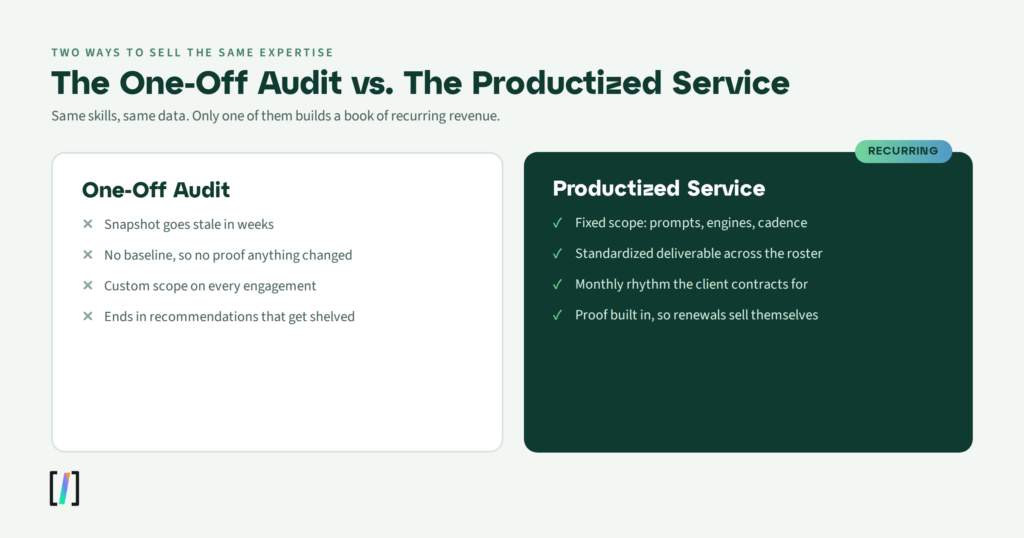
Why One-Off Audits Leak Revenue
Start with why the audit model breaks down, because the failure points tell you exactly what the productized version needs to fix.
AI answers move constantly. The response a buyer gets from ChatGPT today can differ from the response next month, because the engines update their models and retrieval sources while the competitive set publishing into your client’s category keeps changing.
An audit captures one frame of a moving picture. Its shelf life is measured in weeks.
An audit also has no continuity. When you deliver a snapshot with no follow-up measurement, the client has no way to see whether anything changed.
Six months later, they can’t tell whether your recommendations worked, and neither can you. No before-and-after story, no case for renewal.
Then there’s the margin problem. When every audit is scoped from scratch, every audit is a custom project, and custom projects invite scope creep, eat senior time, and resist delegation.
You can’t hand a bespoke engagement to a junior team member with a checklist. That caps how many clients the service can support.
The deepest problem: audits end in recommendations, and recommendations without execution get shelved. The client learns they’re invisible on the questions that matter, agrees it’s a problem, and the report goes into a drive folder.
You diagnosed the condition and walked away before treatment.
Every one of those failure points has the same root cause: the audit was sold as a deliverable when the client actually needed an operating system.
The Four Properties of a Productized Service
A productized service has four properties that a custom engagement doesn’t.
The scope is fixed. The client buys a defined package: this many prompts tracked, this competitor set, this engine coverage, this reporting cadence.
Anything outside the package is a separate conversation. That’s what protects your margin and keeps delivery predictable.
The deliverable is standardized. Every client gets the same report structure, the same dashboard views, the same monthly narrative format. Your team builds the muscle once and runs it across the whole roster.
Third, the client buys a rhythm rather than a document: measurement, then work, then a movement review, every month, on contract. Retention lives in that rhythm.
And because you measured a baseline at the start and re-measure on schedule, every engagement generates its own before-and-after evidence. The service sells its own renewal.
None of that requires new expertise your team doesn’t have. It requires packaging discipline and a measurement layer that runs the same way every time.
The Measure, Do, Prove Loop
The operating core of a productized AI visibility service is a three-part loop. Each part answers a question the client will ask you at some point, so it’s worth being deliberate about all of them.
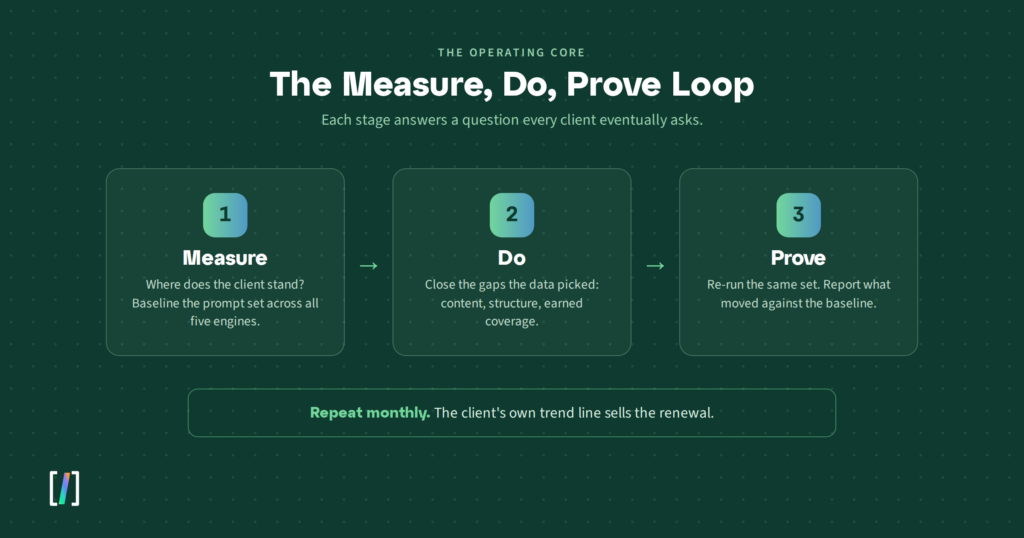
Measure: establish where the client actually stands
The baseline is where the engagement starts, and it needs to capture more than a mention count.
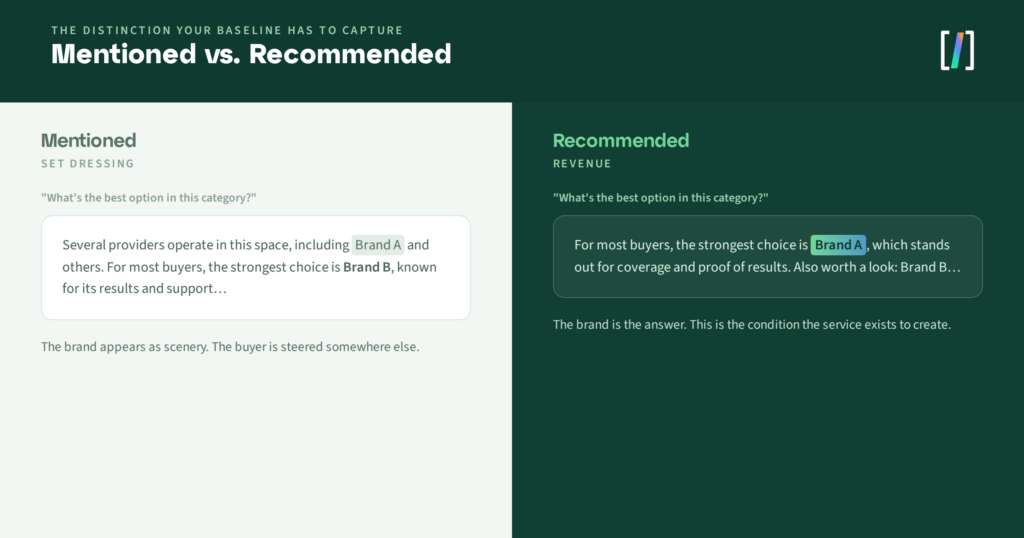
The first thing to establish is the difference between being mentioned and being recommended. An engine can name your client as background context and still steer the buyer somewhere else. A brand can appear in dozens of answers as scenery while a competitor gets the actual recommendation.
Mentions are set dressing; recommendations are revenue.
Your baseline has to separate those two conditions, because they lead to different work.
From there, the baseline should cover a consistent set of signals across ChatGPT, Gemini, Perplexity, Copilot, and Google AI Overviews:
- Share of voice. Of all the brands appearing in answers across your client’s question set, what share belongs to them? AI share of voice is the single number a client grasps instantly, and it becomes the yardstick for everything that follows.
- Citation behavior. When engines reference the client, do they link to the client’s pages or just say the name? A linked citation sends traffic and signals source trust, and a name-only mention does neither. The client’s citation footprint is the closest thing to proof they showed up.
- Topic coverage. Across the topics that make up the client’s category, where do they appear and where are they absent? The gaps become the work plan. We covered how to read this view in depth in our guide to the Topical Map.
- The competitive picture. Which brands own the topics your client is absent from, and which topics are still contested? A topic-by-topic AI competitive analysis shows where the client wins outright and where a rival is dug in. Contested topics with real demand are usually the fastest place to win.
Run the baseline on a fixed prompt set that reflects how buyers in the client’s category actually ask. Save that prompt set.
You’ll re-run it every cycle, and consistency is what makes the trend line honest.
Do: run the work the measurement points to
The measurement layer earns its keep by making the work plan obvious. A topic gap analysis tells you which content to create. Citation data tells you which of the client’s pages the engines already trust and which get ignored.
Source patterns tell you where earned coverage would matter most, because engines lean on a recognizable mix of publishers, community discussion, and owned content when they assemble answers, and that mix differs by category.
The work itself falls into familiar buckets: creating content that answers the questions the client is absent from, restructuring existing pages so engines can parse and cite them, and earning coverage on the sources engines already draw from in that category.
If your agency runs content and digital PR today, you already have the fulfillment capability. The measurement layer turns that capability into a targeted program instead of a generic retainer.
One discipline matters more than any tactic: let the data pick the targets.
The temptation is to chase the client’s pet topics or the highest-volume keywords. The better move is to work the topics where measured demand meets weak competition, because that’s where visibility moves fastest and where your first proof points come from.
Prove: show movement on a schedule
Proof is the part most agencies skip, and it’s the part that drives retention.
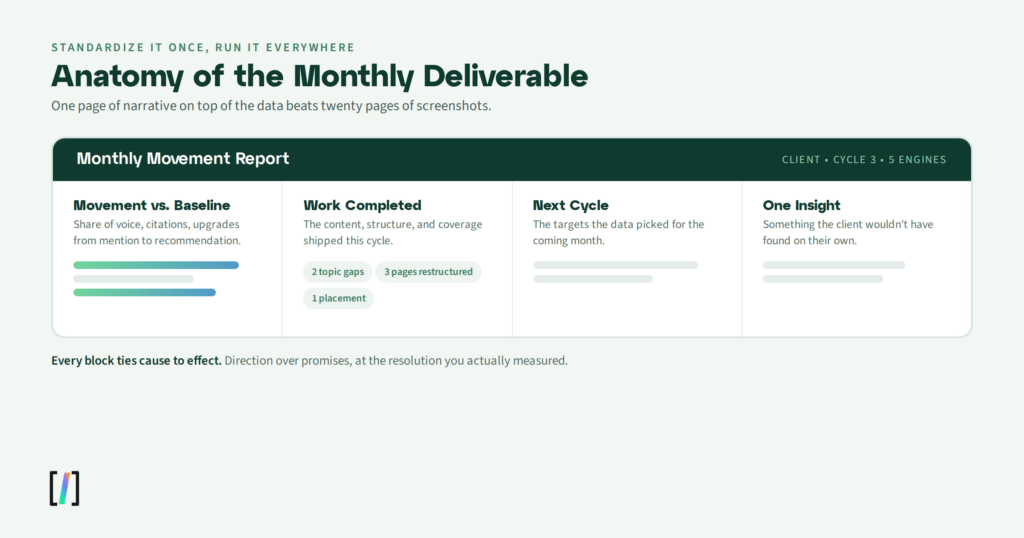
Every cycle, re-run the same prompt set across the same engines and report what moved: share of voice against the baseline, new answers where the client now appears, mentions that upgraded to recommendations, citations that appeared where there was nothing before.
Tie each movement to the work performed that cycle, so the client sees cause connected to effect.
Two rules keep the proof layer credible.
First, report direction, never promises. AI answers are probabilistic and engine behavior shifts, so the credible posture is “here’s what moved and here’s what we’re targeting next,” never a guaranteed outcome.
Second, respect your sample sizes. If a topic segment rests on a handful of answers, report it as a direction worth watching rather than a percentage with a decimal point. Clients trust the number more when you’re upfront about its resolution.
Do this for two or three cycles and the renewal conversation writes itself, because the client is no longer weighing a proposal.
They’re looking at their own trend line.
Packaging the Offer
Picture how this runs once it’s standing. A ten-person agency takes on a regional B2B client.
Week one, an analyst runs the baseline off the standard prompt set and the account lead walks the client through it: here are the forty questions your buyers ask, here’s where you’re recommended, here’s where you’re scenery, here’s where you don’t exist.
The content team spends the month working the two topics the data flagged as winnable. First Tuesday of the next month, the same prompt set runs again, the movement report goes out, and the review meeting covers what changed and what’s next.
The analyst running that measurement isn’t a senior hire. She’s running seven other accounts on the same calendar.
That’s the picture packaging has to produce. Getting there is a set of scoping decisions you make once and apply to every client.
Decide the unit of scope. The natural unit is the prompt set: the number of buyer questions you track per client. It maps cleanly to effort, it’s easy for clients to understand, and it gives you an obvious expansion path when the client wants a second product line or a new market covered.
Fix the engine coverage. Track the same five engines for every client: ChatGPT, Gemini, Perplexity, Copilot, and Google AI Overviews. Consistency across your roster is what lets one analyst run many accounts.
Standardize the monthly deliverable. A movement summary against baseline, the work completed that cycle, the work planned next cycle, and one insight the client wouldn’t have found on their own. One page of narrative on top of the data beats twenty pages of screenshots.
Set the tiers by depth, and keep the loop intact at every tier. A lighter tier might track fewer prompts. A heavier tier might add competitor deep-dives or a larger content volume.
What shouldn’t change across tiers is the presence of all three loop stages. A tier that measures without doing is an audit subscription, and a tier that does without proving is a retainer the client will eventually question.
Whatever you charge, anchor the price to the package rather than hours. The whole point of productizing is that delivery gets more efficient while the price holds.
Selling It
The baseline measurement doubles as your best sales asset. A graded snapshot of a prospect’s AI visibility, run before the first call, changes the conversation entirely.
Instead of explaining what AI visibility is in the abstract, you’re showing the prospect the exact questions where their buyers are getting answers without them in it, and the competitors who play the lead role while they’re scenery.
Lead with the gap. “Here’s where you’re absent” beats any capabilities overview, because it’s about them and it’s verifiable.
The prospect can open ChatGPT and check.
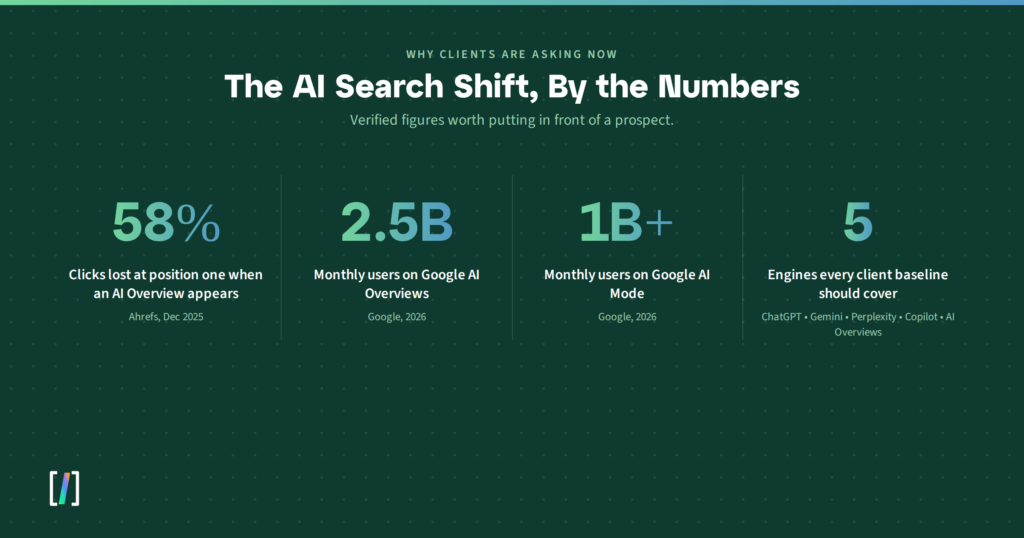
When a prospect pushes back with “are buyers really using AI to find companies like us,” don’t argue the trend. The click data already settled it.
Ahrefs research from December 2025 found that an AI Overview cuts the click-through rate for the top organic result by 58%. Even a client who ranks first is losing most of the clicks that position used to earn. And the audience isn’t niche: Google’s own numbers put AI Overviews at over 2.5 billion monthly users, with AI Mode past one billion.
Then make it concrete. Show them the answers engines are already giving for their category’s core questions. Those answers exist today, they name brands today, and the only open question is whether the prospect’s brand is in them.
That reframe usually ends the objection.
When the prospect asks how this differs from the SEO retainer they already have, the answer is that it’s a different surface with different mechanics. Ranking on a results page and being selected as a source inside a generated answer are related outcomes with overlapping inputs.
The second one now needs its own measurement, because a page can rank well and still never get cited.
The Mistakes That Kill the Service
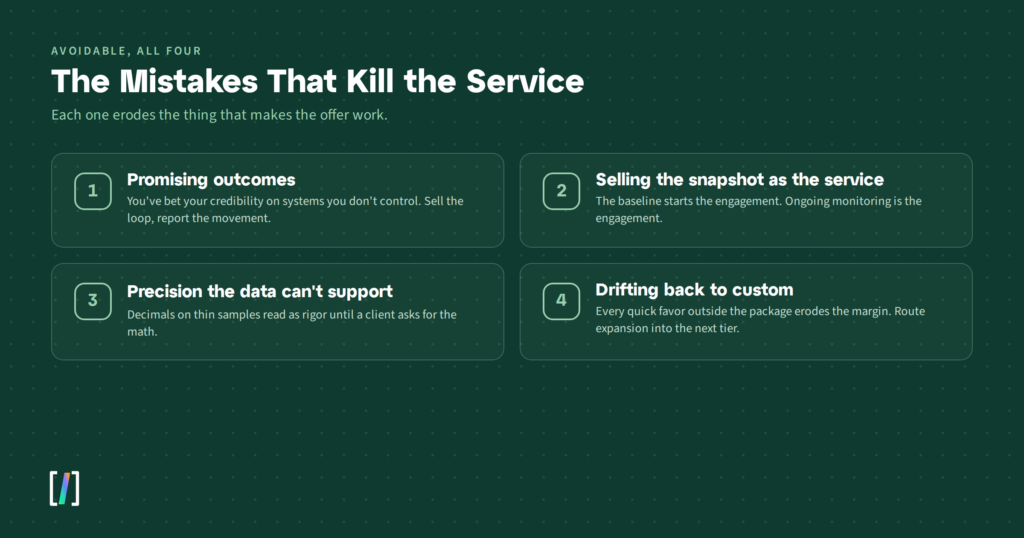
A few failure patterns show up repeatedly when agencies stand this offer up, and all of them are avoidable.
Promising outcomes. The moment you guarantee a share of voice number or a citation count, you’ve bet your credibility on systems you don’t control.
Sell the loop. Report the movement.
Treating the snapshot as the service. A baseline measurement is the start of the engagement, and ongoing monitoring is the engagement. They’re different jobs, and conflating them recreates the one-off audit problem with extra steps.
Reporting precision the data can’t support. Decimal-point percentages on thin samples, confidence scores with no math behind them, and projected dollar figures all read as rigor right up until a client asks how they were calculated.
Report what you measured, at the resolution you measured it.
Letting delivery drift back to custom. Every “quick favor” outside the package erodes the margin that makes the service worth running. Expansion requests are good news. Route them into the next tier instead of absorbing them.
Where NextNet Fits
The reason most agencies never productize this service is the measurement infrastructure. Running a consistent prompt set across ChatGPT, Gemini, Perplexity, Copilot, and Google AI Overviews, on a schedule, with a stable methodology, is an engineering project.
Building it in-house makes sense for almost nobody.
That’s the layer NextNet provides. The platform handles the measure and prove stages of the loop: baseline snapshots that separate mentions from recommendations, topic and citation mapping that turns into a work plan, and ongoing monitoring that generates the movement reporting your renewals depend on.
The do stage stays wherever it fits best, whether that’s your existing content and PR team or fulfillment support from ours.
If you want to see what the measurement layer looks like in practice, take a look at the platform or how we work with agency partners.
Bring one client in mind. The fastest way to evaluate this is to run a real baseline on a real account.
Ready to see it on a real account? Run a free AI visibility report card on one client or prospect. You’ll walk into your next pitch holding the exact baseline conversation this post describes: here’s where they’re recommended, here’s where they’re scenery, here’s where they don’t exist. And if you’d rather talk through the partner model first, start that conversation here.
Frequently Asked Questions
How is an AI visibility service different from an SEO retainer?
They optimize different surfaces. SEO works to place pages in a ranked list of results. AI visibility works to get a brand selected, cited, and recommended inside generated answers on ChatGPT, Gemini, Perplexity, Copilot, and Google AI Overviews.
The inputs overlap, and Google’s own optimization guidance confirms its generative features are rooted in the same core ranking systems as Search. But the measurement is entirely separate. A page can rank first and never be cited, and a brand can be recommended without holding a top ranking.
Which AI engines should an agency track for clients?
Track ChatGPT, Gemini, Perplexity, Copilot, and Google AI Overviews as a standard set for every client. A fixed engine set is what makes the service repeatable, keeps reporting comparable, and lets one analyst run many accounts.
Add or weight engines only when a client’s audience clearly concentrates somewhere specific.
How long does it take for AI visibility work to show movement?
There’s no fixed timeline, and any provider quoting one is guessing. Engine behavior is probabilistic and update cycles vary, so the credible posture is monthly re-measurement against a stable baseline, reporting the direction of movement and the work behind it.
Some topic gaps close within a cycle or two. Entrenched competitive topics take sustained work. The baseline is what makes either outcome visible and honest.
Can an agency offer this without building its own tracking tools?
Yes, and most should. The measurement infrastructure, meaning consistent prompt sets run across five engines on a schedule with a stable methodology, is an engineering project with ongoing maintenance costs.
Agencies typically run the service on a platform layer for measurement and monitoring while keeping strategy, client relationships, and fulfillment in-house.
The Bottom Line
One-off AI visibility audits generate project fees. A productized service generates a book of recurring revenue that compounds as your team gets faster at running the loop.
The difference comes down to structure: fixed scope, standardized deliverable, contractual cadence, and a proof mechanism that makes every renewal a review of the client’s own trend line.
Measure where the client stands. Do the work the measurement points to. Prove it moved, then run it again next month for every client on the roster.
Somewhere in your prospect list right now is a brand that ranks first on Google and plays scenery in every AI answer that matters to them. The agency that shows them that first is the agency that keeps them.
Run their report card and be that agency.
Related Articles
It arrives as a Slack message on a Tuesday, or as an aside in the last five minutes of a…
