
The Complete Guide to AI Search Optimization: AEO, GEO, and LLM SEO

Ask four vendors what they do and you can get four different acronyms for what looks like the same work. One sells AEO. One sells GEO. Another calls it LLM SEO. The fourth tells you it is all just SEO and the rest is packaging.
That is not a vocabulary problem. It is a purchasing problem. When the labels do not map to anything specific, you cannot tell whether two proposals compete or complement each other, and you cannot tell whether either one addresses what is actually happening to your traffic.
AI search optimization is the practice of making your content retrievable, quotable, and attributable, so that AI systems cite your brand when they answer questions in your category. AEO, GEO, and LLM SEO are three names for overlapping subsets of that work. Traditional SEO is the foundation all three depend on.
This guide separates the terms, collects the verified research in one place, explains how engines actually choose sources, and lays out a playbook you can hand to a team on Monday. Every statistic below is sourced and dated so you can check it yourself.
What AEO, GEO, LLM SEO, and traditional SEO each mean
The four terms come from different places and carry different assumptions. Sorting them takes about two minutes and saves a lot of confused meetings.

Traditional SEO optimizes for ranked position in a list of links. Success is a click. Everything else in this list inherits its infrastructure: crawlability, indexation, site architecture, and authority signals.
AEO, or answer engine optimization, optimizes for direct answer extraction. It predates generative AI and grew up around featured snippets, People Also Ask, and voice assistants. Success is your content being the answer, whether or not anyone clicks. The techniques are structural: clear question-and-answer formatting, self-contained passages, schema markup.
GEO, or generative engine optimization, optimizes for inclusion in generated responses. The term comes out of academic work on how large language models assemble answers from retrieved sources. Success is being cited or named inside the generated text.
LLM SEO is the loosest of the four. In practice it describes optimizing for specific assistant products rather than for a general behavior. When someone says LLM SEO, ask which engine they mean.
Why four terms for one problem? Partly timing. AEO was already in use before generative search arrived, GEO came out of research published as the first AI answer products shipped, and LLM SEO emerged from practitioners describing what they were doing to specific assistants. Partly positioning: a new acronym is easier to sell than a refinement of something buyers already budget for.
The overlap is real. The differences that matter are what each one treats as a win and which surface it is aimed at.
| Traditional SEO | AEO | GEO | LLM SEO | |
|---|---|---|---|---|
| Optimizes for | Ranked position in a results list | Direct extraction of a specific answer | Inclusion in a synthesized response | Visibility inside a named assistant product |
| Primary surfaces | Google and Bing organic results | Featured snippets, People Also Ask, voice assistants | Google AI Overviews, Google AI Mode, Perplexity | ChatGPT, Gemini, Perplexity, Copilot |
| Unit of success | A click | Your passage used as the answer | A citation or brand name in the output | A citation or brand name in one engine |
| Core technique | Authority, relevance, technical health | Structure, schema, self-contained passages | Entity clarity, third-party corroboration, extractability | Per-engine source-pool work |
| Relationship to SEO | Is the foundation | Extends it to zero-click surfaces | Extends it to generated answers | Applies it per product |
| Main failure mode | Ranks but earns no click | Answers but earns no attribution | Cited on one engine, invisible on others | Optimizing for one product only |
If you take one thing from this table, take the failure modes row. Each discipline has a way of technically succeeding while producing nothing you can bank.

What the research actually says
The evidence base has grown quickly. Below is what independent research has established, grouped into three questions: how far has behavior shifted, does ranking still get you cited, and what correlates with citation.
How far behavior has shifted
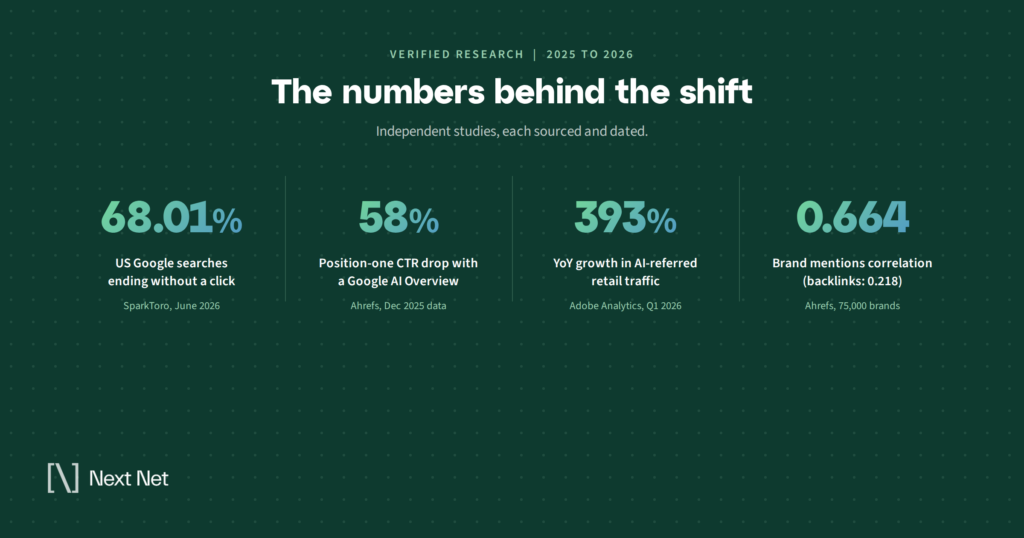
SparkToro’s analysis of Similarweb clickstream data found that 68.01% of United States Google searches ended without a click during the first four months of 2026, up from 60.45% in 2024 (SparkToro, June 2026). That is the steepest two-year move since the firm began tracking the metric.
Google reported at I/O 2026 that AI Mode had surpassed one billion monthly users, with query volume more than doubling each quarter. During SparkToro’s January to April 2026 study window, only 0.34% of searches transitioned into AI Mode, which tells you the surface is early rather than settled.
Volume is moving on the assistant side too. Adobe Analytics reported that AI-referred traffic to United States retailers grew 393% year over year in the first quarter of 2026 (Adobe Digital Insights, April 2026). Adobe also found that in March 2026, AI-referred traffic converted 42% better than non-AI traffic, a reversal from converting roughly 38% worse twelve months earlier. Treat Adobe’s figures as vendor-reported rather than independently audited, and treat the direction as the durable part.
Does ranking still get you cited
Less reliably than it used to, and less than most teams assume.
Pew Research Center tracked the browsing behavior of 900 United States adults across 68,879 Google searches in March 2025. When an AI summary appeared, users clicked a traditional result on 8% of visits, against 15% when no summary appeared. Clicks on a source link inside the summary happened on 1% of visits. Sessions ended outright on 26% of pages with a summary, against 16% without (Pew Research Center, July 2025). Google has disputed the methodology; it remains the most behaviorally rigorous public dataset because it tracks real browsing rather than modeled estimates.
Ahrefs, working from Google Search Console data across 300,000 keywords, found that the presence of a Google AI Overview reduced click-through rate for the top-ranking result by 58% as of December 2025, up from 34.5% in its April 2025 study (Ahrefs, published 2026).
There is a partial rebound worth knowing about. Seer Interactive found Google AI Overviews click-through rate bottomed at 1.3% in December 2025 and recovered to 2.4% by February 2026, based on 53 brands, 5.47 million queries, and 2.43 billion impressions from January 2025 through February 2026 (Seer Interactive, 2026). Seer also found that queries without a Google AI Overview became more valuable over the same period, with click-through rate rising from 2.8% to 3.8%.
Read those together and the picture is redistribution rather than simple loss. Cited pages do better than uncited pages on the same results page. Both do worse than they would with no Google AI Overview present.
The link between ranking and citation has also loosened. Moz ran 40,000 queries through Google AI Mode and reported that 88% of citations came from pages outside the organic top ten (Moz, 2026). Analyses of Google AI Overviews citation sources have tracked a similar drift, with the share of citations drawn from top-ten organic results falling substantially across 2025 and into 2026. The direction is consistent across the studies even where the exact percentages disagree.
Cross-engine fragmentation is the other finding worth planning around. An analysis of roughly 680 million AI citations found only about 11% domain overlap between ChatGPT and Perplexity (Averi, March 2026). A brand can hold a strong position in one engine’s source pool and be close to invisible in another’s.
What correlates with getting cited
Ahrefs studied 75,000 brands and measured which signals correlate with appearing in Google AI Overviews. Branded web mentions correlated at 0.664. Referring domains, the classic backlink metric, correlated at 0.218. Branded anchors came in at 0.527 and branded search volume at 0.392 (Ahrefs, 2025, updated 2026).
The top signals were all off-site and brand-shaped rather than link-shaped. The researchers are explicit that correlation is not causation, and that caveat matters: brands with strong AI visibility also tend to have broad web presence, which is not the same as saying mentions cause citations.
Still, the ordering is hard to ignore. A decade of practice built around link acquisition does not map cleanly onto how these systems choose what to name.
How AI engines actually select sources
Most confusion about AI visibility comes from treating it as one step. It is three, and a page can fail at any of them while passing the others.
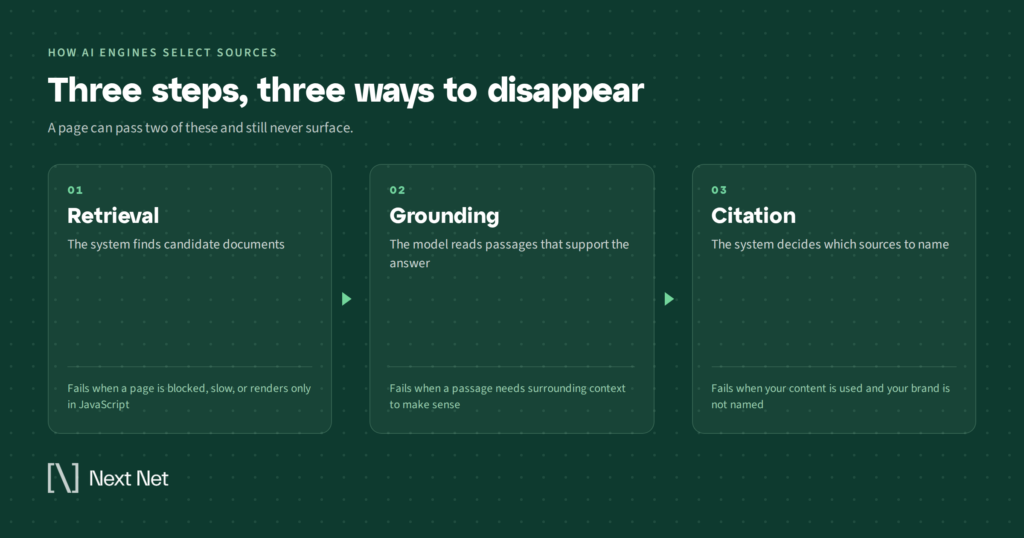
Retrieval is the system finding candidate documents. Depending on the engine this runs off a live search index, a proprietary crawl, or an embedded vector store. If your page is blocked, slow, rendered entirely in client-side JavaScript, or behind a wall, it never enters the candidate pool. Nothing downstream can rescue it.
Grounding is the model reading those candidates and deciding which passages support the answer it is assembling. This is where extractability decides your fate. A passage that only makes sense with three paragraphs of surrounding context is hard to ground against. A passage that states a claim completely in two sentences is easy.
Citation is the system deciding which sources to name in the output. This step is partly a product decision, not purely a relevance judgment, and it differs sharply across engines. Some name many sources per answer. Some name few. Some summarize your content and attribute nothing.
That third step explains the most common complaint we hear. You can be indexed, retrieved, and used, and still never appear. Your content shaped the answer and your brand did not travel with it.
The engines diverge in ways that matter for planning. Google AI Overviews and Google AI Mode draw heavily on the existing organic index, so classic SEO carries more of the load there. Perplexity runs its own retrieval and tends to cite densely across more domains per answer. ChatGPT is more selective per answer and leans toward established reference and editorial sources. Copilot inherits much of its retrieval from Bing’s index.
One more mechanic changes how you should think about coverage. These systems commonly expand a single user question into several related sub-queries, then assemble one answer from the results of all of them. That is why thin, single-page targeting underperforms here. A page can be an excellent answer to the exact question asked and still lose to a site that covers the surrounding cluster well enough to appear across several of the sub-queries.
The practical consequence: cross-engine overlap is lower than most teams expect, and measuring one engine tells you little about the others. We go deeper on this in our guide to how to get cited by AI.
Mentioned versus recommended
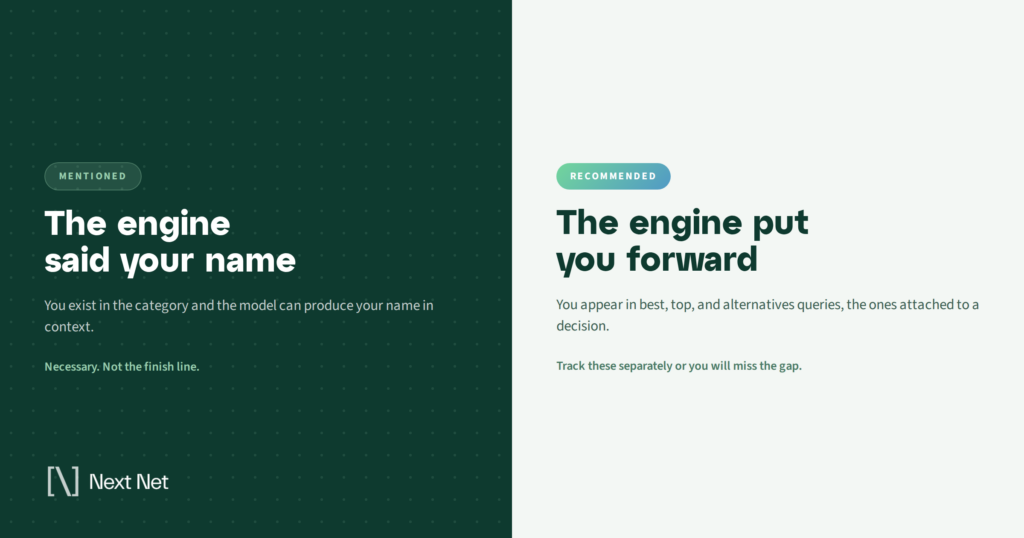
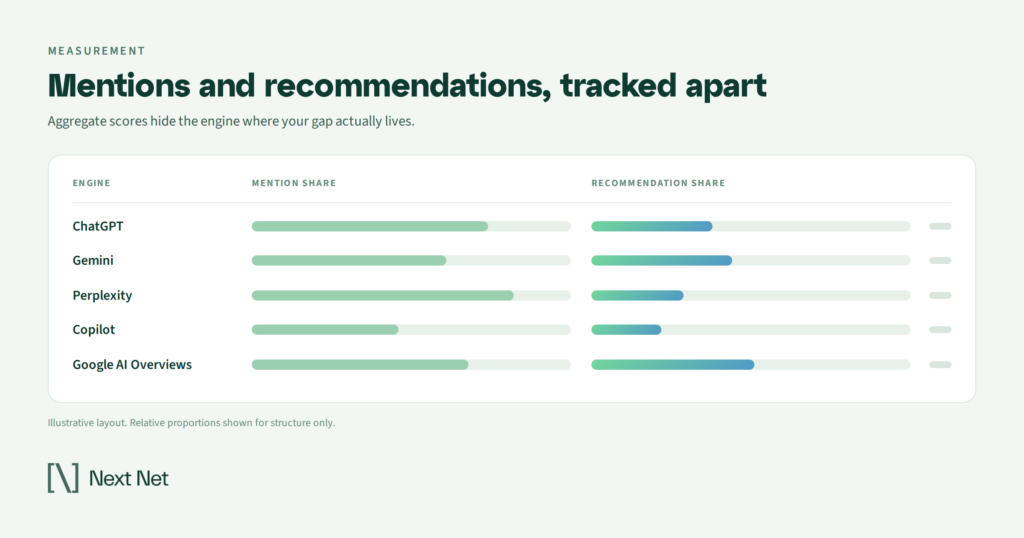
A mention means an engine said your name. A recommendation means it put you forward as the answer to a buying question. Those are different outcomes and they are worth measuring separately.
Mentions are scenery. They establish that you exist in the category and that the model has absorbed enough about you to produce your name in context. That is necessary and it is not the finish line.
Recommendations show up in a narrower band of queries: best, top, alternatives to, who should I use for. Those are the queries attached to a decision, and they are the ones where the composition of the answer set has commercial consequences.
The reason to keep the distinction clean is that most reporting collapses it. A dashboard showing rising mention counts can sit comfortably alongside flat recommendation share, and if you are only watching the first number you will not notice.
It also changes what you do next. Thin mention volume is usually a coverage and corroboration problem, solved by getting talked about in more of the places engines draw from. Strong mentions paired with weak recommendations is a positioning problem, solved by making the case for who you are the right choice for legible in the sources that get cited.
We treat this distinction in depth elsewhere rather than repeating it here. See brand mentions in ChatGPT for how mention behavior works engine by engine, and AI brand authority for how corroboration moves a brand from named to recommended.
The practical playbook
None of what follows is exotic. Most of it is work your team already knows how to do, pointed at a different target.
Structure content for extraction
Lead with the answer. Put the direct response in the first sentence or two under a heading, then expand. Question-formatted headings work because they match how people phrase queries to assistants.
Write passages that survive removal from their page. If a paragraph needs the three above it to make sense, a grounding step cannot use it cleanly.
Keep definitions in single intact blocks. Do not split a definition across a bulleted list and a following paragraph.
Add tables and clearly labeled data for comparisons. Structured comparisons get extracted and cited at a noticeably higher rate than the same information written as prose.
Make your entity unambiguous
Use one consistent brand name, spelled the same way, everywhere you appear. Variants split the signal.
Ensure your About, product, and leadership pages state plainly what you do, who you serve, and where you operate. Models resolve entities from repeated, consistent descriptions across many sources.
Implement Organization, Product, and FAQPage schema. Schema does not force a citation, and it does make your claims machine-readable and easier to reconcile against other sources.
Check whether another organization dominates search for your brand name. If it does, that is an entity resolution problem and it will suppress you across every engine until it is addressed.
Earn third-party corroboration
This is the part the correlation data points at hardest, and the part most programs underinvest in.
Pursue coverage in publications your category already trusts. Independent editorial carries weight that owned content structurally cannot.
Get accurate listings in the directories, review sites, and industry roundups that appear in AI answers for your category queries. Run the queries yourself and see which sources the engines lean on.
Participate where practitioners actually discuss your category. Community sources appear in citation sets at a rate that surprises most marketing teams.
Give sources something quotable: original data, a clear point of view, a named expert who will go on record.
Cover the cluster, not just the keyword
Because engines expand questions into sub-queries, depth across a topic beats a single strong page. Map the questions that surround your core query and make sure something on your site answers each of them credibly.
Interlink those pages so the relationship between them is explicit. A cluster that reads as a coherent body of work is easier for a retrieval step to traverse than a set of orphan posts.
Keep the cluster current. Several engines show a preference for recently updated content, and a page that has not been touched in three years competes poorly against one that has.
Fix technical accessibility first
Confirm AI crawlers are not blocked in robots.txt. This is the single most common self-inflicted wound and it takes minutes to check.
Serve meaningful content in the initial HTML response. Content that only appears after client-side rendering is inconsistently available to retrieval.
Keep pages fast and reachable within a few clicks of your top-level navigation.
Maintain publication and modification dates. Several engines show a clear preference for recent content, and an undated page gives them nothing to weigh.
How to measure AI search optimization
Start by separating the two numbers that are usually merged. Mention counts tell you how often an engine says your name. Citation counts tell you how often it links a specific page. Different mechanisms, different fixes, and tools frequently report one while labeling it the other.
Track both per engine. Aggregate scores across ChatGPT, Gemini, Perplexity, Copilot, and Google AI Overviews smooth over exactly the gaps you need to find, because a brand can be strong on one surface and absent on another.
Watch referral traffic from assistant domains in your analytics, with the caveat that it undercounts badly. Most AI-influenced sessions arrive without a traceable referrer, and zero-click exposure leaves no trace at all.
Segment your queries by intent. Informational coverage and recommendation-stage coverage move independently, and averaging them hides the movement that matters commercially.
Set a baseline before you change anything. Without a starting point you cannot separate your work from a model update, and model updates are frequent.
Sample enough to say something. Answers to the same prompt vary between runs, so a single check tells you very little. Run a consistent prompt set on a regular cadence and read the trend, not any individual response.
Report direction rather than precision on thin samples. A move from occasional to consistent appearance in a category is a real finding. A shift of two percentage points across a few dozen prompts usually is not.
Next Net AI monitors where and how your brand appears across AI answers, and Market Intel runs structured prompts to measure recommendation share rather than raw mentions. Both exist because the native analytics for these surfaces are thin.
Frequently asked questions
Is AEO replacing SEO?
No. AEO extends SEO rather than replacing it, and every AI surface still depends on the crawlability, indexation, and authority signals that traditional SEO builds. The change is that ranking alone no longer reliably produces a visit, so the definition of a win has widened.
Which term should I use with vendors?
Ask what they measure rather than which acronym they use. A vendor who can name the engines they track, distinguish mentions from citations, and show you a baseline is describing real work regardless of the label on the invoice.
How long does it take to see results?
Structural and technical fixes can register within weeks because they change what retrieval can reach. Entity and corroboration work runs on a longer horizon, closer to two or three quarters, because it depends on third parties publishing and models absorbing that coverage.
Do I need to optimize for each engine separately?
Partly. The foundation of accessibility, structure, and entity clarity carries across all of them, while source-pool preferences differ enough that a brand strong on one engine can be nearly absent on another. Measure per engine, then decide where the gap is worth closing.
Does schema markup guarantee citations?
No. Schema makes your claims machine-readable and easier to reconcile, which improves your odds, and no markup forces an engine to cite you. Treat it as removing friction rather than as a lever.
Where to start
The terms will keep multiplying. The underlying work has been stable for a while now: be reachable, be quotable, be corroborated, and measure the right thing.
If you are starting from zero, do the technical audit first. It is the cheapest work with the fastest feedback, and there is no point pursuing coverage while your pages cannot be retrieved.
Then get a baseline. You cannot report on movement you never measured, and the first honest number is usually the most useful thing a team produces in this space.
Our Report Card is a free way to get that starting point. It checks how your brand currently appears across AI answers and where the gaps sit, with no setup required.
If you already have a baseline and want to see how the work compounds, our platform tracks movement across engines over time, and how we help walks through what acting on the findings looks like.