
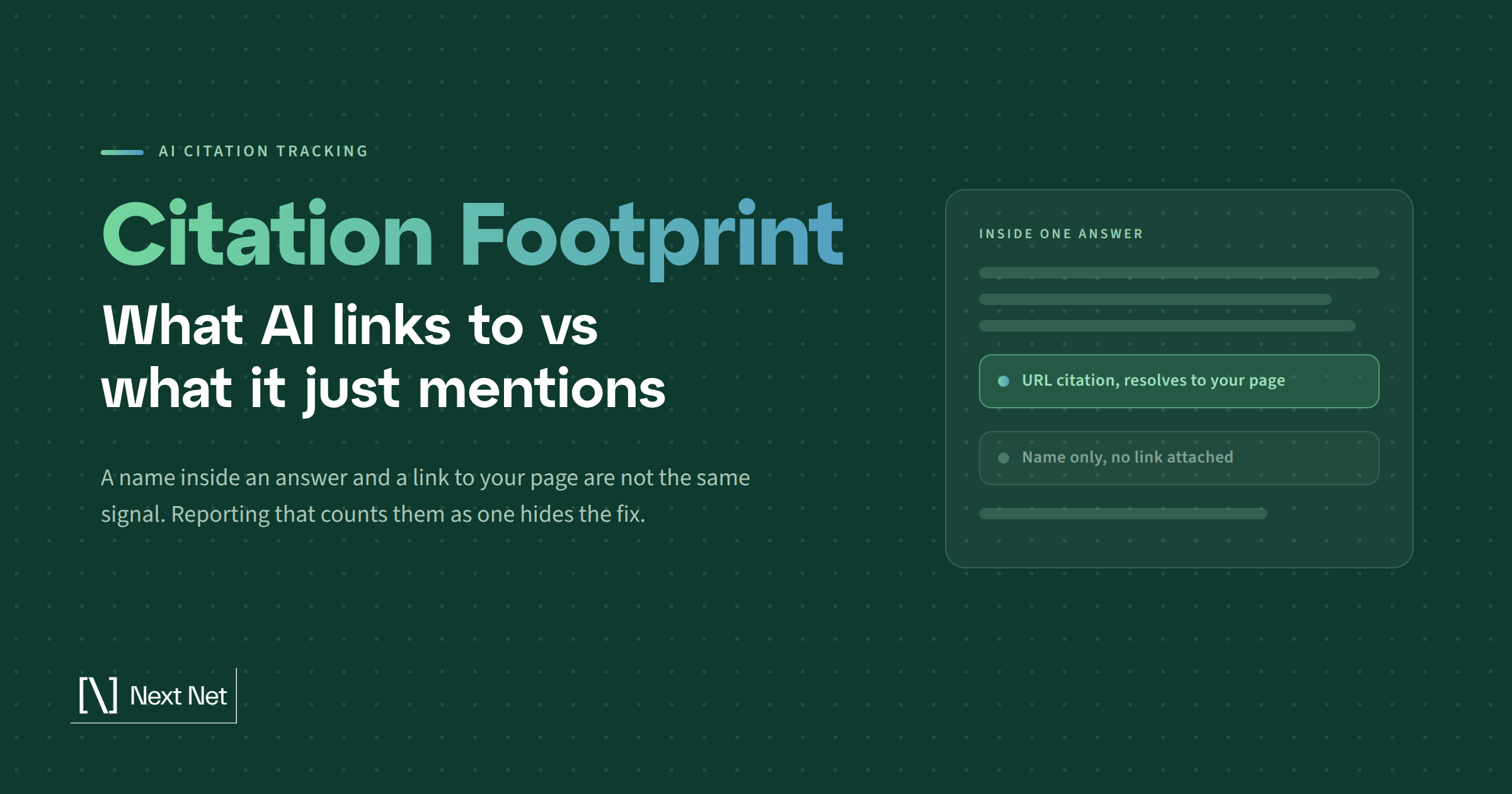
Citation Footprint: What AI Links To vs What It Just Mentions

This morning, inside some ChatGPT answer you will never see, a brand in your category got named. No link. Just the name, dropped into a sentence about good options.
In another answer, a competitor got a link and a source card.
Most reporting counts both of those as visibility. They are not the same event, and the distance between them is the most useful thing your AI measurement can tell you right now.
That distance has a name, and it can be counted.
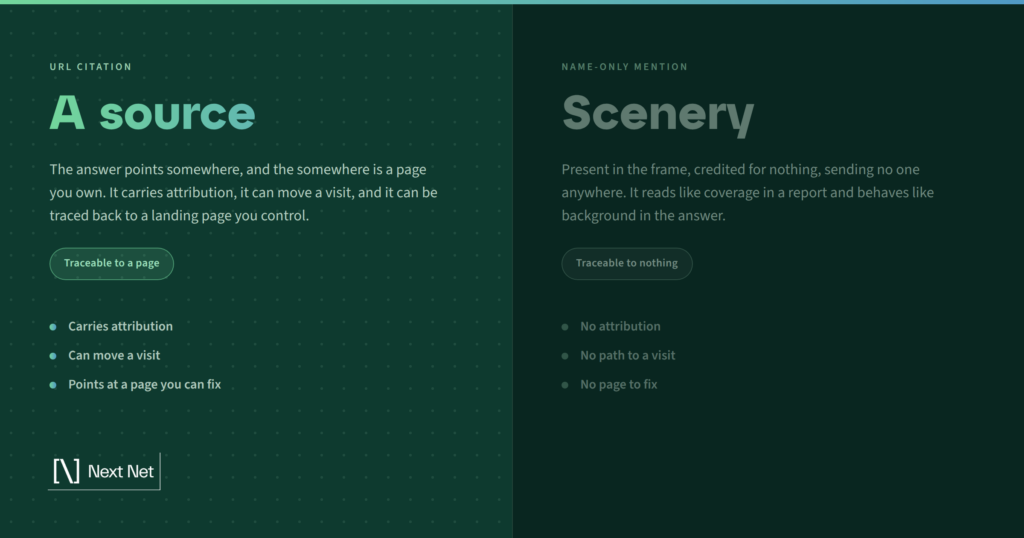
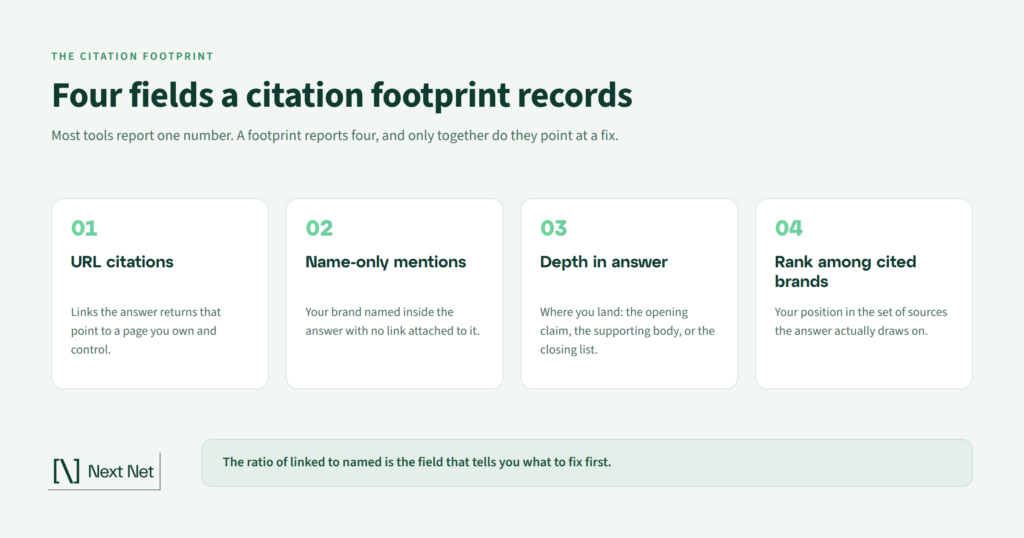
What is a citation footprint? Your citation footprint is the record of where AI engines pointed at you and how they did it. It has four parts: the answers that linked to a URL on your site, the answers that named you with no link at all, how deep into each answer you landed, and where you ranked among the other brands cited in that same response. Read together, those four tell you whether you showed up as a source or as scenery.
Citation Footprint is one of five signals on an AI visibility report card, and it tends to be the one clients ask about first. A share of voice percentage is an abstraction. A citation is a specific engine, answering a specific question, deciding to point at you.
A mention is a rumor. A citation is a receipt.
This post covers what the footprint records, how to trace a single citation from the answer back to the page that earned it, five reads that turn the number into a decision, and the ways teams misread it.
The four things a citation footprint records
Every measurement platform packages this differently, but the underlying data set is the same four fields.
URL citations. The engine pointed at a specific page and made it clickable. Google describes its own retrieval process as pulling pages from the Search index and then showing clickable links to the web pages that support the response. That link is the strongest signal in the whole data set, because it means a machine treated one of your pages as evidence.
Name-only mentions. The engine said your name and moved on. You were part of the answer, not part of the sourcing.
That difference matters more than it looks. A user reading a name-only mention has to go find you. A user reading a URL citation is one click away, and the engine has vouched for the page.
Depth. Where in the answer the appearance landed. First sentence, third paragraph, or the trailing list of also-consider options. Depth is the crudest of the four fields and the one most people skip, which is a shame, because it maps to how a reader experiences the answer.
Nobody reads to the bottom of a long AI response with the same attention they gave the first two lines. A brand named in the closing hedge is standing in the scenery: technically present, practically invisible.
Rank. Your position among every brand cited in that same response. Rank is the only field that is inherently competitive: it tells you not just that you were there, but who was there ahead of you.
Rank is also the field that survives comparison best. Raw citation counts move when the engines change how verbose their answers are, when your question set grows, or when a category gets more or less attention that month. Your position relative to the brands cited beside you holds steadier through all of that, which makes it the better line to put in front of a client over time.
Four fields, and most reporting collapses all of them into one number.
Why the ratio is the number that moves
If you only track one thing from this data set, track the ratio of URL citations to name-only mentions.
A brand with forty appearances split three linked and thirty-seven named has a very different problem from a brand with forty appearances split thirty linked and ten named. The first brand is in the conversation without being a source. The second is a source that could be talked about more.
Same appearance count. Opposite fixes.
The first brand needs pages the engines are willing to treat as evidence, which is a content and corroboration problem. The second needs to appear in more of the answers it is absent from, which is a coverage problem. Sold as one number, both of those brands get told they have “moderate AI visibility” and neither gets told what to do on Monday.
Follow one citation all the way down
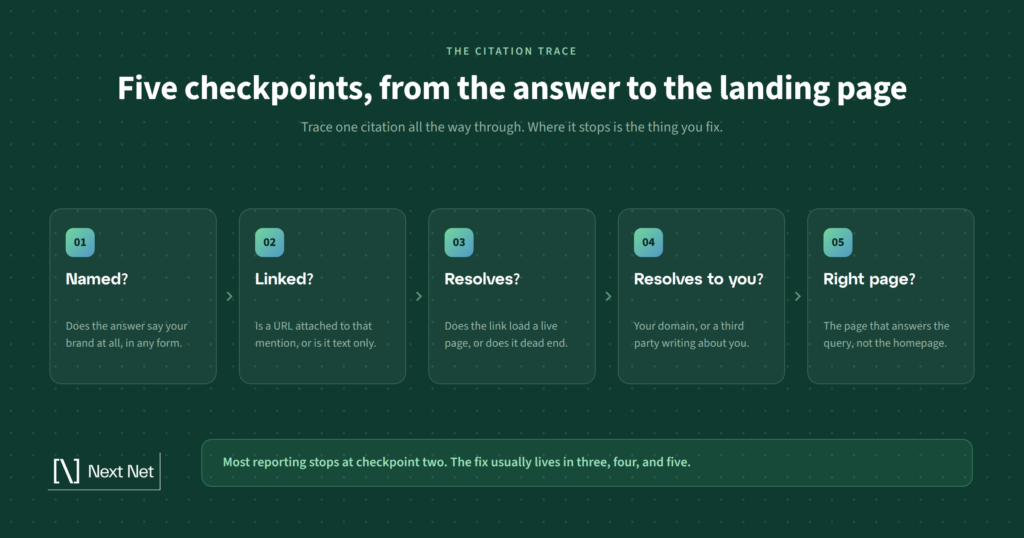
Here is the exercise worth running before you build any dashboard: take one real citation and trace it from the answer to the landing page. There are five checkpoints, and your footprint can lose a point at any of them.
Checkpoint one: did the answer name you? If not, you are absent, and the rest of the trace is moot. Log it and move on.
Checkpoint two: was there a link? This is the mention-to-citation line. Plenty of appearances stop here.
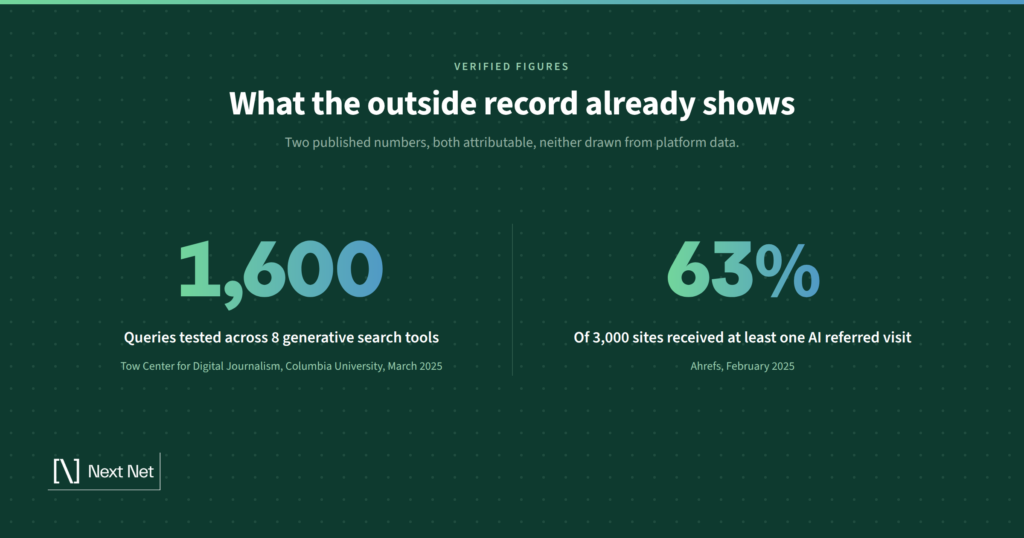
Checkpoint three: does the link resolve? Not a rhetorical question. When researchers at Columbia University’s Tow Center for Digital Journalism ran sixteen hundred queries across eight generative search tools, they found tools inventing URLs that led to error pages. A citation that points nowhere still looks like a citation in a screenshot.
Checkpoint four: does it resolve to you? The same research found tools routing users to syndicated or republished copies of an article rather than the original, in some cases even where a formal content partnership existed between the publisher and the AI company. If the link lands on someone else’s republication of your material, the engine cited your content and sent the visitor to another domain. You earned the reference. Somebody else earned the visit.
Checkpoint five: is it the page you would have picked? An engine linking to a four-year-old blog post instead of your product page is a real result with a real fix.
Two caveats on that research before you quote it in a client deck. It was published in March 2025, and these systems change fast, so treat it as evidence that the failure modes exist rather than as a current error rate. It also focused on news attribution specifically, which is a harder task than naming a business in a category. The checkpoints hold regardless. The proportions in your own category will be your own.
Run this trace by hand on ten appearances before you trust any tool to run it for you at scale. You will find at least one surprise, and it will change what you build.
Five reads that turn the footprint into a decision
A number nobody acts on is a vanity metric with better manners. Each of these reads maps to a different next move.
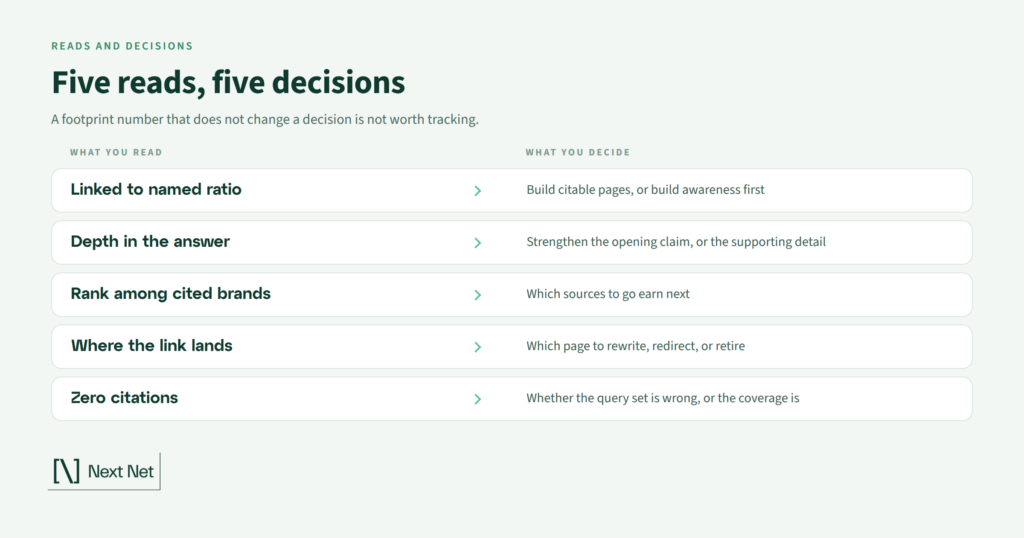
The ratio read. Heavy on mentions, light on links, means the engines know your name but do not treat your pages as evidence. The fix lives in content structure and third-party corroboration, not in more brand awareness. Our post on which publications and site types AI trusts in your category covers where that corroboration tends to come from.
The depth read. Consistently cited in the tail of answers, after the recommendation has already been made, means you are in the consideration set as a hedge rather than a lead. That is a positioning problem, and it usually shows up alongside weak coverage of the comparison and decision questions your buyers ask.
The rank read. If two or three of the same brands sit above you in most responses, you have identified your real AI competitive set, which is often not the competitive set on your slides. Worth checking against your share of voice number, since a healthy percentage can hide a consistently second-place position.
The destination read. Group your URL citations by landing page. Most brands find a small number of pages carrying nearly all of the citations, and they are rarely the pages the marketing team invested in. Those pages tell you what shape of content earns links in your category. Build more of that shape.
The zero read. This one requires discipline. A zero can mean the engines did not cite you, or it can mean the measurement run failed and nothing caught it. Those are opposite findings that look identical in a dashboard.
Before a zero goes anywhere near a client, verify it by hand. Ask the engine the question yourself and see what comes back. It takes four minutes and it has saved more than one uncomfortable meeting.
Why traffic is the wrong scoreboard for this number
The first question a client asks about citations is usually whether they send traffic. The honest answer is that traffic is real, small, and badly measured, and that none of those three facts should be the scoreboard for citation work.
Ahrefs studied three thousand sites and found roughly two in three had received at least one visit attributable to an AI chatbot, while the average site drew a fraction of a percent of its visitors from that channel. More usefully, the same research documented several assistants passing visits through without referrer information, which lands them in the direct bucket where nobody counts them as AI at all.
So the visible number is a floor, not a measurement.
Which means citation footprint is not a traffic proxy and should not be sold as one. It is an exposure and evidence measure: it tells you how often machines that answer questions for your buyers are treating you as the answer. Some of that converts to clicks. More of it converts to a buyer arriving already knowing your name, through a path your analytics will never attribute.
Report the citation trend and the traffic trend as two separate lines. Do not draw a causal arrow between them in a client deck. We go deeper on the attribution problem in our post on proving return on AI visibility work.
Where to look, without buying anything first
Three sources, in order of how much they cost you.
Search Console. Google’s Generative AI performance report shows how your content performs in AI Overviews and AI Mode. It is first-party data from the largest AI surface, and it is free. Start here. In the same documentation, Google advises caution about third-party tools that claim access to internal ranking systems, which is a fair warning to carry into any vendor conversation, including ours.
Manual sampling. Write twenty questions your buyers would ask, run them across ChatGPT, Gemini, Perplexity, Copilot, and Google AI Overviews, and log four columns: named, linked, position in answer, brands cited above you. Twenty questions times five engines is a hundred data points and about two hours. It will not scale, and it will teach you more about your category than any dashboard.
Keep the engines in separate columns rather than summing them. They cite at measurably different rates and lean on different kinds of sources, so a blended total hides the most actionable finding in the set: that you are well cited on one surface and absent from another. That gap is usually fixable, and it disappears the moment you average it away.
A monitoring platform. Worth it when the question shifts from what is happening to what changed since last month. Tracking movement across a large question set by hand stops being feasible quickly. That is the point where an always-on platform earns its place.
Whichever you choose, write down your question set and keep it fixed. AI citation tracking only produces a trend if the questions stay constant between runs. Changing the prompts and then reporting movement measures your prompt edits, not the market.
Five ways teams misread the footprint
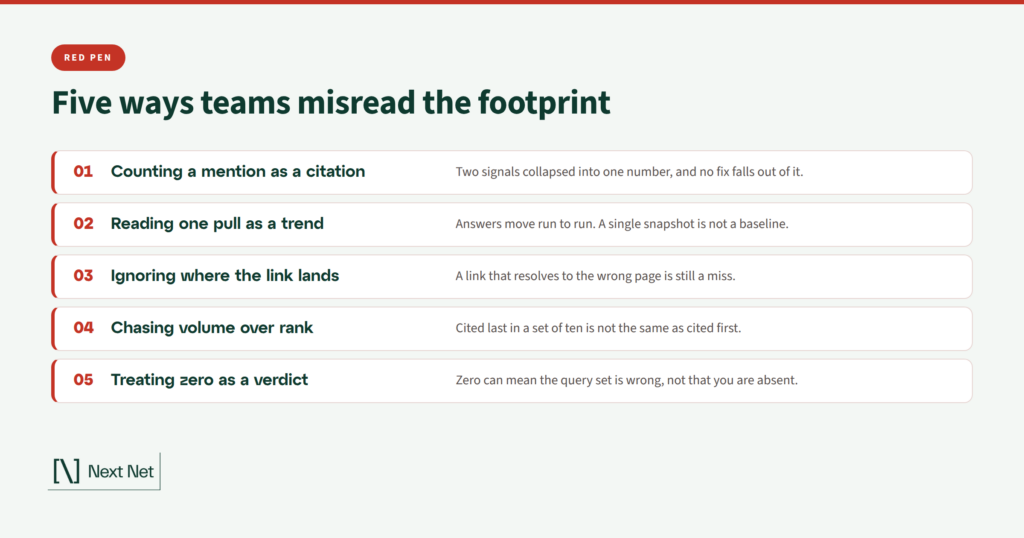
Counting mentions as citations. The most common error, and it inflates every number downstream. Google’s guidance is worth reading here too: it explicitly warns against chasing inauthentic mentions across the web as a visibility tactic. Volume of name-drops is not the goal.
Reading decimals off a thin sample. A hundred data points does not support a citation share of 17.3 percent. It supports “roughly one in six.” Precision you have not earned reads as confidence to a client right up until it moves and you have to explain why.
Treating every cited domain as a competitor. Citation data mixes real rivals with reference sites, trade publications, local resource pages, and the occasional piece of noise. Clean arithmetic over a contaminated list is worse than an obvious error, because it looks right.
Comparing runs with different question sets. Covered above, and worth repeating, because it is the quietest way to produce a chart that means nothing.
Promising that citations will lift revenue. Report the direction. Explain the mechanism. Let the client draw the line to revenue, because you cannot honor it on their behalf.
Frequently asked questions
What is the difference between an AI mention and an AI citation?
A mention is your brand name appearing in an AI answer with no link. A citation is the engine pointing at a specific URL on your site and making it clickable. Both are visibility, but only the citation means a machine treated your page as evidence for its answer, and only the citation gives the reader a path to you.
How do you track AI citations?
Start with Google Search Console’s generative AI performance report for AI Overviews and AI Mode, then add manual sampling: a fixed set of buyer questions run across the major engines on a schedule, logging whether you were named, whether you were linked, where in the answer you appeared, and which brands appeared above you. Monitoring platforms automate that once the question set outgrows a spreadsheet.
Do AI citations send traffic?
Some, and less than the exposure would suggest. Published research puts visible AI referral traffic at a small fraction of total site visits for the average site, and that figure is understated because several assistants strip referrer data, which files those visits as direct. Treat citations as an exposure measure with a traffic tail, not as a traffic channel.
What is a good citation footprint?
There is no universal benchmark, because citation volume scales with how often your category gets asked about. The useful comparison is against the other brands cited in the same answers, and against your own prior run. A footprint improving on the ratio of links to name-only mentions is moving in the right direction regardless of its absolute size.
Why does AI mention my brand but not link to it?
Usually because the engine knows your brand from third-party sources rather than from your own pages. It learned about you from coverage, reviews, and discussion, so it can name you, but it has no page of yours it considers authoritative enough to cite. Structured, specific pages that answer the question directly, plus corroboration from sources the engines already trust, is what moves an appearance from named to linked.
Reading the footprint is the cheap half
The measurement is the easy part. Anyone can count.
What the citation footprint gives you is a short, ranked list of things worth fixing: the pages already earning links, the questions where you sit in the scenery, the brands sitting above you, and the answers you are missing entirely. That list is the plan.
If you want a read on where your brand stands across the major engines, start with a report card. It scores your citation footprint alongside share of voice and the rest, and it will tell you which of the five reads above applies to you.