
What Is an AI Content Supply Chain?

Every AI product you have used this year runs on content somebody else made. The answer engine that summarized a news story, the shopping assistant that compared three products, the research agent that pulled a dozen sources into a brief: none of them wrote the underlying material. They retrieved it, ranked it, and built an answer on top of it.
That dependency is now the least examined part of the AI stack. Teams obsess over model choice, context windows, and evaluation harnesses, then source the content those models reason over through a crawler and a hope. Nobody would run a factory that way. Nobody would run a bank that way either.
This post gives the term a definition, walks through the four stages that make up a working supply chain, and then makes the argument we have been making since SAIL launched: the AI companies that treat content as supply, with a pipeline behind it, are going to outlast the ones that treat it as a free input. Cloud computing needed AWS. Online payments needed Stripe. Content for AI needs the same kind of layer.
An AI content supply chain, defined
An AI content supply chain is the pipeline that moves content from the people who own it to the AI systems that use it, with sourcing, rights clearance, delivery, and settlement handled as one connected process. Sourcing identifies and ingests the content an AI product needs. Rights clearance confirms what that product is permitted to do with each piece and on what terms. Delivery gets the cleared content to the model or agent at the moment of retrieval, in a form it can use. Settlement records the use, attributes it, and compensates the owner. When any one of those four stages is missing, the system is not a supply chain. It is a crawler with extra steps.
The term borrows deliberately from physical logistics, and the parallel holds better than most tech metaphors do. A supply chain is not a warehouse. It is the set of agreements, handoffs, and records that let a manufacturer depend on inputs it does not produce itself. The content an AI product depends on is exactly that kind of input.
One disambiguation, because the phrase is already in use elsewhere. Enterprise marketing teams use “content supply chain” to describe how a brand plans, produces, approves, and distributes its own marketing content. That is an internal workflow question. An AI content supply chain is an external sourcing question: how an AI system obtains and pays for content it does not own. Same words, different problem, and this post is about the second one.
Why every AI product already has a supply problem
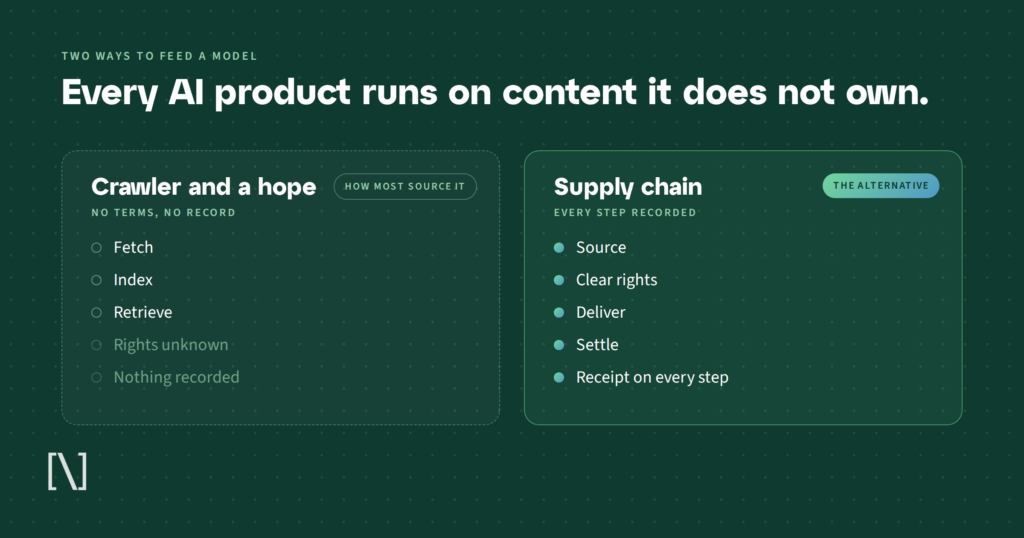
Most AI products source content the way the early web did: a crawler fetches whatever it can reach, the pipeline indexes it, and retrieval pulls passages back at query time. That worked when the only thing a crawler did with a page was point people to it. It stopped working the moment the crawler’s output became the product.
Grounding is now the norm rather than the exception. Google’s own guide to generative AI features in Search describes how its AI answers are grounded in pages retrieved from the search index, which is the same retrieval-augmented pattern most AI products use. The model is only as current, accurate, and defensible as what it retrieved. Fresh, trusted content is not a nice-to-have for an AI product. It is the raw material.
And the raw material is getting harder to take for free. Publishers have moved from tolerating crawlers to managing them: blocking some, rate-limiting others, and increasingly attaching machine-readable terms to what they publish. We covered the mechanics in the four ways AI systems use your content, and the short version is that crawling, training, retrieval, and licensed retrieval are legally and economically different acts, and publishers are starting to set different rules for each.
The response from the largest AI companies has been bespoke licensing deals. Those deals prove the point about demand, but they do not scale. A negotiated agreement takes months, covers one publisher, and produces terms nobody else can reuse. Multiply that by the number of publishers a general-purpose product needs and the number of AI products that need them, and one-off contracts are not a supply strategy. They are a workaround for not having one.
Then there is the exposure. Sourcing content without a record of what you took, from whom, and under what terms means that if the question is ever asked in a legal setting, you reconstruct the answer from logs after the fact. We wrote about why that reconstruction is what AI copyright disputes are really fighting over. A supply chain produces the record as a byproduct of operating. That difference is worth more than any single license.
The four stages, one at a time
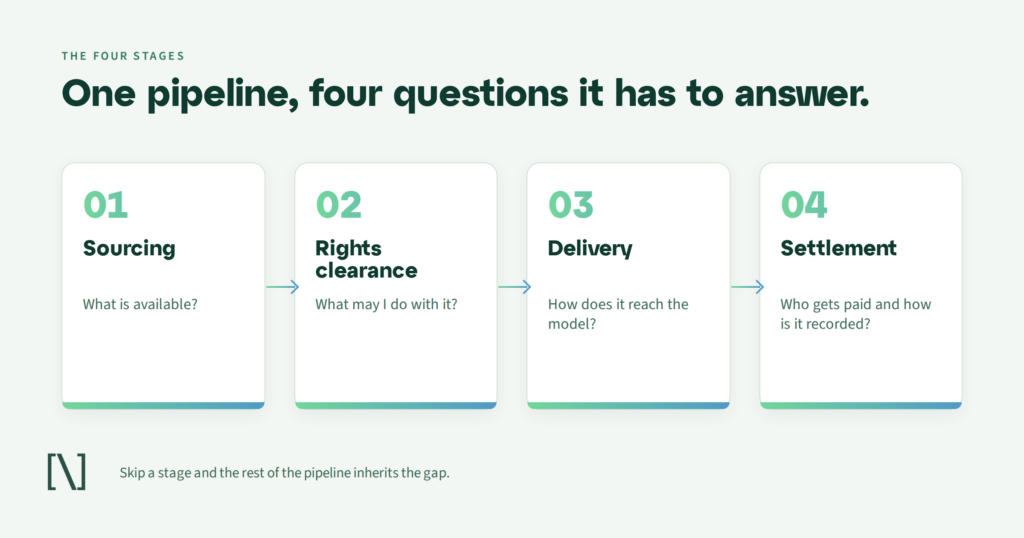
The definition above names four stages. Each one has a standards story, a status quo, and a gap, and it helps to see them separately before seeing them as a pipeline.
Sourcing
Sourcing is the act of finding and ingesting content. Today that is almost entirely crawling, governed by the Robots Exclusion Protocol, which was standardized as RFC 9309 in 2022 and still only speaks in allow and disallow. It cannot express “yes for search, no for training, licensed for retrieval,” because it was never designed to.
In a supply chain, sourcing means something narrower and more useful: identifying content that is available for your use case, from owners who have said so, in a form that carries its own identity and provenance. The unit stops being a URL and starts being a content object with terms attached. We explained why that shift matters in why URLs won’t be enough in agentic AI.
Rights clearance
Rights clearance is where most of the standards work is happening, and where an AI team can get lost fastest. Two efforts matter.
The Really Simple Licensing 1.0 specification, published in December 2025, gives publishers an XML vocabulary for stating machine-readable usage, licensing, payment, and legal terms, along with discovery and authorization mechanisms so an automated client can find those terms and acquire a license. It builds on the RSS and robots.txt lineage on purpose, so that a crawler that already understands the old signals can be taught the new ones.
Separately, the IETF AI Preferences working group is standardizing a vocabulary for expressing how content may be collected and processed for AI, and the means of attaching those preferences through metadata and delivery protocols. Its charter is explicit about what it does not do: it expresses preferences. It does not enforce them.
That last point is the whole gap. A rights vocabulary tells you what the owner wants. Clearance means confirming, before retrieval, that your intended use matches those terms, and being able to prove later that it did. Reading the label is not the same as clearing the rights.
Delivery
Delivery is the stage AI teams already understand, because it is the retrieval half of retrieval-augmented generation. The difference in a supply chain is that delivery happens only for cleared content, and it delivers the content object with its terms and identity intact rather than a scraped text blob.
This is also where enforcement lives. If clearance happens before delivery and delivery is the only path into the model’s context, the publisher’s policy is enforced automatically rather than relying on the AI company’s good behavior after the fact. We laid out the four parts of a rights-managed object, including this enforcement threshold, in the plain-English guide to rights-managed content objects.
Settlement
Settlement is what makes the other three stages worth building. Every delivery event gets recorded: which object, which use, under which terms, at what time. That record is the receipt. It is what a publisher can bill against, what an AI company can point to when asked how an answer was sourced, and what an enterprise buyer can audit.
Settlement also closes the loop that crawling leaves open. Without a record of use, nobody can price anything, because nobody can measure anything. We made that argument at length in why AI still has no system for paying for the content it uses. The supply chain framing simply puts the meter where it belongs: at the point of delivery.
The shipping container, and why standardization is the whole game
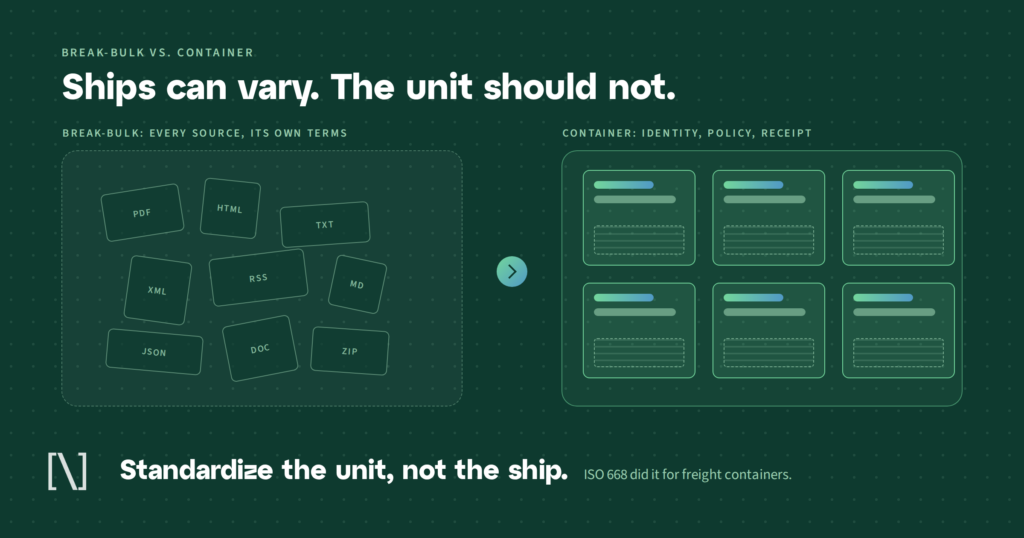
For most of shipping history, cargo moved as break-bulk: barrels, sacks, and crates, each loaded and unloaded by hand, each negotiated separately at every port. Nothing was wrong with the cargo. Ships spent days in port because nothing about a crate of tea told the next crane what to do with it.
The intermodal container changed that, and not because the steel box was clever. The standard was. ISO 668 fixes the external dimensions, ratings, and corner fittings of series 1 freight containers so that any crane, chassis, railcar, and ship built to the standard can handle any container built to it, without anyone reading the manifest first. Global trade did not scale because ships got bigger. It scaled because the unit got standardized.
Content moving into AI systems is still break-bulk. Every publisher has different terms, expressed in different places, enforced in different ways or not at all. Every AI company negotiates, integrates, and reconciles separately. Nothing is wrong with the content, either. Every port is still reading the manifest by hand.
A supply chain standardizes the unit. When every piece of content moves as a rights-managed object with the same shape, carrying its own identity, policy, terms, and reporting hooks, then any compliant retrieval system can handle any compliant object. Clearance becomes a check, not a negotiation. Settlement becomes a ledger entry, not an invoice dispute. That is the standardization argument in one paragraph, and it is the reason the term is “supply chain” rather than “content marketplace.” A marketplace is where you shop. A supply chain is how the goods get there.
Cloud computing needed AWS. Online payments needed Stripe.
This part of the argument starts with a pattern rather than a product.
Before 2006, every company that wanted to run software on the internet built its own storage and compute. Then Amazon Web Services launched S3, describing it in the original announcement as storage for the internet, with a simple interface any developer could call. Within a few years, building your own data center went from the default to the exception. The applications that defined the following decade, most of them, were only possible because that layer existed underneath them.
Payments followed the same arc. For years, accepting money online meant a merchant account, a gateway, a compliance review, and weeks of integration. Stripe collapsed that into an API call. An entire generation of online businesses was built on top of that abstraction by founders who never thought about interchange fees once.
The pattern: infrastructure precedes ecosystems. The layer arrives first, it looks like plumbing, and then the things built on top of it become the industry. Nobody remembers the plumbing until it is missing.
Content is the unbuilt layer of the AI stack. As the SAIL launch put it, the internet created standards for moving information and the digital economy created standards for moving money, and the AI economy still has no equivalent for moving content with rights and receipts attached. Models are commoditizing. Compute is a utility. The one input every AI product needs and no AI product owns is trusted, current, rights-cleared content, and the mechanism for obtaining it at scale does not exist inside any AI company today.
Why every AI company will eventually need one
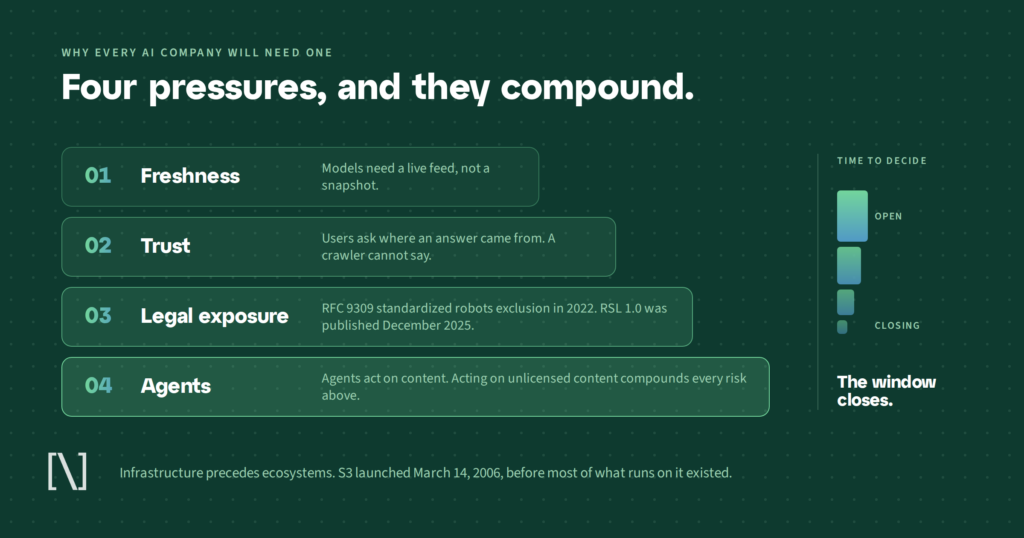
“Eventually” is doing real work in that sentence. Most AI companies do not need a content supply chain today, in the sense that they can ship a product without one. The argument is that the window closes, for four reasons that compound.
Freshness. Models train on a snapshot. Products answer questions about this morning. The gap between the two is filled entirely by retrieval, and retrieval is only as good as the sourcing behind it. Crawling delivers whatever was reachable; a supply chain delivers what the owner published, when they published it, in the form they intended.
Trust. Users, and especially enterprise buyers, are starting to ask where an answer came from. “We found it on the web” is not an answer that survives a procurement review. Provenance attached to each content object, and a receipt for each use, turns a hard question into a lookup.
Legal exposure. The disputes over AI and content are, at bottom, disputes about records: who used what, when, and under what terms. A company sourcing content through a supply chain generates those records by default. A company sourcing through a crawler generates them in discovery, at whatever that costs. This is the plainest part of the thesis: the companies that build on licensed supply will not carry the litigation overhang that the companies built on scraped supply will. That is a structural advantage, and it accrues from day one.
Agents. Summarization was the first wave. Autonomous agents that browse, decide, and transact on a user’s behalf are the second, and they multiply the number of content requests by orders of magnitude while removing the human who used to notice when something looked off. Governance that relied on a person in the loop does not survive that transition. Governance built into the delivery path does.
Put those four together and the shape of the future is not hard to see. Some AI companies will build their own supply chains, the way the largest companies built their own clouds. Most will use a shared one, for the same reason most companies use AWS. Either way, the ones that keep sourcing content the way it was sourced in 2023 will find themselves competing on stale, unverifiable, legally exposed inputs against companies that are not.
Where SAIL fits
Next Net built SAIL, the Standardized Agentic Intelligence Ledger, to be that shared supply chain. We announced it in July 2026 with Sundial Media and Technology Group as the inaugural media partner and NVIDIA AI software as the infrastructure underneath it; the launch announcement has the full detail. In supply chain terms, here is what it does at each stage.
Sourcing: publisher content is converted into rights-managed content objects, each carrying identity and provenance, so the unit an AI system requests is an object with terms rather than a page with none. Rights clearance: each object carries the owner’s policy, compatible with the RSL and CoMP standards for machine-readable rights, and that policy is checked before anything is delivered. Delivery: governed AI retrieval returns cleared content to the requesting system, which is the enforcement point. Settlement: every use is recorded in a verifiable ledger, producing the receipt a publisher can bill against and an AI company can show its customers.
Two things to be clear about. SAIL is infrastructure, not a model, and it is not a substitute for the standards work happening at the IETF and the RSL Collective. It is the layer that turns those expressed terms into cleared, delivered, settled transactions. And it is built to be two-sided: it only works as a supply chain if there is supply. That is why publishers are the first audience on the SAIL page for publishers, and why AI teams are the second.

Where to start
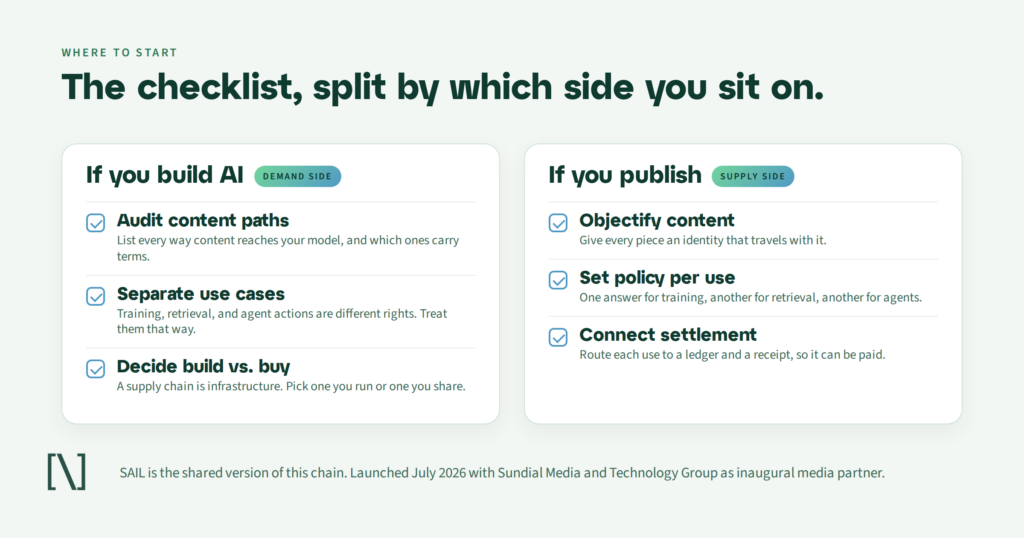
If you build AI products, the first move is an audit, not a purchase. Map how content enters your system today: what is crawled, what is licensed, what is user-provided, and what is inferred. For each path, ask whether you could produce a record of a specific retrieval event six months from now. Wherever the answer is no, you have found a supply chain gap.
Second, separate your use cases. Training, indexing, and retrieval are different acts with different rights attached, and the standards emerging now let publishers say yes to some and no to others. A pipeline that treats them as one thing will be blocked from all of them by owners who only object to one.
Third, decide what you are willing to build versus buy. Rights clearance, governed delivery, and a ledger are each real engineering. Building all three in-house is a choice some companies will make. Most should treat it the way they treat storage and payments.
If you publish, the sequence is simpler. Get your content into a form that carries its own terms, so it can participate in the supply chain at all. The rights-managed content object post above covers the four parts. Then decide your policy per use, not per site. Then plug into a settlement layer so that the uses you allow produce a record you can act on.
Frequently asked questions
What is an AI content supply chain in one sentence?
It is the pipeline that sources content for AI systems, clears the rights to use it, delivers it at retrieval time, and settles each use with a record and compensation, all as one connected process.
How is an AI content supply chain different from a content licensing deal?
A licensing deal is one agreement between one publisher and one AI company. A supply chain is infrastructure that lets many publishers and many AI systems transact under standardized terms without negotiating each pair separately. Deals prove the demand exists. A supply chain is what meets it at scale.
Do AI companies need this if they only use retrieval and never train on the content?
Yes, arguably more so. Retrieval happens at query time, continuously, against current content, which is exactly where freshness, provenance, and per-use records matter most. Training happens once, while retrieval is an ongoing supply relationship.
Is this the same as the “content supply chain” marketing teams talk about?
No. That term describes how a brand produces and distributes its own marketing content internally. An AI content supply chain describes how an AI system obtains, clears, and pays for content it does not own. The words overlap, but the problems are different.
What standards does an AI content supply chain rely on?
The RSL 1.0 specification for machine-readable licensing terms, the IETF AI Preferences work for expressing and attaching usage preferences, and provenance frameworks such as C2PA for content identity. Those standards express terms and identity. A supply chain is the layer that clears, delivers, and settles against them.
The layer arrives before the ecosystem
Every AI product depends on content it does not own, and almost none of them have a dependable way to get it. That is not a moral problem or a legal problem first. It is a supply problem, and supply problems get solved with infrastructure: a standardized unit, a clearance step, a delivery path, and a record of every transaction.
The companies that build on that layer early will look, in hindsight, like the companies that built on cloud storage early. The ones that wait will spend the next few years reconstructing records they could have been generating all along.
If you publish, join the supply. If you build AI products and want licensed, receipted access to trusted content, talk to us.