
How to Rank in ChatGPT: What the 2026 Research Actually Shows

Your buyers are asking ChatGPT which vendor to hire. About 900 million people use it every week, OpenAI reported it crossed a billion monthly users in June 2026, and something close to 2.5 billion prompts move through it every day.
A large share of those prompts are commercial. Which tool should I use. Which firm is best for this. Who do people recommend.
ChatGPT answers, names a few brands, and links to a few sources. If your brand isn’t in that answer, you’re not in the consideration set, and there’s no second page to fall back to.
So the question is a fair one. How do you rank in ChatGPT?
That question contains a wrong assumption, so start with the correction.
Ranking in ChatGPT is not a position you hold. It is the probability that ChatGPT names your brand or cites your content when someone asks a question in your category. No ordered results page exists, and no position one. A retrieval step gathers sources, then a synthesis step writes an answer from them. You influence what gets retrieved and what gets said, not where you sit in a list.
That distinction changes the whole job. The research published across 2025 and 2026 also agrees on what the job actually is, across a lot of independent methodologies.
Two mechanisms, two different problems
Before any tactic makes sense, know that ChatGPT can say your name for two separate reasons.
The first is training data. The model absorbed an enormous quantity of text, and your brand either occupies a stable place in that material or it does not. That’s where unattributed mentions come from, the ones where ChatGPT recommends you without linking to anything. You can’t edit training data, and a change you made last month won’t show up in it.
The second is live retrieval. When a prompt needs current information, the system searches, pulls a set of sources, and cites them. That’s where links appear, and it’s the mechanism you can actually influence on a reasonable timeline.
Most brands need both, and they need different work. Training-data presence is built slowly through consistent, widespread coverage that describes you the same way everywhere. Retrieval presence is built by being in the source pool the engine reaches for right now.
Confusing the two is the most common reason AI visibility programs disappoint. A team ships a batch of optimized pages, sees nothing change in how ChatGPT describes the brand, and concludes the work doesn’t function. What actually happened is that they aimed on-page work at a problem living in the coverage layer.
The scale question, and why it is not settled
The usage numbers get quoted a lot and mangled almost as often, so here they are precisely.
OpenAI reported roughly 900 million weekly active users in late February 2026, up from about 400 million a year earlier. Monthly users crossed a billion in June 2026. Daily prompt volume sits near 2.5 billion.
On share, StatCounter measured ChatGPT at 76.85% of AI chatbot referrals to third-party websites as of April 2026. That’s dominant, and it’s also down from about 84.21% a year prior, having fallen for three straight months.
ChatGPT is far and away the surface to prioritize if you can only afford to think about one. The category is also diversifying fast enough that building a strategy around a single engine is a short-term position.
One measurement caveat belongs in any conversation about these figures. Referral share only counts engines that send outbound clicks, which excludes Google AI Overviews entirely, because it answers inside Google Search and generates no referral at all. Any chart ranking AI engines by referral traffic is describing a slice, not the whole picture.
The finding that reorganizes everything: 84% of AI citations are earned media
Muck Rack’s Generative Pulse team published the May 2026 edition of its ongoing study, What Is AI Reading?, analyzing more than 25 million links cited in ChatGPT, Claude, and Gemini responses across 17 industries.
Earned media accounted for 84% of all AI citations.
Journalism alone made up 27% of cited sources. Paid and advertorial content accounted for 0.3%.
Sponsored placement is close to inert as citation material. The channel a lot of marketing budget is built around barely registers in the answer layer.
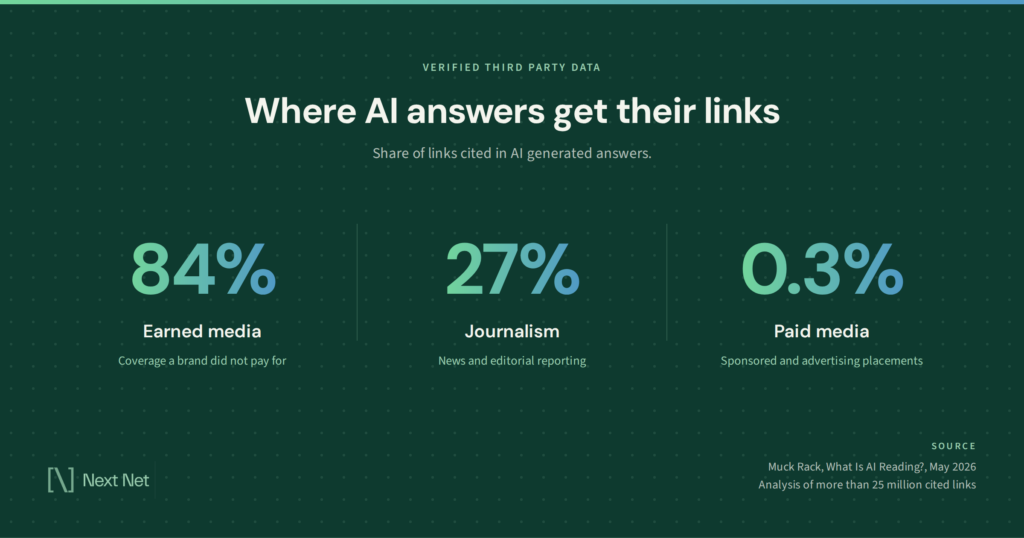
The figure has also held steady. Across three editions going back to July 2025, earned media has ranged from 82% to 89%, and journalism citations have stayed between 25% and 27%. Three readings that close together over a year describe the structure of the system, not a quarterly wobble.
Independent work points the same way. A University of Toronto study found that AI search engines show a systematic preference for earned media over brand-owned content. Ahrefs, analyzing 75,000 brands, found brand web mentions correlated three times more strongly with AI Overview visibility than backlinks did.
And in a controlled study across five leading large language models, Stacker found that distributing content through third-party news outlets produced a median lift of 239% in AI search visibility.
For anyone who’s spent a decade building owned content, the implication stings. Your blog isn’t the lever here. Coverage is.
Where ChatGPT actually pulls from
Knowing that earned media wins is only half useful. You also need to know which surfaces the model actually reaches for.
A Q1 2026 citation source audit published by the communications firm 5W synthesized nine independent research datasets covering hundreds of millions of citations and prompts. The picture it produced isn’t the one most communications plans assume.
Wikipedia accounted for 13.15% of United States ChatGPT citations. Reddit accounted for 11.97%. Together those two surfaces represent more than a quarter of everything ChatGPT cites.
Below those two, the list gets strange.
Reuters landed at number seven with 2.27%. Forbes was the only United States business publication in the top 20, at number 18 with 1.38%. The Wall Street Journal, The New York Times, Bloomberg, and the Financial Times did not appear in the top 20 at all.

The tier system most brands inherited from public relations doesn’t map onto how these systems assemble answers. A placement that would headline your quarterly report can contribute almost nothing to what ChatGPT says about you.
A second structural point matters just as much. Outside Wikipedia and Reddit, no single domain exceeds 3% of ChatGPT citations. At the individual publication level, citation share is long-tailed rather than winner-take-all.
Concentration still exists further up. A separate 5W index built on roughly 680 million citations found the top 15 domains capture about 68% of consolidated AI citation share. So the right read isn’t that every site counts equally. Below the handful of dominant surfaces, breadth across many credible sources beats one marquee placement.
In practice this is a target list problem. Most communications teams work from a media list built around readership, prestige, and relationships. The list governing your AI visibility is built around which domains the engines actually retrieve in your category, and the two overlap less than anyone expects.
Building the second list isn’t complicated. Run your category questions, record what gets cited, and count. You get back a ranked set of publications and platforms demonstrably in the pool. Pitch that list instead.
Review platforms, video, and the multipliers most teams do not budget for
Two findings in the 2026 research surprise marketing teams every time.
Review platforms come first. Brands with profiles across G2, Capterra, Trustpilot, and Yelp showed roughly a three times citation multiplier against brands without them. Those profiles are structured, machine-readable, third-party descriptions of what you sell and what customers think, which is close to what a retrieval system wants.
Video comes second. In the Ahrefs analysis of 75,000 brands, YouTube presence correlated at 0.737 with AI visibility, the strongest single predictor found in any study across 2025 and 2026.
Neither line usually appears in an AI visibility plan. Both are cheap to fix.
One important exception cuts the other way. For local queries, research from Yext found about 86% of citations come from owned sources, meaning your own listings, profiles, and site. If you’re a local business, your structured data and listing hygiene are the asset, not press coverage. The earned media finding governs category and consideration queries, not everything.
Volatility is the variable most strategies ignore
This next finding should change your reporting cadence rather than your tactics.
In September 2025, Reddit’s share of ChatGPT prompt responses fell from roughly 60% to roughly 10% in two weeks.
Two weeks, not two quarters.
Source mixes are retrieval decisions, and retrieval decisions get retuned without notice. A position you measured in January might not describe anything true by March. A plan built on an annual audit is measuring a system that reorganizes faster than the report cycle.
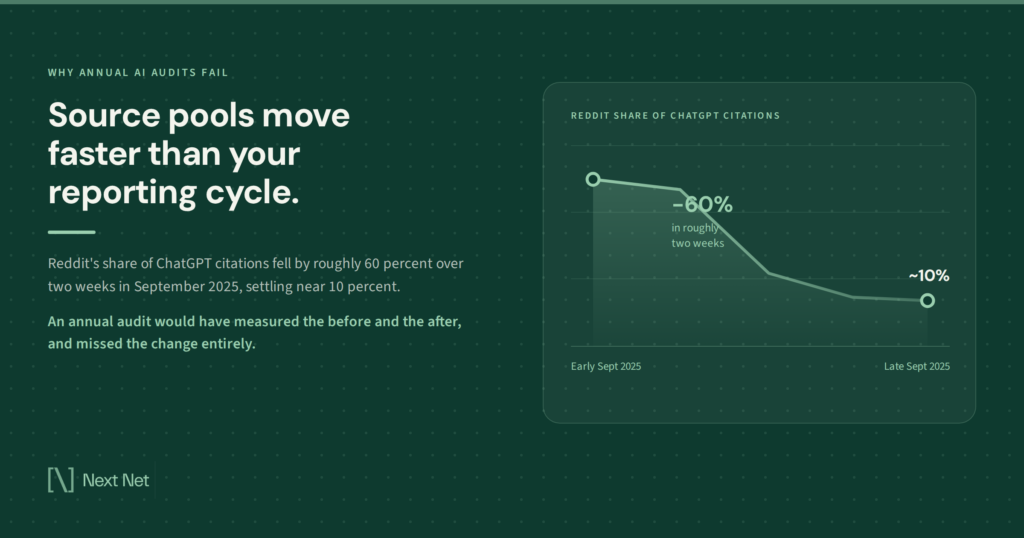
Quarterly is the floor and continuous is better. That’s the practical argument for always-on monitoring over point-in-time snapshots, and it’s the answer for any client asking why a one-time audit isn’t enough.
What doesn’t work anymore
Some of this work is addition. A lot of it is subtraction, and the research is specific about which habits have stopped paying.
Chasing Tier 1 logos. The Wall Street Journal, The New York Times, Bloomberg, and the Financial Times did not appear in the top 20 ChatGPT citation sources at all. A masthead that still moves a boardroom can be close to invisible in the answer layer. Pitch the outlets the engines actually retrieve in your category, which you can identify by running your own category questions and counting what comes back.
Wire-only press release distribution. Releases distributed purely through wire syndication accounted for about 0.04% of citations. The wire moves the news, and the coverage it produces is the part that gets cited. Budget for the pickup rather than the send.
Paid and sponsored placement. Advertorial content accounted for 0.3% of citations. Sponsored material is largely ignored as source material, so a paid program aimed at AI visibility is spending against a channel the engines barely read.
Backlink volume as the headline metric. Brand mentions correlated three times more strongly with AI Overview visibility than backlinks did across 75,000 brands. Links still carry weight in classic search, so this is a change of priority rather than an abandonment. An unlinked mention in a source the engine reads can be worth more than a followed link from a site it never touches.
Content velocity on your own blog. Publishing more posts is the reflex answer, and it aims at the wrong layer when earned media accounts for 84% of citations. Owned pages earn their place by being the primary source for something specific, not by covering ground already covered well elsewhere.
Gating your best material. Content behind a login or a form can’t be retrieved or quoted. The lead-capture convention that built a decade of business-to-business pipelines now removes your strongest pages from the pool entirely. Ungate what you want cited, and capture demand somewhere else on the page.
One-time and annual audits. Reddit’s share of ChatGPT responses moved from roughly 60% to roughly 10% in two weeks. An annual reading describes a system that has already reorganized several times since you measured it.
None of these were bad practice. Most of them worked, and several still do for other purposes. They stopped being the lever for this particular outcome, which is a different claim and an easier one to act on.
The on-page work that still matters
None of this makes your own pages irrelevant. It changes their job.
Owned content earns citations when it’s the primary source for something specific: original data, methodology, technical documentation, definitions of terms you own. It doesn’t earn citations by restating what’s already covered well elsewhere.
Google publishes its own guidance for generative AI optimization, and its fundamentals overlap heavily with what every engine needs.
- Answer first. Lead each section with the direct answer, then add context. Retrieval systems extract passages rather than whole articles, so a passage that stands alone gets used.
- Structure for parsing. Clear headings, FAQ and Article and Organization schema, and consistent entity naming across your site.
- Don’t gate what you want cited. Content behind a login or paywall can’t be retrieved or quoted.
- Keep dates current. Stale timestamps on evergreen pages signal decay.
- Be substantive. Thin pages rarely get pulled as sources.
Query type also shapes what gets cited. In the Muck Rack data, industry trend queries drove journalism citations at more than double the rate of how-to questions, and press releases appeared 3.5 times more often in trend-based responses than in best-of lists.
Set that against one more number. Press releases distributed purely through wire syndication accounted for about 0.04% of citations in BuzzStream’s January 2026 analysis. The wire is a distribution mechanism, and it only pays off when the release produces real coverage in publications the engines already read.
A sequence you can run this quarter
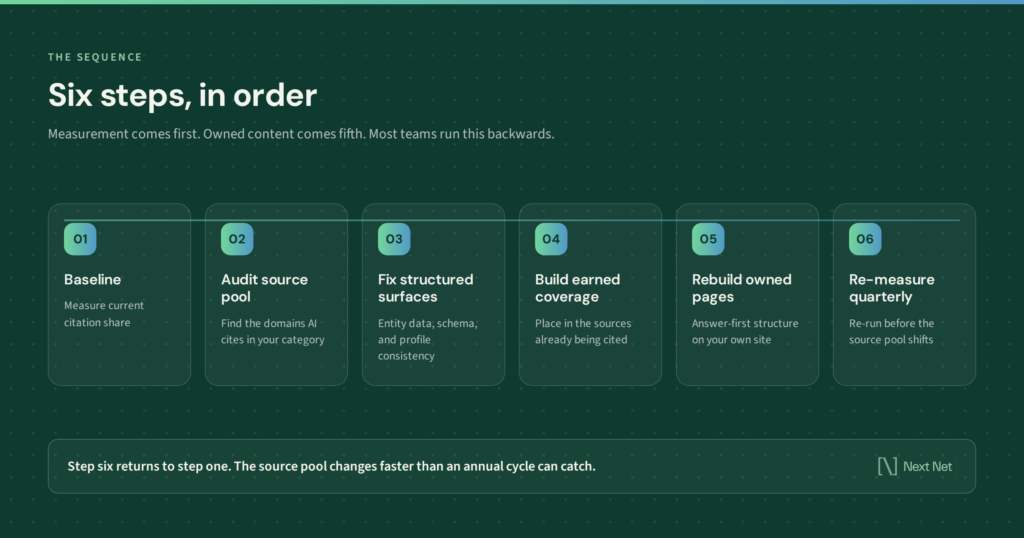
If you’re starting from nothing, run it in this order. The sequence matters more than the speed.
- Establish a baseline. Measure where you currently appear across ChatGPT, Gemini, Perplexity, Copilot, and Google AI Overviews, and record which sources the engines cite when they answer your category questions. You can’t direct work you haven’t measured.
- Audit the source pool, not just your brand. Pull the list of domains the engines actually cite for your category. That list is your target media list, and it’ll look different from the one your team is using.
- Fix the structured surfaces first. Review platform profiles, listings, and entity consistency are the fastest available lift given the multiplier in the data.
- Build earned coverage in the publications already in the pool. A mention inside a source the engines read does the work links used to do. A placement in a publication no engine cites does almost nothing.
- Rebuild your owned pages around primary information. Original data and clear definitions, structured to be extracted.
- Re-measure quarterly at minimum. Given the volatility in the data, treat any single reading as a snapshot rather than a standing position.
What ranking in ChatGPT will not do for you
A caution, because this is where expectations tend to break.
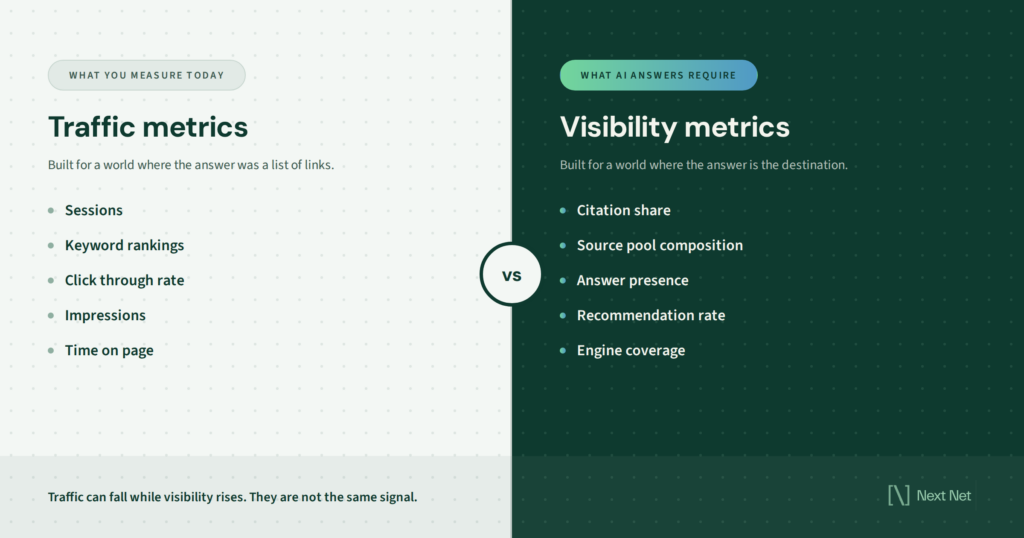
Visibility in AI answers doesn’t convert to traffic the way a search ranking did. Ahrefs measured AI Overviews cutting click-through rate on the position one organic result by 58%. Google has reported AI Overviews reaching around 2.5 billion monthly users. The answer layer is absorbing the click rather than routing it.
So if you measure this work with a sessions report, it’ll look like it failed.
The metrics that describe what’s actually happening are different. Whether the engines mention you, whether they cite you, how your share of the category conversation moves, and what they say about you when they do. Being mentioned and being recommended aren’t the same outcome, and only one of them moves revenue.
Set that expectation before the work starts, not in the quarterly review.
Frequently asked questions
Can you pay to rank in ChatGPT?
No. Paid and advertorial content accounted for 0.3% of AI citations in Muck Rack’s May 2026 analysis of more than 25 million cited links. No ad placement puts your brand into an organic AI answer, and sponsored content is largely ignored as citation material.
How long does it take to show up in ChatGPT?
It depends on whether the engine is retrieving live sources or drawing on training data. Changes to structured surfaces like review profiles and listings can register within weeks, while shifts driven by earned coverage usually take a quarter or more to show up consistently. Treat any timeline claim more precise than that with suspicion.
Do backlinks help you rank in ChatGPT?
Less than mentions do. Ahrefs found that brand web mentions correlated three times more strongly with AI Overview visibility than backlinks did across 75,000 brands. An unlinked mention in a source the engine reads can carry more weight than a link from a site it never cites.
Is ranking in ChatGPT different from ranking in Gemini or Perplexity?
Yes, and the differences are large enough to matter. The 2026 source audits show each engine drawing on a distinct mix, with Reddit strong across the board, Fandom leading on Google AI Mode, and Perplexity skewing toward professional and reference sources. No single set of tactics covers every engine, which is why you measure ChatGPT, Gemini, Perplexity, Copilot, and Google AI Overviews separately.
Should we still invest in SEO?
Yes. The retrieval layer still draws heavily on the open web, and the fundamentals that make a page rankable also make it retrievable. What changes is what you expect the work to return. Traditional SEO earns the click, and this work earns the mention.
Where to start
The gap between brands that appear in AI answers and brands that don’t is rarely a content gap. The 2026 research agrees on that across independent methodologies.
It’s a coverage gap and a measurement gap.
Closing the first is a public relations problem before it’s a search problem, plus some unglamorous listing cleanup. Closing the second is where most teams should start, because you can’t direct any of this work without knowing which sources the engines currently reach for in your category, and who’s standing in the answer where you aren’t.
Run the baseline first. Then go get covered in the places that turned out to matter.

Related Articles
You ask an engine a question in your category. Your brand comes up. That feels like a win, right up…


Most teams working on AI visibility end up holding two reports that never quite meet. One is a keyword export.…
Nine months into the engagement, the client asks the question you knew was coming. What did we get for this,…