
How Publishers Earn AI Brand Authority

In our guide to seeing which sources AI trusts, we showed how to read the cast list for your coverage area: the short list of outlets the engines quote again and again. This post is about the question underneath that list. Why those outlets? What did they accumulate that everyone else on the beat didn’t?
The answer is authority, and the engines define it differently than publishers are used to. It isn’t your masthead, your traffic, or your years in print. It’s evidence, and most of it lives on pages you don’t own.
AI brand authority is the accumulated third-party evidence that leads AI engines to treat a publication or brand as a reliable source: references from outlets the engines already trust, coverage that corroborates who you are and what you know, consistent reputation signals across the sites engines check, and named expertise they can attribute. It’s observable in outcomes, as citations and mentions across ChatGPT, Gemini, Perplexity, Copilot, and Google AI Overviews, and it’s earned in other people’s pages as much as your own.
This post covers why authority lives off-site, the four channels it flows through, the one asset that feeds all four at once, and how to run the earning motion deliberately instead of waiting for it to happen.
Why Authority Lives Off-Site
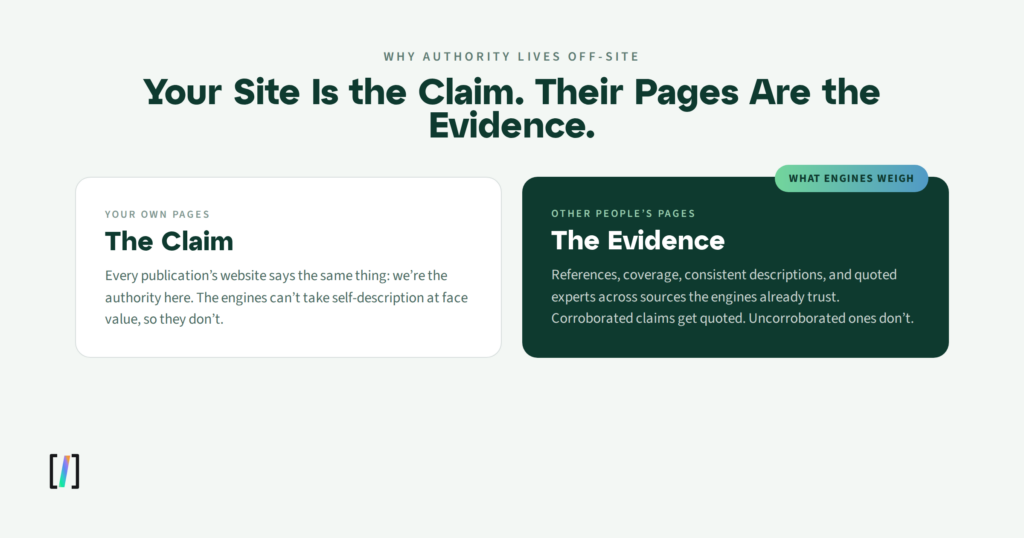
An engine assembling an answer has a trust problem. Every publication’s own website says the same thing: we’re the authority here. The engine can’t take that claim at face value, so it does what a careful editor does. It corroborates.
Your website is your claim. Everyone else’s pages are your evidence. When the outlets an engine already trusts reference your reporting, quote your people, link your data, and describe your publication consistently, the engine’s picture of you sharpens. When they don’t, your claim sits uncorroborated, and uncorroborated claims don’t get quoted to millions of people.
This is visible in the guidance the engines themselves publish. Google’s guidance on appearing in AI experiences keeps returning to consistency: information about who you are and what you cover should agree everywhere it appears. That’s a corroboration requirement wearing technical clothes.
You can watch corroboration operate in any answer that cites sources. Ask an engine a question on your beat and look at what it does: it rarely leans on a single page. It assembles two or three sources that agree, quotes the one that stated the finding most cleanly, and names the outlets whose descriptions of the topic match each other. Agreement among trusted pages is the machine’s version of a second source, and publications outside that web of agreement simply don’t make the answer.
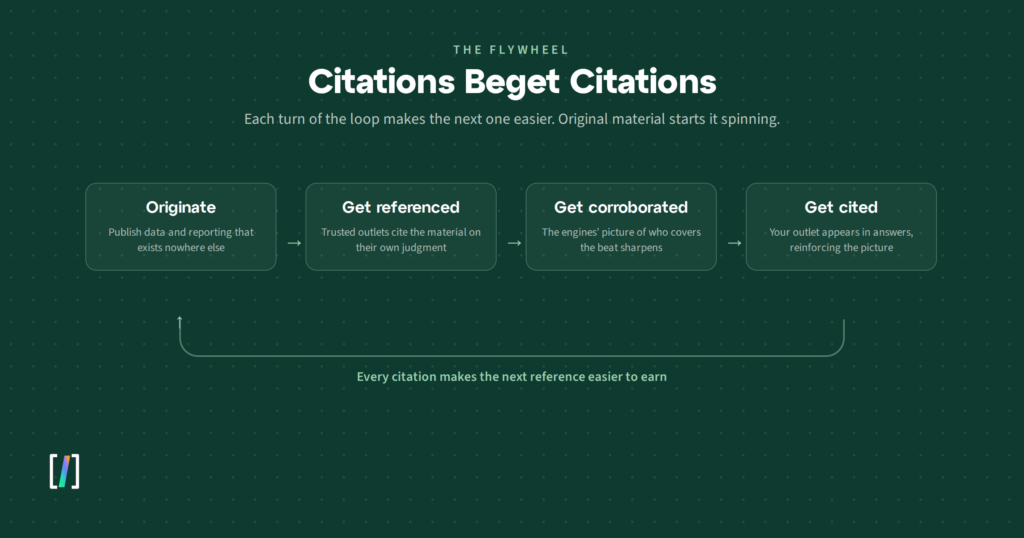
And corroboration compounds. Each citation an engine makes reinforces its own picture of who covers the beat, which makes the next citation more likely. The loop is the whole game: the work below exists to start it turning in your direction.
There’s an irony for publishers specifically, and it’s worth naming. For decades, your industry was the corroboration layer: a fact was considered established when outlets like yours reported it. The engines have kept that logic and widened the pool. Your publication is now both a corroborator and a claimant, judged by the same standard you spent a century applying to everyone else. The publications adapting fastest are the ones that noticed the role change and started building their own evidence file instead of assuming the masthead still speaks for itself.
The Four Channels of Earned Authority
Third-party evidence reaches the engines through four channels. Strong publications tend to be present in all four; publications stuck at name-only mentions are usually strong in one and absent in the rest.
- Coverage: being written about. When trusted outlets report on your publication, your findings, or your role in a story, they teach the engines what you are. This is the classic digital PR channel, and it works for publishers exactly as it works for brands: newsworthy actions earn coverage, and coverage earns standing.
- Reference: your work cited by peers. When other outlets link your data, quote your reporting, or build on your findings, they hand the engines the strongest possible signal: professionals who compete with you still treat your work as the record. Reference is earned by originating material worth referencing, which is why aggregation-heavy publications struggle here.
- Reputation surfaces: the places engines check. Directories, industry lists, review platforms, association memberships, and reference sites are where engines verify identity and standing. Boring, structural, and skipped constantly. A publication that’s inconsistent or absent across these surfaces makes itself hard to resolve, and engines don’t cite what they can’t resolve.
- Named expertise: people the engines can attribute. Engines increasingly attach trust to named authors and quoted experts, not just mastheads. Consistent bylines, author pages that establish beats and credentials, and journalists who get quoted elsewhere all build attributable expertise the engine can connect back to your publication.
Audit yourself against the four honestly. Most publications discover they’ve been investing in exactly one channel (usually coverage, occasionally reference) while the reputation surfaces sit inconsistent and the bylines stay generic. The engines read the whole picture.
The audit takes an afternoon. For coverage: when did a trusted outlet last write about your publication or its findings, rather than merely competing with it? For reference: can you name three pieces of your work that other outlets cited in the past year? For reputation surfaces: does your publication’s description agree across the top ten places it appears, and are you present in the directories and lists that define your vertical? For named expertise: do your key bylines have author pages that establish a beat, and have those people been quoted anywhere but your own site? Every no is a channel the engines are reading as silence.

Original Research Is the Flywheel
If the four channels share one input, it’s this: publish material that exists nowhere else. Original research (surveys, datasets, analyses, benchmarks drawn from your own reporting or your own numbers) is the single asset that feeds every channel at once.
A genuinely useful dataset earns coverage, because data is news. It earns reference, because peers and analysts need something to cite and yours is the source. It strengthens reputation surfaces, because being the publication behind a known study is exactly what industry lists and directories record. And it builds named expertise, because someone authored the study and gets quoted about it.
Two practical notes keep this honest. First, small and true beats big and vague: a focused survey of two hundred practitioners in your actual coverage area outperforms a sprawling report with soft methodology, because the outlets that would cite you have editors who check. Second, publish the methodology and the underlying numbers. Engines and editors both reward material they can verify, and the citation goes to the version of the finding that’s easiest to trust.
Publishers also start this race with an advantage most brands would pay for: the raw material already exists. Your archive is a dataset. Your reporting produces numbers, timelines, and records nobody else holds. Your audience is a survey panel with a genuine relationship to you. Turning any of these into a citable asset is an editing job, not a research budget, and the publications that treat their own accumulated work as source material tend to lap the ones commissioning studies from scratch.
Package the asset for citation, not just publication. Give the finding a stable permalink that won’t rot, a one-sentence plain-language version an editor can lift verbatim, charts that carry your publication’s name when they travel, and a clearly stated attribution line. Outlets cite the version that’s easiest to cite correctly, and engines inherit whatever attribution the citing pages used. Ten minutes of packaging decides who gets credit for a quarter of work.
Running the Motion Deliberately
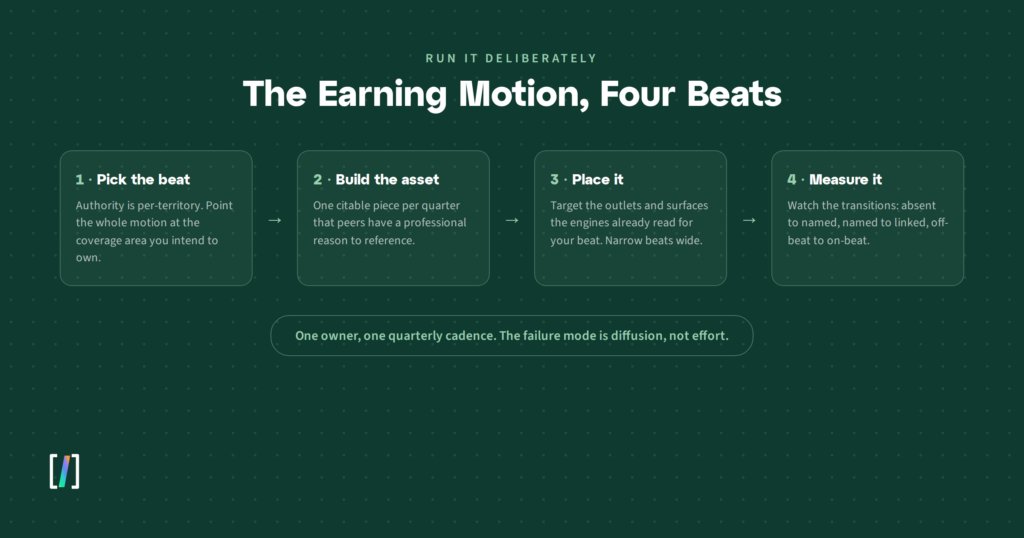
Left alone, earned authority accumulates at the speed of accident. Run deliberately, it’s a repeatable motion with four beats.
- Pick the beat you’re consolidating. Authority is per-territory. Choose the coverage area where you intend to own the citations and point the whole motion at it, rather than spreading effort across everything you publish.
- Build the citable asset. One piece of original material per quarter that your beat’s other outlets would have a professional reason to reference: a dataset, a benchmark, a definitive explainer with reporting behind it.
- Place it where the engines already look. Promotion isn’t spray; it’s targeting the specific outlets and reputation surfaces the engines lean on for your coverage area. That target list is readable from the citations themselves, which is what the coverage-area read is for.
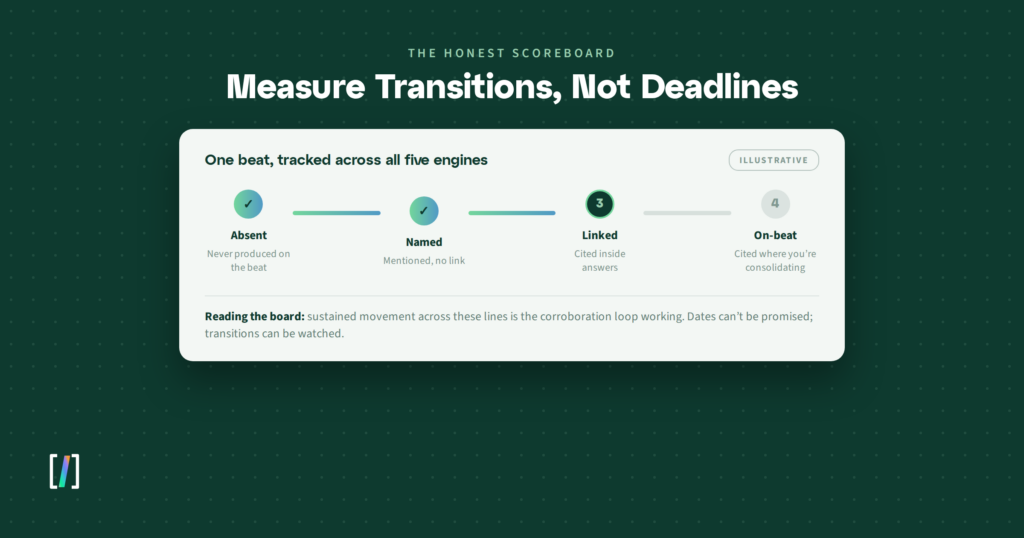
- Measure the movement. Re-run your visibility read on a rhythm and watch the transitions that matter: absent to named, named to linked, off-beat to on-beat. Those are the lines that tell you the loop has started turning.
The target list in the third beat comes straight from the data: our guide to AI citation sources covers how to read which publications and site types the engines lean on for any topic area. Earning references from those specific sources is worth more to your authority than coverage anywhere else, because they’re the pages the engines are already reading.
Give the motion an owner and a cadence, or it dissolves back into accident. One person accountable for the quarterly asset, the target list, and the measurement rhythm is enough; the failure mode isn’t effort, it’s diffusion, where everyone agrees authority matters and nobody owns the ledger. A quarterly beat is sustainable for most newsrooms and fast enough to show transitions within two or three cycles.
Resist the volume instinct on the target list. Ten references from the outlets that actually carry your vertical’s citations outweigh a hundred from outlets the engines never read, and the concentrated version is usually cheaper to earn, because those ten outlets have a professional appetite for exactly the original material you’re producing. The narrow list is the efficient list.
The Shortcuts That Backfire
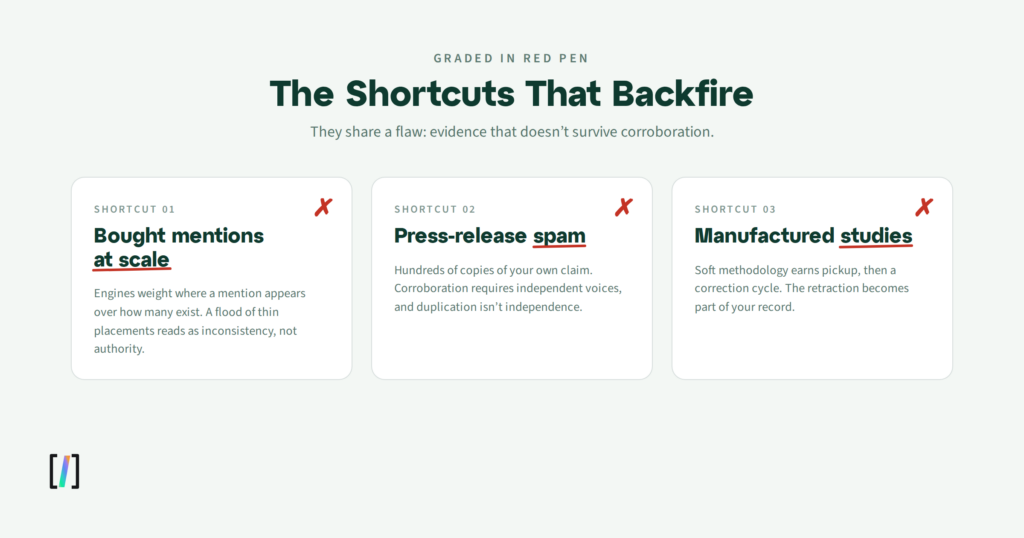
Because the mechanics above are slow, a market of shortcuts has formed around them, and the shortcuts share a flaw: they produce evidence that doesn’t survive corroboration.
- Bought mentions at scale. Bulk placements on low-trust sites don’t move engines that weight where a mention appears over how many exist. Worse, a sudden flood of thin mentions sits inconsistently against your real footprint.
- Press-release spam. Syndicating the same announcement across hundreds of outlets creates hundreds of copies of your own claim. Corroboration requires independent voices, and duplication isn’t independence.
- Manufactured studies. Data with soft or hidden methodology earns a first wave of pickup and then a correction cycle, and the correction becomes part of your record. Engines corroborate; retracted findings corrode the exact trust you were trying to build.
One gray zone deserves a fair reading: contributed articles and expert commentary. Done as expertise (your editor or reporter contributing genuine analysis to a relevant trade outlet, under their real byline, on their actual beat) it builds the named-expertise channel legitimately. Done as link laundering (generic articles placed anywhere that will take them, optimized for the backlink) it collapses into the bought-mentions problem. The test is whether the placement would be worth doing if no engine ever read it.
None of this means promotion is dirty. It means the engines are structurally biased toward evidence that independent, trusted sources produced on their own judgment. The motion in the previous section is how you give them a professional reason to produce it. What no one can honestly sell you is a date when the loop starts turning; direction is knowable, timelines are not.
Frequently Asked Questions
What is AI brand authority?
AI brand authority is the third-party evidence that leads AI engines to treat a brand or publication as a source worth citing: references from trusted outlets, corroborating coverage, consistent reputation signals, and named expertise the engines can attribute. Unlike domain authority in traditional search, it isn’t a published score; it’s observable only in outcomes, as the mentions and citations a brand earns across ChatGPT, Gemini, Perplexity, Copilot, and Google AI Overviews. The working test is simple: when the engines answer questions on your beat, are you in the answer?
How does AI decide which brands are authoritative?
By corroboration. Engines weigh what the sources they already trust say about a brand: whether those sources reference its work, describe it consistently, and treat it as the record on its topic. Signals include citations from established publications, presence and consistency across directories and review platforms, original material other outlets build on, and named experts the engine can connect to the brand. No one outside the AI labs knows the exact weighting, but the direction is consistent: independent evidence beats self-description everywhere it’s been observed.
Does digital PR help with AI visibility?
Yes, when it earns coverage in the sources the engines actually lean on for your topic area. Digital PR that lands references in trusted, relevant outlets feeds the corroboration engines run on, and it’s one of the four channels authority flows through. Digital PR that optimizes for placement counts on low-trust sites doesn’t, because engines weight where evidence appears over how much exists. The difference between the two is targeting, and the citation data for your coverage area tells you exactly which outlets are worth earning.
How long does it take to build AI brand authority?
Longer than a campaign and shorter than a reputation used to take, and no one can honestly give you a date. Engines re-read the web continuously, so new evidence gets absorbed on an ongoing basis, but the corroboration loop needs multiple independent signals before citations follow. The honest way to manage the timeline is to measure transitions rather than deadlines: track when your brand moves from absent to named and from named to linked in the engines’ answers, and treat sustained movement across those lines as the loop working.
Evidence Is a Body of Work
The outlets on your beat’s cast list didn’t get there by describing themselves well. They got there because other pages, written by other people, kept agreeing that they were the source, until the engines had no reason to conclude anything else.
That’s buildable. Pick the beat, originate the material worth citing, place it in front of the sources the engines already read, and measure the movement. The loop turns slowly at first and then it compounds, and every publication currently being quoted started with the same empty ledger.
It’s also defensible in a way rankings never were. A competitor can outspend your ad budget and out-optimize your pages, but a body of corroborated work, referenced by the outlets your beat trusts and attributed to people the engines recognize, has to be earned at the same speed by anyone who wants to take it from you. Authority built this way is slow to gain and slow to lose, which is exactly what makes it worth the quarters.
When you’re ready to see your starting position and watch the transitions, our platform tracks where your brand stands across all five engines: where you’re cited, where you’re named without a link, and which sources are doing the corroborating in your coverage area.
Related Articles

The newest reader of your coverage never visits your homepage, never sees your paywall, and never clicks your headlines. It…
