
How to See Which Sources AI Trusts in Your Coverage Area

The newest reader of your coverage never visits your homepage, never sees your paywall, and never clicks your headlines. It reads everything you publish, weighs it against everything your competitors publish, and then decides whose reporting to quote when a real person asks a question on your beat.
That reader is an AI engine, and in every vertical it works from a short list. Your outlet is either on it or it isn’t.
A source AI trusts is a publication that AI engines repeatedly cite or quote when answering questions in a topic area. Trust here is observable rather than declared: it shows up as citations, where an engine links to your page inside an answer, and as mentions, where your outlet is named without a link, across ChatGPT, Gemini, Perplexity, Copilot, and Google AI Overviews. Learning how to get cited by AI search engines starts with seeing which outlets currently hold those citations in your coverage area, and understanding why the engines keep going back to them.
This post covers how the engines pick their sources, how to see exactly who owns the citations on your beat, what the gap between your outlet and the incumbents actually looks like, and the work that closes it.
Your Coverage Has a New Reader
The questions your audience used to type into a search box are increasingly asked as full sentences to an assistant. Google reports that AI Overviews alone reach 2.5 billion people a month, with AI Mode past a billion. Those answers are assembled from sources, and the engines are not shy about which ones: many responses carry visible citations, quotes, and outlet names.
For a publisher, this changes what distribution means. The answer box has become a front page you don’t control, and a small cast of outlets gets quoted on it while everyone else sits in the audience. The uncomfortable part is that the cast list for your coverage area already exists. The useful part is that you can read it.
It also changes the relationship. When a reader found you through search, they arrived at your page and you owned the encounter. When an engine answers with your reporting, the encounter happens inside the answer, on the engine’s terms, whether or not the reader ever clicks through. The engines have quietly taken on an editorial role: for millions of questions a day, they decide whose version of the facts gets read aloud. Treating that decision as unknowable is a choice, and the outlets on the short list didn’t make it.

How Engines Choose Their Sources
Two mechanisms feed an AI answer. The first is training data: what the model absorbed about your vertical, your outlet, and your competitors before anyone asked anything. The second is live retrieval: when a question calls for current information, the engine searches the web, reads a handful of pages, and builds its answer from what it finds.
Nobody outside the AI labs knows the exact weighting, and anyone who claims to is selling certainty they don’t have. But the recurring patterns are consistent enough to act on, and Google’s own guidance on appearing in AI experiences points the same direction: content that answers the question directly, pages structured so a machine can lift the relevant passage cleanly, and publications whose identity and subject matter are unambiguous across the web.
Add one more pattern the guidance understates: originality. Engines cite the outlet that produced the number, the document, or the on-the-ground reporting. Aggregation gets absorbed; origination gets attributed. If your coverage is a rewrite of someone else’s reporting, the citation goes to the someone else.
And resist the urge to check one engine and generalize. The five behave differently: they retrieve from different indexes, weight sources on different rhythms, and update at different speeds. An outlet can be a fixture in Perplexity’s citations and invisible to Copilot, or carry Google AI Overviews on the strength of its search standing while ChatGPT quotes a competitor. A single-engine check tells you about that engine. The coverage-area read only means something across all five.

How to See Who Owns the Citations on Your Beat
The read itself is simple. Take the questions your audience actually asks in your coverage area: not “best local news site” but the real questions your reporting answers, from “what do the new short-term rental rules mean for homeowners” to “which heat pump brands hold up in cold climates.” Ask them across all five engines. Record which outlets get cited, which get named without a link, and which never appear.
Do this across enough questions and the cast list emerges. Every coverage area has one: a handful of outlets the engines return to again and again, a longer tail of names that surface occasionally, and a large population of publications the engines never quote at all.
A few mechanics keep the read honest. Use clean sessions with no history, because engines personalize and yesterday’s conversation bleeds into today’s answer. Ask each question the way a reader would phrase it, in a few variants, because small wording changes swing which sources get pulled. And repeat the exercise over weeks rather than treating one afternoon as the truth: answers vary run to run, and the outlets that persist across variance are the ones the engines actually trust rather than the ones that got lucky in a single response.
Record three things per answer: which outlets were cited with a link, which were named without one, and which site types the citations clustered in. Skip the decimal places. On a sample of thirty questions, “the trade press owns this beat and we appear twice” is a finding; “we hold 6.7% of citations” is false precision.
You can run this by hand, or you can read it from a Sources view that aggregates it: which publications and site types earn citations for a topic area, across engines, over many questions. The full walkthrough of that data set lives in our guide to AI citation sources. That post reads the data from the brand side, asking where a business should seek placements. You’re reading the same map from the other direction: the placements are your pages.
Pay attention to site types, not just names. In some verticals the engines lean on trade publications; in others, review platforms, reference sites, or local news carry the citations. Knowing which type owns your beat tells you which game you’re actually in.

The Gap Read: Three Patterns and What Each One Means
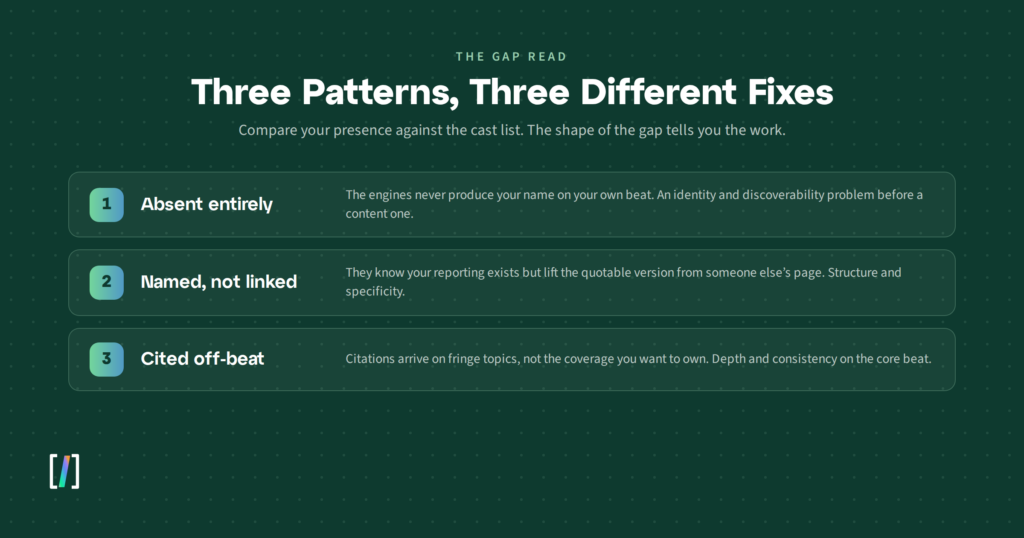
Once you can see the cast list, compare it against your own presence. The gap usually takes one of three shapes, and they call for different work.
- Absent entirely. The engines never produce your outlet’s name on your own beat. This is usually a discoverability and identity problem before it’s a content problem: the engines haven’t built a stable picture of who you are and what you cover.
- Named but not linked. Your outlet appears as a mention while the linked citations go elsewhere. The engines know your reporting exists but lift the quotable version from someone else’s page. This is most often a structure and specificity gap.
- Cited off-beat. You earn citations, but on fringe topics rather than the coverage you want to own. The engines have you filed under the wrong subject. This is a depth and consistency gap on the core beat.
The linked-versus-named distinction matters more than it looks. A linked citation can carry a reader to your page; a name-only mention builds presence without a path. The mechanics of that split are covered in our post on the citation footprint, and it’s worth tracking both numbers separately for your outlet.
If more than one pattern applies, work them in the order listed. Identity problems undercut everything downstream, so resolve who you are before optimizing what you publish. Structure gaps pay back fastest once identity is settled, because the reporting already exists and only the packaging is losing the citation. Beat consolidation is the slowest lever and the most durable one.
How to Become One of the Sources
Engines don’t cite the loudest outlet on a beat. They cite the one that made the fact easy to trust. The work below is how publications earn that position, and none of it is exotic. It’s the craft you already practice, aimed at a reader that parses instead of skims.
- Originate, don’t just cover. Publish the numbers, documents, datasets, and firsthand reporting that don’t exist anywhere else. Original material is the strongest recurring predictor of citation, because the engine has no one else to attribute it to.
- Make your identity unambiguous. Your outlet’s name, coverage area, authors, and expertise should read consistently on your own site and everywhere else you appear. Engines cite entities they can resolve with confidence.
- Structure for the lift. Answer-first ledes, headlines that state the finding, clean subheads, and passages that stand alone when extracted. If a machine has to reconstruct your point from six paragraphs, it will quote the outlet that stated it in one.
- Go deep on a defined beat. A publication that covers one territory thoroughly gets filed under that territory. Breadth spreads the signal thin; the cast list rewards outlets the engines can categorize.
- Be present where the engines already look. Citations beget citations. When outlets the engines already trust reference your reporting, link your data, or quote your coverage, they corroborate your standing on the beat. Your presence across the rest of the cast list is part of how you join it.
One honesty note, because publishers get pitched a lot of certainty on this subject: the read can tell you which gap is yours, and the work above points at each one. A timeline for when the citations arrive is not something anyone can credibly sell you. Direction is knowable. Dates are not.
What you can hold yourself to is the rhythm. Re-run the coverage-area read on a schedule (monthly is plenty; the engines don’t re-file a publication overnight) and watch three lines: whether your outlet moves from absent to named, from named to linked, and whether the citations arrive on the beat you’re consolidating rather than the fringe. Those transitions are the honest scoreboard for this work. If the lines aren’t moving after two or three quarters of the right effort, the read itself will usually show you why, because the outlets that are moving leave a visible trail of what the engines rewarded.

What a Citation Is Actually Worth
Be clear-eyed about the payoff, because it has changed shape. Ahrefs measured a 58% drop in clicks to the top organic result when an AI Overview sits above it, and referral traffic from AI answers is real but modest for most publications. If you value citations purely as a click source, you’ll be disappointed.
The value is broader than the click. Being the outlet an engine quotes is presence at the exact moment your audience asks a question, in the surface where a growing share of them now ask it. It compounds: cited outlets keep getting cited, because each citation reinforces the engine’s picture of who covers the beat. And it is becoming a business asset in its own right, as licensing and content-partnership conversations increasingly start with the question of whose material the engines already lean on.
There’s an advertiser dimension too. A publication that can show it’s the source AI engines quote on its beat is demonstrating exactly the authority that sponsors and partners pay for, with third-party evidence no media kit claim can match. The citation record is becoming part of how an outlet proves it owns its territory.
The audience is migrating to the answer box. The publications that get quoted there keep their seat in the story. That, more than the referral line in your analytics, is what the citation buys.
Frequently Asked Questions
What sources does AI cite?
AI engines most often cite established publications, trade and industry sites, review platforms, reference pages, and well-structured local and niche outlets, and the mix varies sharply by vertical. In one coverage area the citations concentrate in trade press; in another, review platforms or government and reference sources dominate. There is no universal list. The practical answer for any publisher is to run your beat’s real questions across ChatGPT, Gemini, Perplexity, Copilot, and Google AI Overviews and record who actually gets cited, because your vertical’s cast list is an observable fact, not a guess.
How do I get cited by ChatGPT?
Publish original, attributable material on a clearly defined beat, structure it so the key finding can be lifted in one clean passage, and keep your outlet’s identity consistent everywhere it appears. ChatGPT draws on training data plus live retrieval, so both your historical body of work and your current pages matter. Start by checking where you stand today: ask it the questions your coverage answers and note whether you’re cited, named, or absent. The same check across the other four engines usually reveals that each one treats your outlet differently, which tells you where the nearest ground is.
Why isn’t my site cited by AI?
Usually one of three reasons: the engines can’t resolve who you are and what you cover, your pages don’t offer a passage clean enough to lift, or your coverage restates reporting that originated elsewhere, so the citation flows to the originator. Occasionally it’s simpler: your strongest work sits behind structures engines struggle to read. Diagnosing which reason applies is exactly what the coverage-area read is for, and the fix differs enough by cause that guessing wastes quarters.

Do AI citations send traffic?
Some, and less than a top ranking used to. Linked citations do send referrals, and for specific question-shaped queries they can be meaningful, but the larger value is presence: being the quoted source in the surface where your audience increasingly asks its questions, and building the compounding trust that keeps your outlet on the engines’ short list. Publishers who measure citations only in sessions undercount what they’re earning.
The Short List Is Still Being Written
Every coverage area’s cast list is older than it looks in one sense (the engines lean on outlets with years of consistent work behind them) and younger than it looks in another: these systems re-read the web constantly, and beats change hands.
Specificity is the smaller publication’s edge here. National outlets rarely own the citations on a local zoning fight or a niche trade question; the engine wants the source closest to the facts. If your coverage area is genuinely yours, the short list has a seat with your name on it, held by whoever does the work first.
The publications that will own the citations in three years are doing the unglamorous work now. Seeing the list is the first move. Getting on it is a body of work, and it starts with knowing exactly which gap is yours.
When you want the read at full resolution, our platform maps which sources the engines cite in your coverage area, across all five engines, question by question: where you appear, where you’re named without a link, and which outlets currently hold the beat.
Related Articles
On September 15, 2026, Cloudflare flipped a default that touches a large slice of the web. Training and Agent crawlers…

Every year or so a new file shows up at the root of publisher sites, and this cycle’s file is…
Every few weeks another headline lands: a publisher sues an AI company, an AI company calls the claim meritless, and…