
What AI Copyright Lawsuits Are Really Fighting Over

Every few weeks another headline lands: a publisher sues an AI company, an AI company calls the claim meritless, and everyone argues about fair use. If you run a publication, it is tempting to read these stories as a referendum on whether AI training is legal. That is not what the courts are deciding, at least not first.
AI copyright lawsuits look like fights over infringement. They are fights over evidence.
Strip away the press releases and each case turns on the same three questions. Was a specific work copied? Did it show up in a specific output? Did that use take money out of the publisher’s pocket? Every one of those questions is answered with records. And the awkward truth, on both sides of the caption, is that the records mostly do not exist. Nobody installed a system to write them down.
This post walks through what the major cases have revealed about that evidence problem, what a public company’s own filings say it costs to litigate without receipts, and why licensing deals and lawsuits are two readings of the same gauge. It ends with what a publisher can do about it before the next crawl.
What AI copyright lawsuits are really about
AI copyright lawsuits are legal disputes over whether copying works to build or run a generative AI system infringes the owner’s rights, and whether that copying is excused as fair use. Under U.S. law, the plaintiff has to establish two things: that it owns a valid copyright, and that the defendant copied protectable elements of the work. If copying is shown, the defendant carries the burden of proving fair use, which turns on four statutory factors, with the effect on the market for the original work treated as the most important. Because every one of those elements is a question of fact, the outcome of an AI copyright lawsuit depends less on what the law says than on what each side can prove about what was copied, where it appeared, and what it cost.
That framing comes straight from the primary sources. The Congressional Research Service’s legal sidebar on generative AI and copyright lays out the two-part infringement test and notes that access, one of the ways copying gets proven, can be shown by evidence that a work was in the training data. The U.S. Copyright Office’s Part 3 report on generative AI training makes the same point from the other direction: use of a work in preparing a model is not enough on its own, there has to be evidence of substantial similarity in what comes out.
Read those two sentences again as a publisher. Both sides need proof of what went in and what came out. Neither side built the meter.
Why the fight moves to discovery
In a normal copyright case, the evidence is the work itself. Someone published a book, a song, a photo, and the copy can be set next to the original. AI training breaks that shortcut. The copying happened inside a data pipeline nobody outside the company can see, the outputs are generated on demand for millions of users, and the model itself is a list of numbers that does not look like anything.
So the case shifts into discovery, the phase where each side demands the other’s records. What was in the training set? Which version? When was it downloaded, from where, and was it kept? Can the output logs be searched for a specific article? Were the logs preserved once the lawsuit was filed?
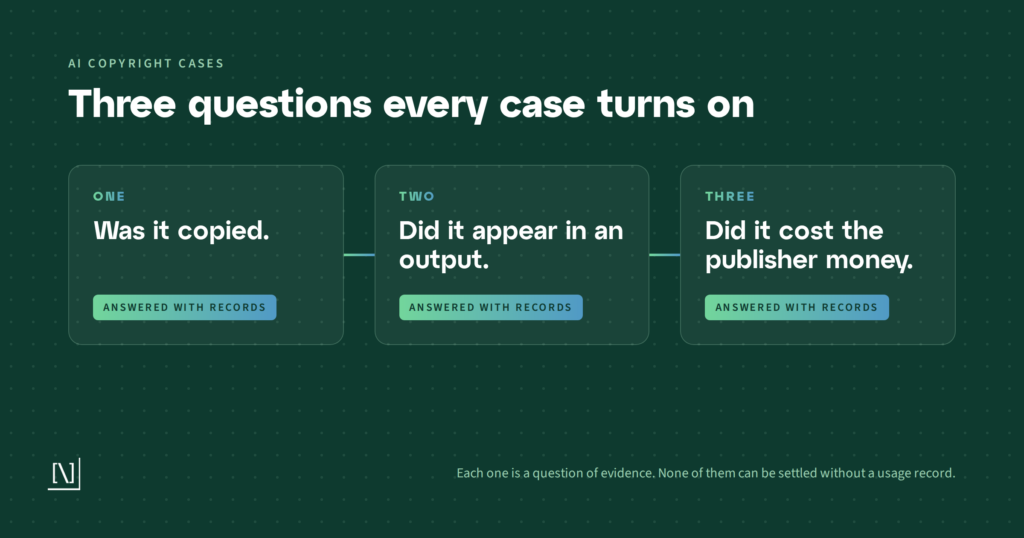
Those questions are not legal arguments. They are audit requests. And an audit request made of a system that was never designed to be audited produces exactly what you would expect: partial exports, disputes over what is feasible, and motions about the motions.
This is where your journalism has been living. In an AI answer, your reporting is scenery, the set the answer stands in front of, present in every frame and credited in none. Discovery is what happens when the scenery is asked to prove it was in the room.
The cash register that was never installed
Picture a shop that opened without a register. Customers came in for years and took what they needed, some paid on the honor system, some did not, and nobody wrote any of it down. One day the owner and a regular end up in front of a judge. The owner says the regular took thousands of items. The regular says it was a handful and most of them were free samples. The judge asks for the receipts. There are no receipts, because there was never a register. So the court spends two years and both parties’ money reconstructing, from delivery invoices and security footage and the memory of clerks, what a receipt would have said. That reconstruction is discovery, and it is expensive precisely because it is a substitute for a record that should have been created at the moment of the transaction.
What the newspaper case shows about missing records
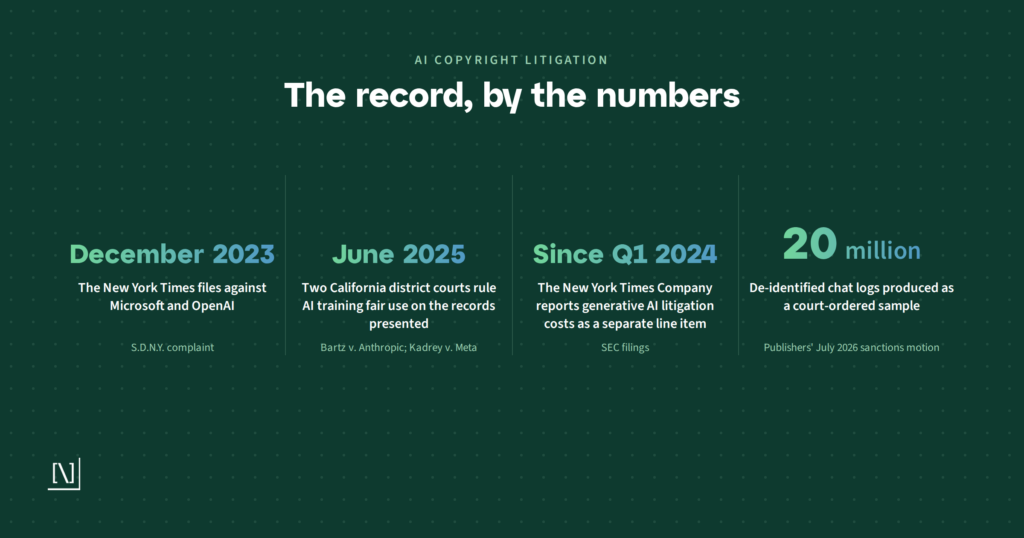
The most watched case is the one The New York Times filed against Microsoft and OpenAI in the Southern District of New York in December 2023. Other news organizations, including the Daily News and the Center for Investigative Reporting, were later consolidated into it. The claims are direct and contributory infringement, and the defendants argue that training on publicly available material is transformative fair use and that facts are not copyrightable.
What the docket shows is a long fight over records. Per coverage of the publishers’ July 2026 sanctions motion, the plaintiffs told the court that for more than two years the defendant said it could not feasibly search its training datasets or its output logs for their articles, and that a later deposition showed it had built tools capable of doing exactly that. The same motion alleges that a court-ordered sample of 20 million de-identified chatbot conversations arrived with so many redactions that, in the motion’s account, the court itself called it unusable, and that some logs were deleted after a preservation order was in place.
The defendant disputes all of it. In its response, described in the same reporting and elsewhere, it says it followed the preservation order, turned over its training data and tens of millions of outputs, and that the publishers are seeking sanctions because they lack evidence that the chatbot systematically reproduces their work.
Neither of those positions has been ruled on. What matters for this post is what both sides agree on: the question of whether copying occurred, and how much, is being settled by reconstructing usage records. The plaintiffs want the logs because the logs are the receipt. The defendant argues about the burden of producing them because producing them means building, after the fact, the accounting system that was never there.
As of early September, per Axios’s summary of the summary-judgment filings, all three parties have submitted their arguments, the Justice Department has filed a brief supporting the defendants’ fair use position, and the judge is expected to decide in the coming months whether the case, or parts of it, goes to trial. The Times argues that two California rulings the defendants rely on are distinguishable because those plaintiffs failed to show outputs competed with their work. Which brings us to the other side of the ledger.
What the authors’ case shows about the other side of the ledger
In June 2025, a federal judge in California granted summary judgment to Meta on fair use in a case brought by thirteen authors over the use of their books to train the Llama models. The order in Kadrey v. Meta is worth reading in full, because the judge went out of his way to say the ruling was not a finding that the training was lawful in general. It was a finding that these plaintiffs did not put the right evidence in front of him.
The court laid out three theories of market harm a plaintiff might bring. That the model regurgitates the works. That the copying destroyed a market for licensing the works as training data. Or that the model can flood the market with competing works, which the court called market dilution and described as the potentially winning argument. The authors led with the first two, which the court rejected on the record, and barely mentioned the third. They presented no evidence of how the model’s outputs would dilute the market for their books. Meta presented expert testimony that sales had not moved. Speculation, the court wrote, cannot defeat summary judgment.
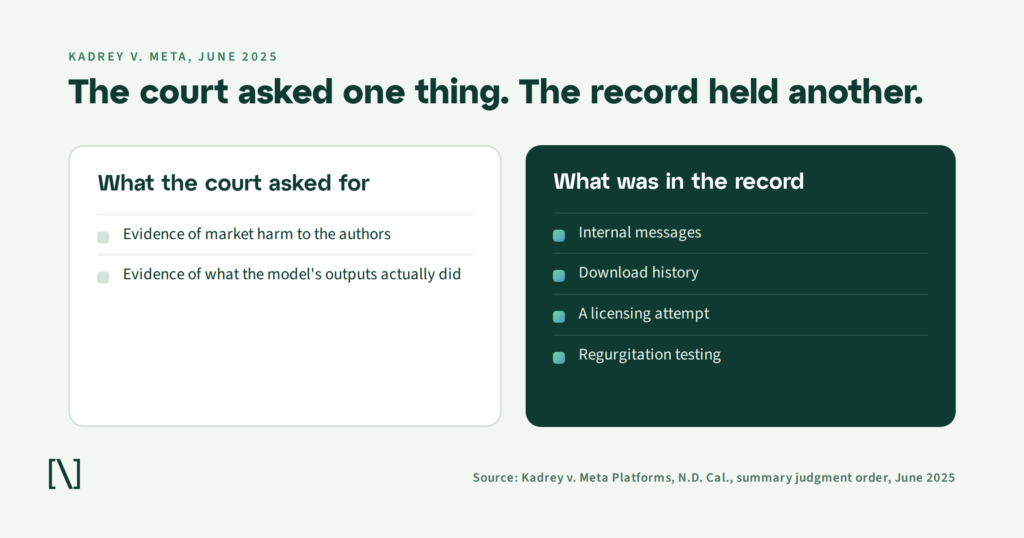
Notice what the court did have. It had the defendant’s internal messages about needing books. It had the download history from the shadow libraries, including the count of at least 666 copies of the plaintiffs’ books. It had the defendant’s failed attempt to license those books, which stalled in part because publishers generally do not hold AI training rights for the titles they publish and no collective licensing body existed to clear them. And it had expert testing on both sides showing the model would not reproduce more than a short passage of any plaintiff’s book even under adversarial prompting.
Every one of those facts is a receipt. The ones the defendant kept, on ingestion, decided the input question. The ones nobody kept, on what the outputs did to the market, decided the case.
Deals and lawsuits are the same market signal
It is easy to sort publishers into two camps: the ones who sued and the ones who signed. That sorting misreads the market.
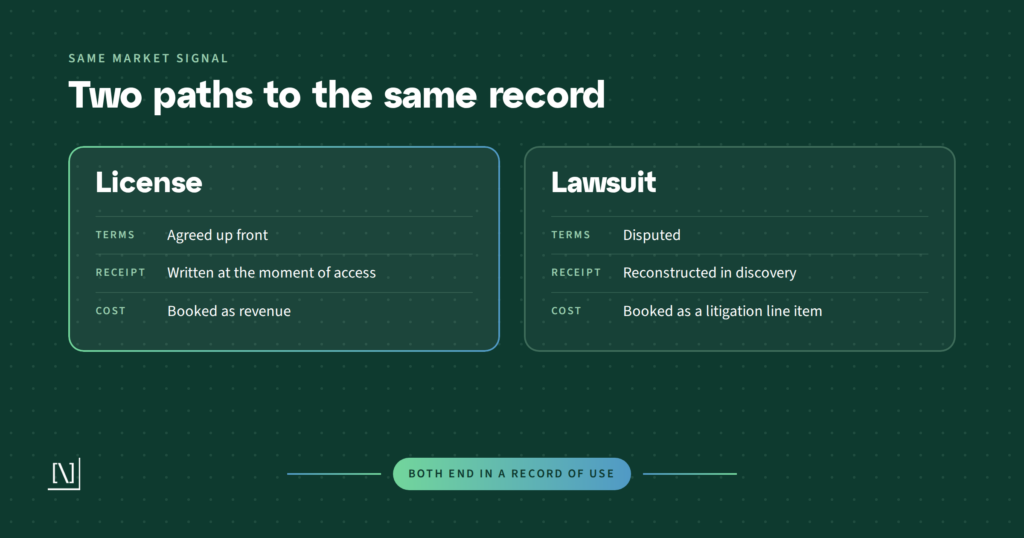
The Times sued one set of AI companies and, in 2025, signed a licensing agreement with another. The Copyright Office’s Part 3 report catalogs a growing set of voluntary licenses between rightsholders and developers, recommends letting that licensing market keep developing without government intervention for now, and flags that retrieval-augmented uses, where a system pulls a live article into an answer, are a particular concern for news media. The Kadrey court, for its part, said flatly that if books are as useful for training as developers say, developers will figure out how to pay for them, and predicted publishers would soon start negotiating the rights they need to license at scale.
A deal and a lawsuit are two answers to the same question: what is a specific use of a specific work worth, and who has the records to say so? A licensed article stops being scenery because the license is the record. Where no license exists, the lawsuit tries to build the record backward. Either way, the thing being priced is the same, and the thing missing in the lawsuit is the thing the deal creates by default.
What the cost of litigation tells publishers
Here is the part that should get a publisher’s attention, and it comes from a securities filing rather than a press release.
The New York Times Company reports its generative AI litigation spending as a separate special item in its quarterly results, and has since the first quarter of 2024. The second-quarter 2026 earnings release filed with the SEC shows the line for the quarter, for the first six months of the year, and for the comparable periods a year earlier, with management’s note that these costs arise from discrete and unusual proceedings and are excluded from adjusted operating profit for that reason. The exact figures are in the filing. What matters here is the shape: a recurring, growing, separately disclosed cost, quarter after quarter, for a case that has not yet reached trial.
That is what it costs to build a receipt in a courtroom. It is the price of the register that was never installed, paid by the one party in the market with the balance sheet to pay it. Most publishers cannot carry a line item like that. Which is why the lesson of the case is not “sue.” The lesson is that whoever holds the usage records controls the negotiation, and right now that is not the publisher.
What publishers can do now
You cannot retroactively log what has already been crawled. You can change what the next crawl leaves behind. Four steps, in order.
First, inventory your rights. The Kadrey order is explicit that licensing talks stalled partly because the party at the table did not hold the AI training rights to the works. Before you can license, block, or sue, you need to know which of your content you control for machine use, per piece, not per site. Our guide to what a rights-managed content object is covers the four parts that need to travel with each piece.
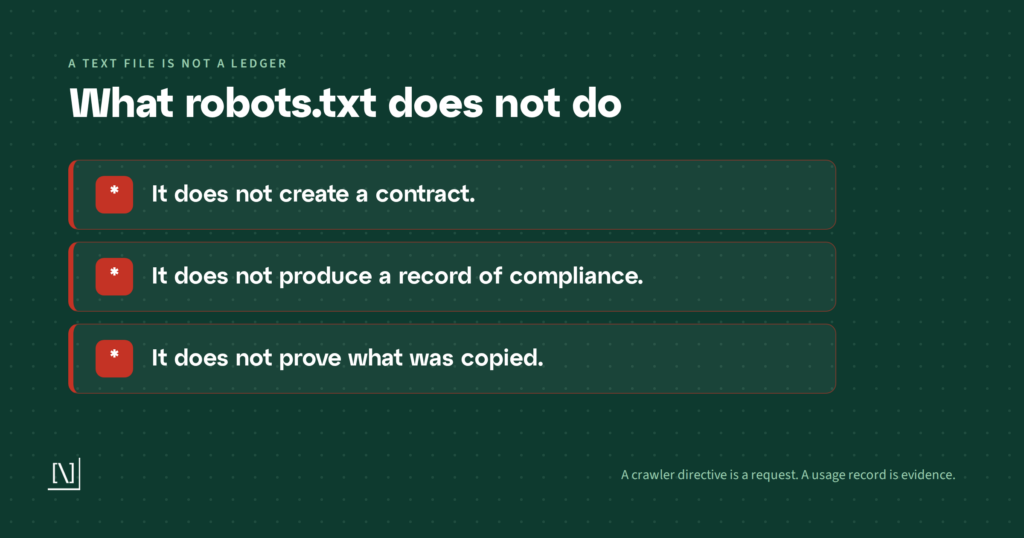
Second, state terms where machines can read them. A robots.txt disallow is a preference, not a contract, and it produces no record of compliance. Per-piece policy, expressed in a machine-readable standard, is what turns “you should not have” into “here is what you agreed to.” That is the difference between a claim and a term.
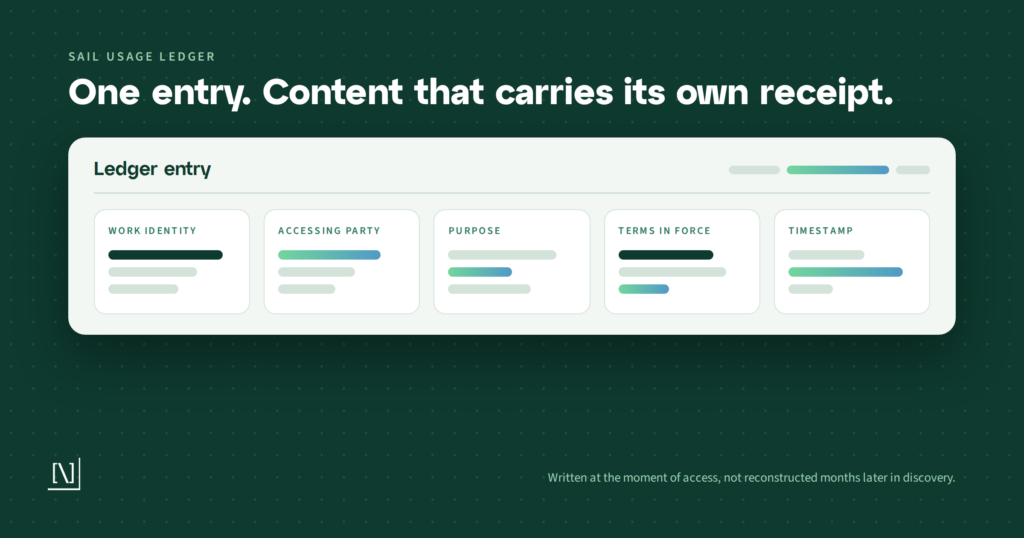
Third, demand a receipt for every access. This is the piece the lawsuits are reconstructing at enormous cost. A usage record, written at the moment of access, identifying the work, the accessing party, the purpose, and the terms in force, is the evidence both sides in every case above went to court to find. If your content carries its own ledger, the discovery fight is already over. The AI content payment gap post explains why that ledger layer is the one still missing from the stack.
Fourth, measure your exposure before you price it. You cannot negotiate a license for use you cannot see. Knowing which of your pages appear in answers across ChatGPT, Gemini, Perplexity, Copilot, and Google AI Overviews, and how often, is the starting point for any conversation about what that use is worth.
Where SAIL fits
Next Net built SAIL, the Standardized Agentic Intelligence Ledger, to be the register. It is a transaction and receipt layer for AI content rights: each piece of content carries its identity, its policy, and its terms, and every agentic access against it writes a record that both the publisher and the AI system can see. The point is not to pick a side in the litigation. The point is to make the litigation unnecessary by creating, at the moment of use, the evidence the courts are currently paying to reconstruct.
For publishers, that means three things. Terms enforced per piece rather than per site. A usage record that exists whether or not a deal is in place, so the deal conversation starts from data. And a cost basis for AI use that shows up as a line of revenue, not a line of litigation expense. You can see how the pieces fit on the SAIL for publishers page.
Frequently asked questions
Is there a copyright case against AI?
Yes, there are dozens. The Copyright Office’s Part 3 report describes dozens of pending U.S. lawsuits centered on fair use, brought by news publishers, book authors, music companies, and visual artists. The most prominent publisher case is the one The New York Times and other news organizations are pursuing against Microsoft and OpenAI in New York, where summary-judgment arguments were completed in September 2026 and a ruling is pending.
Has any court ruled that AI training is fair use?
Two federal district courts in California ruled in June 2025 that training on copyrighted books was fair use on the records before them, in Bartz v. Anthropic and Kadrey v. Meta. The Kadrey judge stressed the ruling turned on the plaintiffs’ failure to present evidence of market harm, and a separate February 2025 ruling in Delaware found a non-generative legal research tool’s copying was not fair use. District court rulings bind only the parties, and no appellate court has settled the question.
What is discovery in an AI copyright lawsuit?
Discovery is the pretrial phase where each side is required to hand over relevant documents and data, and it is where AI copyright cases are being decided in practice. Requests typically cover training datasets, download and ingestion records, internal communications about data sourcing, and searchable output logs. Disputes over what can feasibly be produced, and whether logs were preserved, have generated some of the most consequential motions in the New York case.
Why do AI companies sign licensing deals if they believe training is fair use?
Because a license creates certainty and a record that a fair use defense does not. The Copyright Office’s report documents a growing voluntary licensing market alongside the lawsuits, and the Kadrey court noted that where copying is not fair use the practical consequence is paying for a license rather than stopping. For a publisher, a deal and a suit are two ways of establishing what a use is worth.
What can a small publisher do if it cannot afford to sue?
Make your content carry its own evidence. Inventory the rights you hold for machine use, express your terms per piece in a machine-readable form, and adopt a system that writes a usage record at the moment of access. The publishers in the cases above are spending on discovery to reconstruct those records. A publisher whose content generates them by default does not need to.
The bottom line
The AI copyright cases will eventually produce rulings on fair use, and those rulings will matter. But the story they are already telling is about something more basic. Publishers went to court to find out how their work was used, and found the records did not exist. AI companies went to court to defend how they used the work, and found they had to build accounting systems on the witness stand. Both sides are paying for the absence of a receipt.
Your journalism does not have to stay scenery. It can carry its own call sheet. Set the terms, keep the ledger, and let the next negotiation start from what the record shows rather than from what a court has to reconstruct. If you want to see what that looks like for your catalog, start with the SAIL for publishers page.
Related Articles
On September 15, 2026, Cloudflare flipped a default that touches a large slice of the web. Training and Agent crawlers…

Every year or so a new file shows up at the root of publisher sites, and this cycle’s file is…
Ask a publisher whether AI is using their content and the answer is almost always yes. Ask them how, and…