
How to Run a Client’s AI Visibility Audit in an Afternoon

A client forwards you a screenshot. They asked ChatGPT which provider to use in their category, and a competitor came back first.
Now they want to know what you plan to do about it.
You could open a tool and start clicking. Plenty of people do, and four hours later they have thirty screenshots, no through line, and nothing the client can sign off on. The fix is not more time. It is a fixed shape you can run the same way on every account.
An AI visibility audit is a structured read of how AI engines describe one business when buyers ask category questions: whether ChatGPT, Gemini, Perplexity, Copilot, and Google AI Overviews name the brand at all, whether they recommend it, who they name instead, and which pages they pull from to build the answer. It runs against a defined question set and a defined competitor set, which is what makes it repeatable across a book of accounts instead of a one-off exercise.
What follows is the execution workflow: what to pull, in what order, and how to turn it into a document by end of day. Using the finished audit to win the account is a separate motion, covered in the report-led pitch post. What you do about the findings once the client says yes is covered in the productized service post.
What This Audit Answers That a Technical Audit Does Not
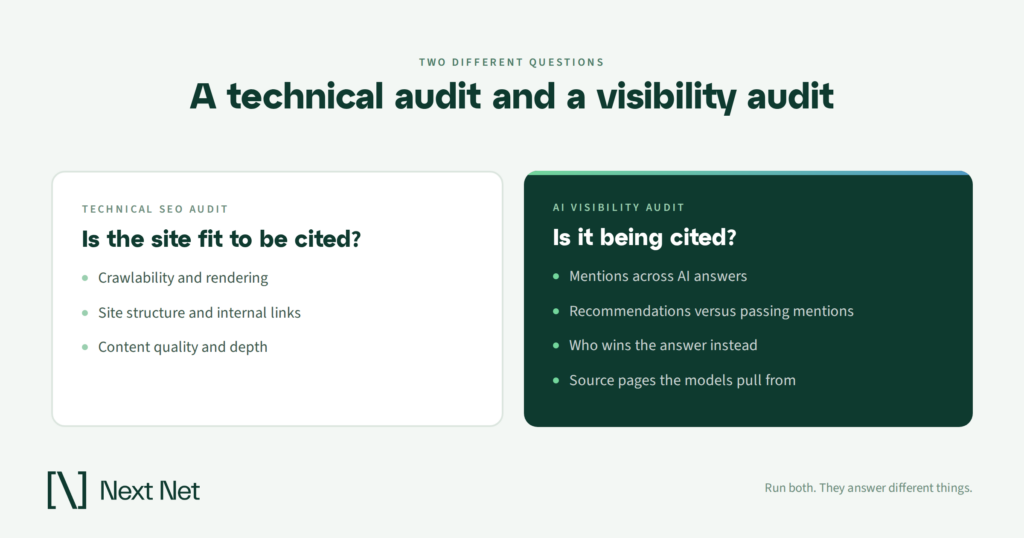
A crawl-based audit answers whether a site can be indexed and whether it deserves to rank. Useful, and still necessary.
An AI visibility audit answers a different question: when a buyer asks an engine for a recommendation, does this business get named. Different question, different evidence, different deliverable.
Worth being clear about what you are not looking for. Google’s guide to optimizing for generative AI features takes the position that optimizing for AI search is still SEO, and its documentation on AI features and your website states there are no additional requirements or special optimizations needed to appear in AI Overviews or AI Mode. So the audit is not a hunt for a hidden AI ranking factor. It measures the distance between what a business has already earned and what engines say about it today.
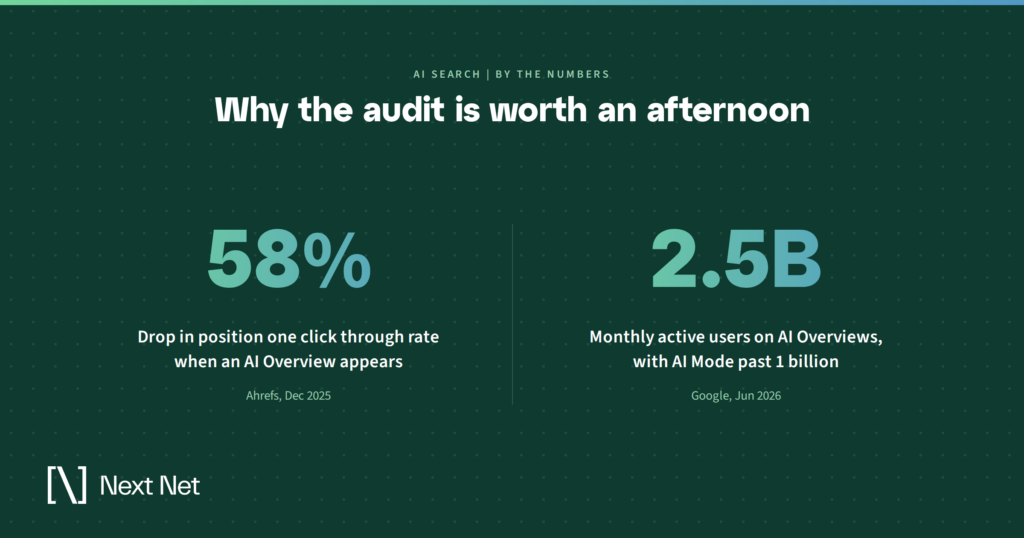
The stakes are what make this a business conversation rather than a curiosity. Ahrefs re-ran its click-through study on 300,000 keywords using December 2025 data and found that an AI Overview cuts position-one CTR by 58%. The effect thins as you go down the page but does not disappear, running near half at position two and still around a fifth at position ten.
And the surface is not small. Google put AI Overviews at over 2.5 billion monthly active users and AI Mode past one billion in June 2026.
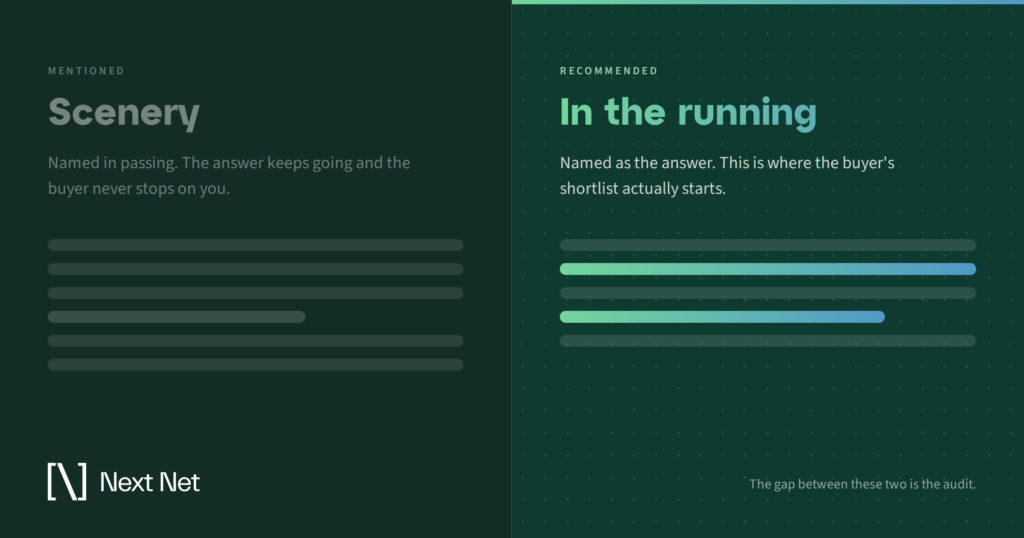
Most established brands are not missing from these answers. They turn up as scenery: named in passing, credited for nothing, recommended to no one.
Scope the Afternoon Before You Open a Tool
Thirty minutes here saves the whole day. Skip it and you will spend hour three discovering that the question set was built for a different buyer than the one the client sells to.
Three decisions, in this order.
Pick questions, not keywords
Buyers do not type keywords into an engine. They type questions, often long ones with context attached.
Build a set of twenty to forty that a real buyer in this category would ask, spread across the journey: definition questions, comparison questions, best-of questions, cost and objection questions, and local variants where geography matters. If the client has a sales team, ten minutes on the phone with a rep produces a better question set than an hour in a keyword tool.
Fix the competitor set with the client, not with software
Ask who they lose deals to, by name. Write those names down.
A competitor set assembled from organic overlap will hand you national brands the client will never bid against, and every downstream number inherits that error. This is the input that most often quietly ruins an otherwise clean audit.
Decide the deliverable now
Two-page finding summary, or a full report. Choose before you start collecting, because deciding at the end is how a four-hour audit becomes a two-week project.
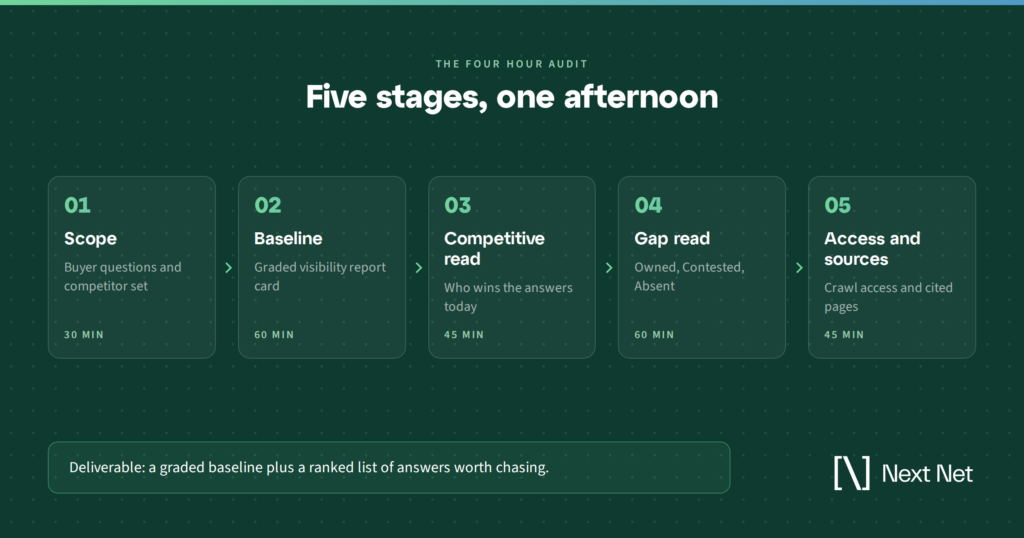
Hour One: Establish a Baseline You Can Point At
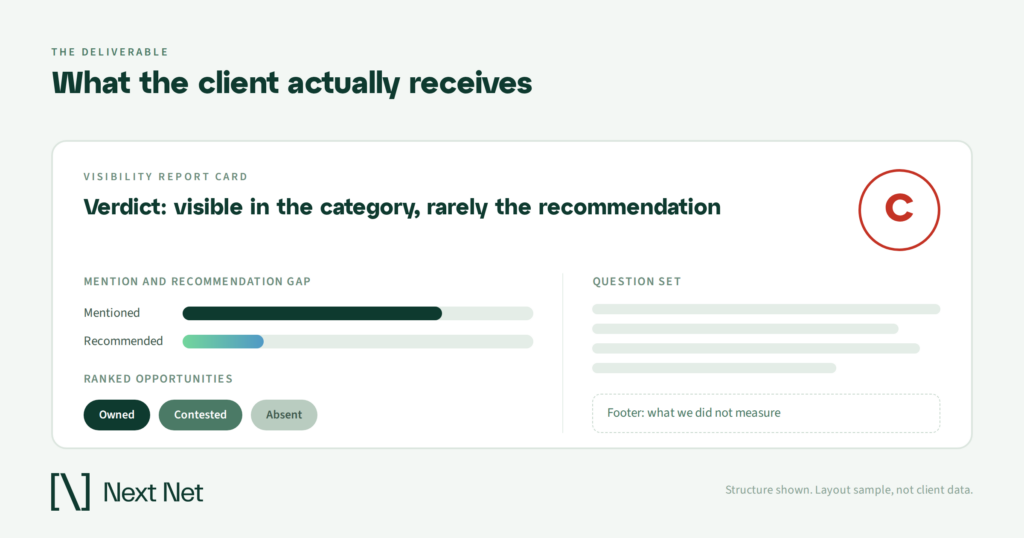
Start with the graded snapshot. A report card compresses the whole picture into something a client reads in ninety seconds, which matters more than it sounds like it should.
Three things to read before anything else.
The overall grade and its one-line verdict, which is the sentence you will end up repeating in the meeting. The gap between how often the brand gets mentioned and how often it gets recommended, which is the entire finding in most audits. And the coverage figure: how many of the prompts you sent came back with an answer.
That third one gets skipped constantly, and it decides whether everything above it is trustworthy.
Here is why it matters. A zero in an AI visibility tool is ambiguous. It can mean the engine never named the brand, or it can mean the run failed and nobody surfaced the failure. Both render as the same confident zero in the same font.
So verify the headline zeros by hand before they reach a client document. Open the engine, ask the question, read what comes back. Ten minutes of manual checking is the habit that separates an audit from a screenshot collection.
Mentions tell you the brand exists in the model’s picture of the category. Recommendations tell you it is in the running. The gap between them is the thing you are selling against.
Hour Two: Read Who Is Winning the Answers
Now look at share of voice across the completed prompts. You are answering one question: when the engine has to name somebody, who does it name.
Three patterns are worth flagging. Whether recommendations concentrate in one or two names or spread across a long tail. Whether the client appears anywhere in the set. And whether the names coming back are competitors at all.
That last one is the most common misread in the whole audit, and it changes the recommendation completely.
A review aggregator, a directory, or a manufacturer spec page that surfaces constantly is not a brand your client is losing to. It is a page the engine trusts, which makes it a placement target. Read it as a competitor and you write a competitive content plan. Read it correctly and you write an earned media plan, which is usually the faster path.
Either way, the read tells you something the client cannot see from the outside: whether they are absent from the answer or standing in it as scenery while somebody else gets the close.
The mechanics of both reads have their own posts: how to read AI share of voice and what citation sources tell you. For the audit, you need the pattern, not the deep dive.
Note where the engines disagree with each other
Run the same question through more than one engine and the answers rarely line up. One names three local providers, another names two national brands, a third hedges and names nobody.
That spread is a finding, not noise. A brand that shows up in one engine and vanishes in the others usually has a source problem rather than a content problem, because each engine leans on a different mix of pages to build its answer.
Log it per engine in the working file even if the client report collapses it into a single number. When they ask why a competitor beats them in ChatGPT but not in Google AI Overviews, you want the row rather than a guess.
Hour Three: Find the Gaps Worth Selling
Sort every topic in the question set into three states.
Owned, where the brand comes back at or near the top with real share. Contested, where it appears but so do several others and nobody holds the answer. Absent, where it does not come back at all.
The instinct is to build the whole recommendation around Absent, because absence looks like the biggest problem.
Resist that as a default. Absent with no underlying demand is a rabbit hole that costs a quarter and proves nothing. Contested with real demand is where a quarter of work tends to move a number, because the brand already has a claim to the topic and the field is unsettled. Contested is also where most scenery lives, which makes it the cheapest place to convert a mention into a recommendation.
Rank the gaps by search demand, and say that is what you ranked them by. Revenue estimates attached to a forty-prompt sample are the fastest way to lose the room in the second meeting, because the first thing a sharp client asks is how you got the number.
Three to five ranked gaps is the right output here. More than that and the client cannot act on any of them. The topical map walkthrough covers the fuller version of this read when you have more than an afternoon.
Hour Four: Check Access, Sources, and What Google Will Show You
Two checks left, and they catch problems no dashboard will show you.
Confirm the engines can reach the site at all
Google’s documentation is explicit that crawling has to be allowed in robots.txt and by any CDN or hosting infrastructure. That second clause is the one that catches teams.
A site can have a spotless robots.txt and still block at the edge, through bot management rules set by an IT team that never told marketing. Everything else in the audit sits downstream of this, so check it before you write a single recommendation.
Google also states you do not need to create new machine-readable files or AI-specific markup to appear in these features. If an audit’s recommendation section is mostly about adding a new text file to the root directory, it is following a trend rather than the evidence.
Pull the pages the engines are citing
For the questions where the client loses, note which pages the answers draw from. Publications, directories, forums, comparison sites, whatever comes back repeatedly.
That list is the shopping list. It is also the part of the audit that converts most reliably into scoped work, because it names specific placements rather than describing a content posture.
Check Search Console, but do not lean on it
Google has begun rolling out generative AI insights in Search Console, including impressions and which pages appear in AI responses and in which countries. The rollout started with a subset of website owners in the UK.
Worth two minutes to check whether the client’s property has it. Not worth building the audit’s spine on, because most accounts will not see it yet, and an audit that depends on data the client cannot produce is an audit you cannot deliver.
Turn Four Hours Into Something the Client Can Act On
The deliverable has a fixed shape, and the shape is what makes this repeatable.
Open with the one-line verdict. Follow it with the mentioned-versus-recommended gap, stated plainly. Then who is winning the answers, with competitors and citation sources labeled separately. Then three to five ranked opportunities, each with the demand figure that earned its position. Then what you would do first and what you would need from the client to do it.
Then close with the section most audits leave out: what you did not measure.
Name the engines you covered, the prompt count, the completion rate, and the date. It reads like hedging. It functions as the opposite, because a client who can see the edges of your method has a reason to trust what sits inside them.
Expect the first question to be some version of “is this real.” Have the raw prompt-and-answer log ready to open, even if it never leaves your laptop. Being able to scroll to the exact answer where a competitor got recommended ends that conversation in about fifteen seconds, and it is the moment most audits either earn the room or lose it.
Date every report, prominently. AI answers move, and an undated audit becomes wrong without anyone noticing.
One more discipline: report direction, not outcomes. Noting that recommendations concentrate in two brands while the client holds a small share is a finding you can defend. Promising a top spot in ChatGPT by a certain date is a commitment nobody controls.
Five Ways an Afternoon Audit Goes Wrong
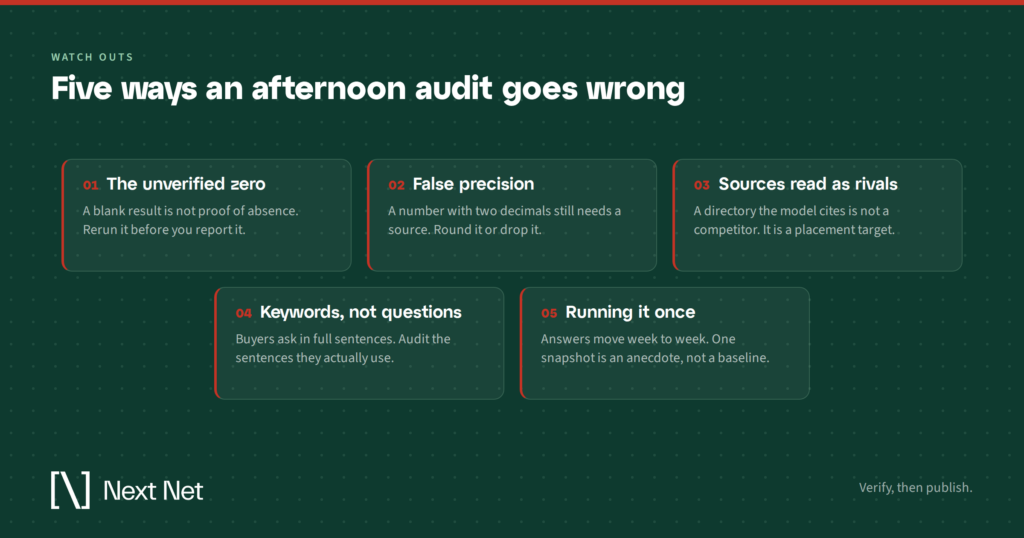
Reporting an unverified zero. If a tool cannot distinguish measured absence from a failed run, you cannot either, until you check by hand.
Precision the sample cannot carry. Two decimal places on forty prompts invites the one question you do not want asked.
Treating citation sources as competitors. This sends the client after the wrong work for a full quarter.
Auditing keywords instead of questions. It produces a report about search that happens to mention AI, which every client has already seen.
Running it once. A single audit is a photograph, and photographs do not renew contracts. The value compounds on the second and third pass, which is the argument for a monthly movement review rather than an annual one.
Frequently Asked Questions
What is the difference between an AI visibility audit and an AI SEO audit?
An AI SEO audit inspects the site: crawlability, structure, content quality, technical health, all evaluated against how search systems assess pages. An AI visibility audit inspects the answers: what engines say about the brand when buyers ask, and who they name instead. The first tells you whether the site is fit to be cited. The second tells you whether it is being cited. Most accounts need both, and they are usually run by different people on different timelines.
How many prompts does an AI search audit need to be meaningful?
Twenty to forty questions is enough to see a pattern in a single category, which is what an afternoon supports. Below about twenty, one unusual answer skews the read. Above forty, you are into work that needs more than a day and probably needs monitoring rather than a snapshot. Whatever number you land on, state it in the report so the client can weigh the finding against the sample.
Can you run an AI visibility audit manually, without a tool?
Yes, and it is worth doing at least once so you know what the automated version is summarizing. Ask your question set in each engine, log which brands come back, and note the sources cited. It takes most of a day for a single account and it does not scale past a handful of clients, which is the case for tooling. It also makes you much better at spotting when a dashboard is wrong.
How often should the audit be re-run?
Monthly is the cadence that produces a story worth reporting. AI answers shift as engines re-crawl and re-rank their sources, so a quarterly check tends to show movement without any way to explain what caused it. If monthly is not realistic for an account, run it at the start and end of each engagement phase so there is at least a before and after.
Do you need client access to run one?
Not for the visibility portion. Everything about what engines say is observable from outside, which is why this works as a prospecting exercise as well as a client one. You will need access for the technical checks, since confirming crawl permissions at the CDN level and reading Search Console both require credentials. A useful sequence is to run the outside-in read first, then ask for access to explain what you found.
Start With One Account
Pick a client you know well enough to spot a wrong answer when you see one. Run the four hours end to end. The first pass will take longer than an afternoon and will teach you which parts of your question set were lazy.
The second one lands in an afternoon. By the fourth, it is a service line.
A graded visibility report is the fastest way to get the baseline in front of a client, and how we help agencies covers what running this across a full book of accounts looks like.
Related Articles
You ask an engine a question in your category. Your brand comes up. That feels like a win, right up…


Most teams working on AI visibility end up holding two reports that never quite meet. One is a keyword export.…
Nine months into the engagement, the client asks the question you knew was coming. What did we get for this,…