
What Is a Rights-Managed Content Object? A Plain-English Guide for Publishers

Every day, AI systems pull your articles into answers that millions of people read. Ask ChatGPT, Gemini, Perplexity, Copilot, or Google AI Overviews almost anything and the response is stitched together from content that someone, somewhere, paid to produce. Most of the time, that someone is a publisher.
Here is the strange part. When your article gets retrieved, it arrives at the AI system with nothing attached. No terms. No price. No record that the retrieval happened. The web was designed to move documents from one machine to another, and it does that job well. It was never designed to move the rights that come with those documents.
A rights-managed content object fixes that gap at the level of the content itself. This guide explains what one is, what goes inside it, why per piece matters more than per site, and what it means for how your content gets used and paid for from here on. You do not need a technical background to follow along. If you have ever scanned a barcode, you already understand the core idea.
The definition, in one paragraph
A rights-managed content object is a unit of content, such as an article, image, video, or dataset, packaged together with machine-readable information about who owns it, what an automated system is allowed to do with it, what that use costs, and how each use gets recorded. The object carries its terms with it, so any system that retrieves the content also retrieves the rules for using it, and those rules can be checked and enforced by software before the content is served.
Notice what that definition does not say. It does not say the terms live on a separate page, or in a contract somewhere, or in a file at the root of your domain. The terms are part of the object. Wherever the content goes, the rules go with it.
Why a URL was never going to be enough
For thirty years, the unit of the web has been the URL. A URL is an address. It tells a machine where to find something. That is all it does.
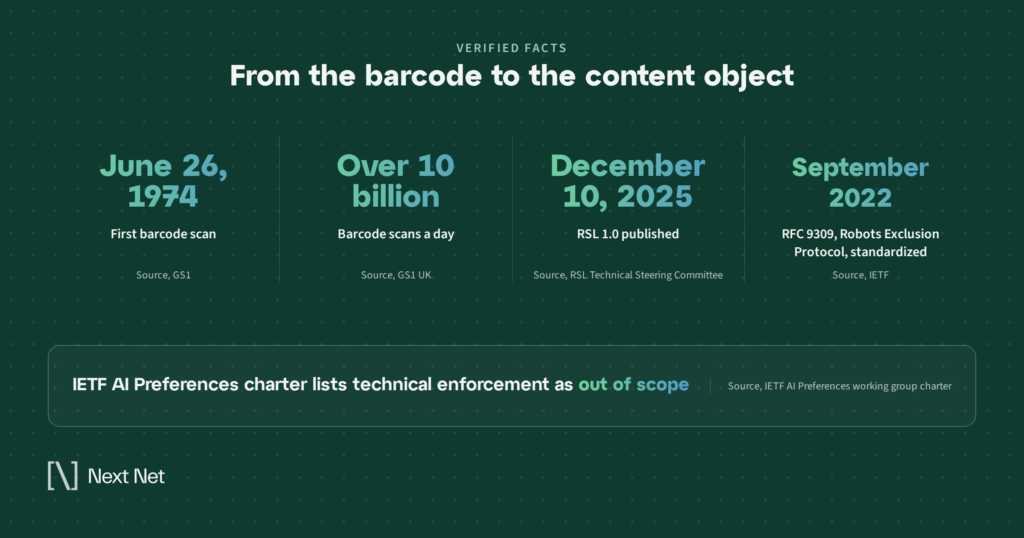
The rules for automated access have been just as thin. The robots exclusion protocol, formalized by the IETF as RFC 9309, lets you tell crawlers which paths to stay out of. The specification itself is clear about the limits: those rules are not a form of access authorization. A crawler that ignores robots.txt breaks etiquette, not a lock.
So when an AI system retrieves a page today, it gets a location and, at best, a polite request. It does not get an owner, a license, a price, or a receipt. We covered why this breaks down for AI agents in a separate post, but the short version is that a URL locates content while an object describes it. Retrieval systems need the description.
The barcode moment for content
On June 26, 1974, a cashier at a supermarket in Ohio scanned a pack of chewing gum, and modern retail changed. GS1, the organization that administers the barcode standard, marks that scan as the moment a physical product first connected to a digital identity. Today the same standard is behind more than 10 billion scans a day.
What the barcode did was simple and enormous. Before it, a product on a shelf was just a product. The price lived on a sticker, the inventory lived in a ledger book, and every piece of information about the item lived somewhere other than the item. The barcode put a machine-readable identity on the product itself. Once every item could announce what it was, checkout, inventory, reordering, and eventually the entire global supply chain could run on that identity automatically.
A rights-managed content object is the barcode moment for publishing, with one upgrade. A barcode says what a product is. A content object says what a piece of content is, who owns it, what an AI system may do with it, and what that use is worth. The identity and the terms travel together, and machines can act on both without a human in the loop.
That is why the concept matters more than any single standard built on it. Barcodes made retail supply chains possible. Content objects make an AI content supply chain possible, and every part of the AI content economy, from licensing to attribution to payment, depends on that supply chain existing.
What is inside a rights-managed content object
Strip away the vocabulary and a content object has four parts. Each one answers a question an AI system needs answered before it uses your work.
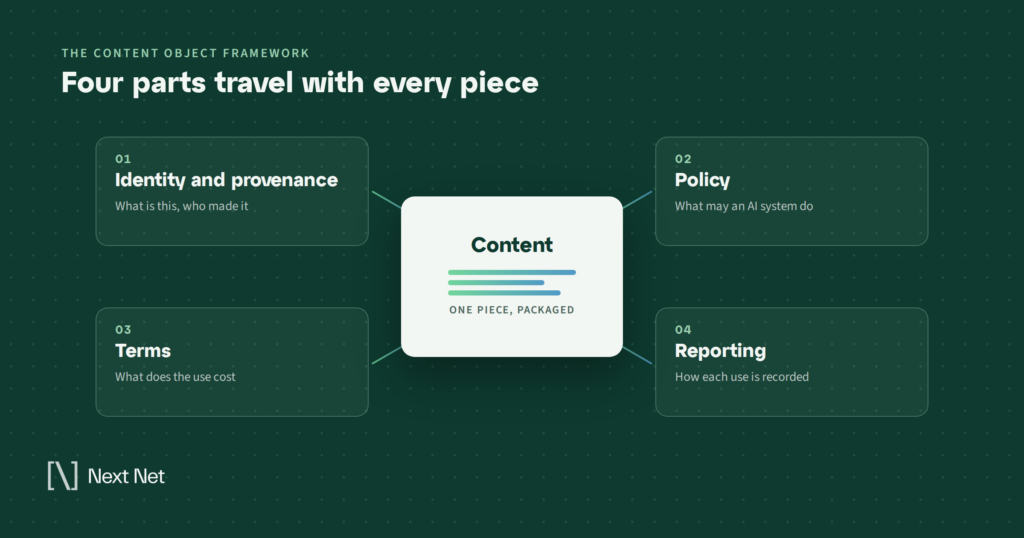
1. Identity and provenance: what is this, and who made it?
The object carries a stable identifier for the content and a verifiable record of where it came from. This is the barcode part. In practice it can be as simple as a canonical URL bound to a rights holder, or as rigorous as a signed provenance manifest. The C2PA Content Credentials standard defines exactly that kind of manifest: a cryptographically signed record of an asset’s origin and edit history that travels with the file and can be verified by anyone who receives it.
Provenance matters for a reason that is easy to miss. AI systems increasingly decide what to trust based on where content came from. A piece of content that can prove its origin is more valuable to a retrieval system than one that cannot, and the same proof is what makes the rest of the object enforceable.
2. Policy: what may an AI system do with it?
This is the part most publishers picture when they hear rights management, and it is more granular than a yes or no. The Really Simple Licensing 1.0 specification, published as an industry recommendation in December 2025, defines a vocabulary that separates the ways automated systems use content: training a model, feeding content into a model as input for grounding or generation, storing it in a retrieval index, and building a traditional search index. A publisher can permit some of those uses and prohibit others on the same piece of content.
Policy can also be scoped by who is asking (commercial, non-commercial, educational, government) and where they are. The point is that the object encodes your decision, so a system reading the object learns the answer instead of guessing at it.
3. Terms: what does the permitted use cost?
An object states how a permitted use is compensated. That might be attribution with a link back, a payment per crawl, a payment each time the content contributes to a generated answer, a subscription, or nothing at all for open content. The same RSL specification enumerates those payment types and lets a publisher point to either a shared license framework or a custom licensing endpoint.
Notice that the object does not set prices for you and does not require that you charge anything. It gives your commercial decision a machine-readable shape, which is what makes it enforceable at machine speed.
4. Reporting: how does each use get recorded?
The fourth part is the one the web has never had. A complete content object specifies how use is reported back: what was retrieved, by whom, for what purpose, and under what terms. RSL 1.0 includes a reporting element for exactly this, covering event-level telemetry about access and citation, provenance reporting, and periodic audit reporting.
This is the receipt. Without it, every other part of the object is a promise. With it, every retrieval leaves a record you can reconcile, bill against, or produce as evidence.
Policy is per piece, not per site
If you take one idea from this guide, take this one. Rights management on the web has always been site-wide. A robots.txt file governs a whole domain. A licensing deal covers a whole archive. A paywall wraps everything behind it in the same terms.

Content objects work the other way around. Each object carries its own policy, and standards built for this model resolve conflicts by specificity. The RSL specification, for example, requires that a more specific declaration takes precedence over a broader one, so terms set on a single article override terms set for the section it sits in, which override terms set for the site.
Think about what that lets you do. Your evergreen explainer library might be open for AI grounding with attribution, because those pages benefit from being cited. Your breaking coverage from the last 72 hours might require payment per use, because that is where the value concentrates. Your investigative archive might permit indexing but prohibit training entirely. Three policies, one publication, no site-wide compromise.
Publishers have made these distinctions editorially for decades. Content objects let you make them commercially, at the granularity you already think in.
Enforcement is automatic, or it is not rights management
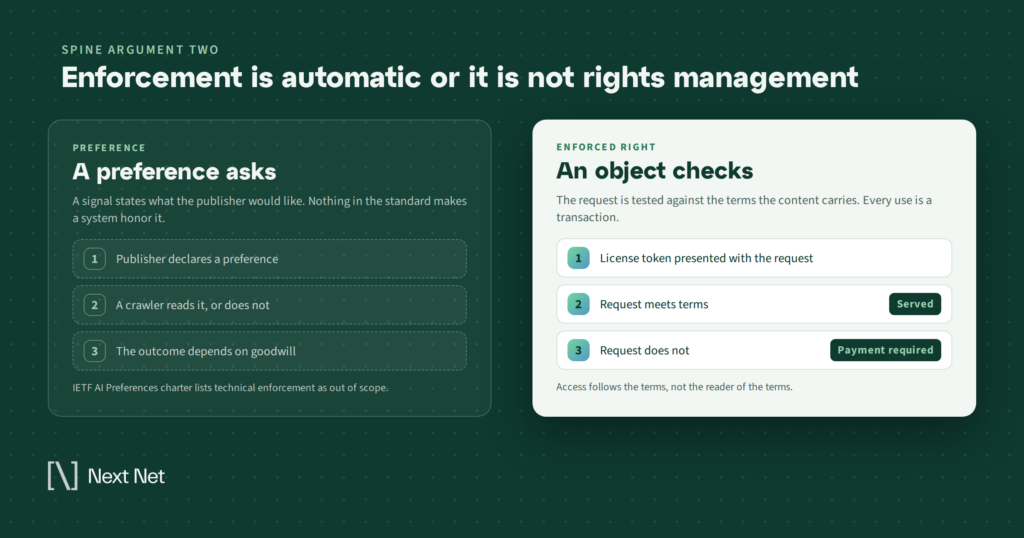
A declared preference and an enforced right are different things, and it is worth being precise about which is which, because the standards landscape currently offers both.
The IETF’s AI Preferences working group is standardizing a vocabulary for expressing how content should and should not be used for AI, attached either in content metadata or through the protocol that delivers the content. That is valuable, and it will give publishers a common language. But the working group’s charter explicitly lists technical enforcement of preferences as out of scope, along with authorizing clients and auditing AI training. A preference asks. It does not check.
A rights-managed content object closes that loop. Because the object carries identity, policy, and terms in a form software can evaluate, the system serving the content can check the request against the terms before responding. RSL 1.0 describes this pattern in its optional protocol layers: a client discovers the license, obtains a token that represents an accepted license, presents the token with each request, and gets the content only if the token covers that resource. A request without a valid license gets a standard HTTP response that says, in effect, payment required, along with a pointer to the terms.
The practical consequence is that enforcement stops depending on good behavior. You are not asking the AI system to honor your policy. The object and the server enforce it, and the request either meets the terms or it does not get served.
Where the standards fit together
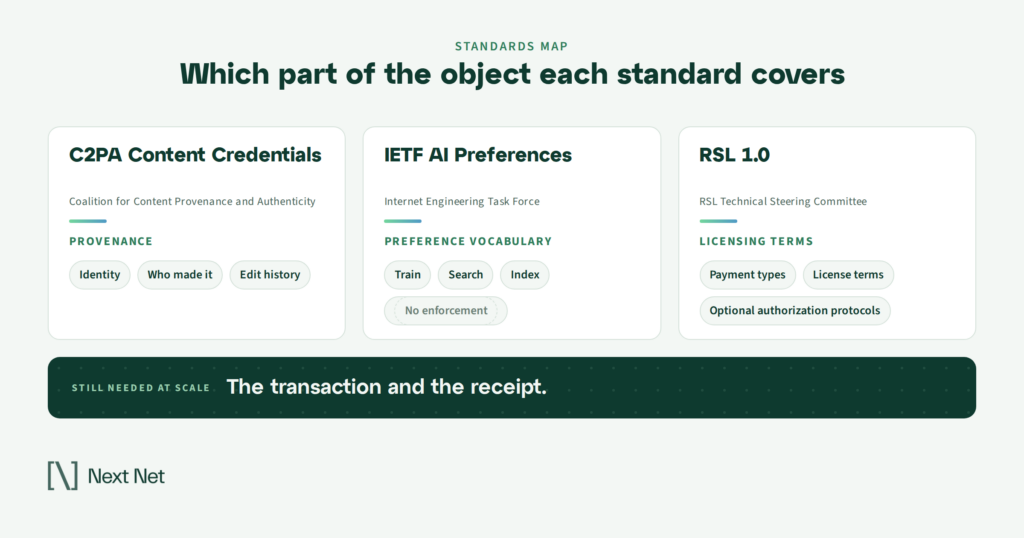
Publishers hear a lot of acronyms right now, and it helps to sort them by which part of the object they address.
Provenance standards answer the identity question. C2PA Content Credentials is the most developed of these, and its own explainer is careful to note that it does not restrict access or impose usage limits. It proves what content is and where it has been. It does not say what you may do with it.
Preference and licensing standards answer the policy and terms questions. The IETF vocabulary expresses preferences. RSL goes further, expressing licensing terms and payment types and defining optional protocols for authorization. RSL also allows a license to be embedded directly in a media file’s metadata, so the terms travel with the asset the way a barcode travels with a product.
What none of them fully supply on their own is the transaction and the receipt at scale: the system that turns a licensed retrieval into a recorded, settled event across many publishers and many AI products. The standards define the object. Something still has to run the market the objects trade in.
What this changes for publishers, in practice
You do not need to become a standards engineer to prepare. Most of the work is editorial and commercial, and you have already done versions of it.
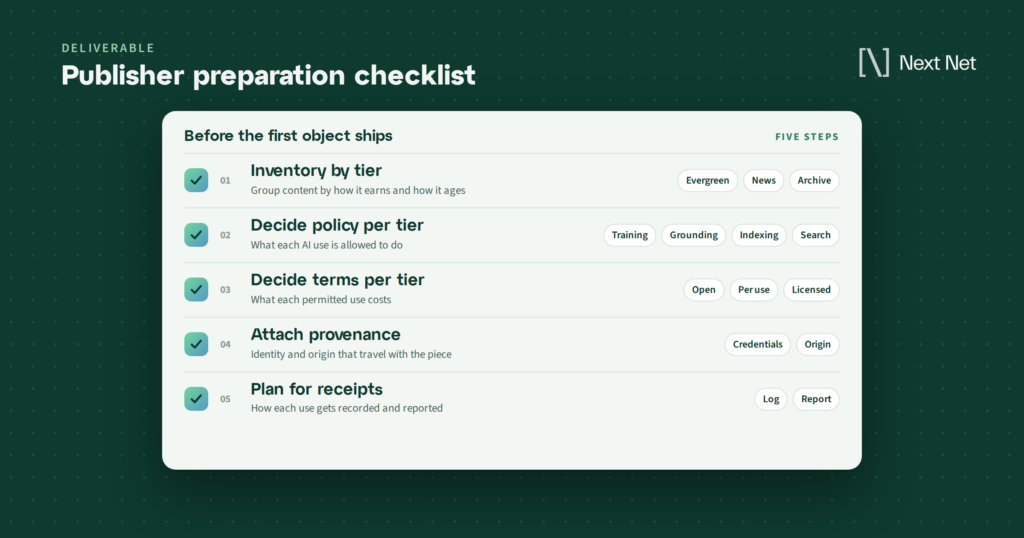
Start with an inventory. Which parts of your content are evergreen, which are perishable, which are the crown jewels? Content objects reward publishers who already know the answer, because the object is where that answer gets written down.
Then decide policy by tier, not by domain. For each tier, decide which uses you permit: training, grounding and generation, retrieval indexing, traditional search. Our guide to the four ways AI systems use content walks through what each one means for you. Most publishers land on different answers for different tiers, which is exactly what per-object policy is for.
Decide terms by tier as well. Attribution may be the right answer for content that gains from citation. Per-use payment may be right where the value is in the content itself. You are not locking anything in; you are stating your starting position in a form machines can read.
Get serious about provenance. If your CMS or asset pipeline can attach Content Credentials or an equivalent signed manifest, turn it on. Provenance is the part of the object that makes the rest trustworthy, and it is the part AI systems increasingly weigh when choosing sources.
Finally, plan for receipts. Decide now what you want to know about each use of your content and who in your organization needs that data. Licensing, audience, and legal teams will all want it, and the reporting profile you ask for shapes what you get.
Where SAIL fits
Full disclosure: Next Net created SAIL, the Standardized Agentic Intelligence Ledger, and the concept in this guide is the unit SAIL works in. We announced SAIL in July with Sundial Media & Technology Group, home to ESSENCE, Refinery29, AFROPUNK, and Beautycon, as an inaugural media partner.
SAIL is a transaction, receipt, and market intelligence layer for AI content rights. It converts a publisher’s content into rights-managed content objects, enforces each object’s policy through governed AI retrieval, and records every use in a verifiable ledger. It is designed to be compatible with RSL and CoMP, so the objects it produces speak the same language as the standards described above rather than a proprietary dialect.
That last part is the point. The standards give the object a shape. SAIL is built to give publishers a place to create objects at scale, enforce them without negotiating AI product by AI product, and receive the record of use that makes licensing auditable. Whether you work with us or not, the shift toward content that carries its own terms is the one to prepare for.
Frequently asked questions
Is a rights-managed content object the same thing as DRM?
No. Digital rights management locks content so that only approved software can open it, and it is mostly built for consumer media. A rights-managed content object is about machine-to-machine access: it describes the rules and terms for automated use in a form software can check, and it can be enforced at the point of retrieval without wrapping the content in an encrypted container. Some standards, including RSL, offer optional encryption for paywalled assets, but the core concept is declarative, not restrictive.
Does making my content a rights-managed object block AI systems from using it?
Only if you tell it to. The object encodes your policy, and that policy can be fully open, fully closed, or anything in between, per use type and per piece of content. Most publishers use objects to permit uses they want on terms they set, rather than to block. Blocking is one policy among many.
Do I need to rebuild my website to use content objects?
Generally no. Standards in this space are designed to attach to existing publishing infrastructure through a directive in robots.txt, an HTTP header, a link element in the page, an entry in an RSS feed, or metadata embedded in the file itself. The work is mostly in deciding your policies and terms; the technical attachment is comparatively light.
What is the difference between RSL, C2PA, and the IETF AI Preferences work?
They cover different parts of the object. C2PA Content Credentials handle provenance, proving what content is and where it came from. The IETF AI Preferences work standardizes a vocabulary for expressing how content should be used, without enforcement. RSL expresses licensing and payment terms and defines optional protocols for authorization and enforcement. A complete rights-managed content object can draw on all three.
How do I know an AI system honored the terms?
That is what the reporting and receipt part of the object is for. When retrieval is governed, each request that meets the terms produces a record of what was accessed, by whom, and under which license. Without that layer you are relying on the AI system’s word. With it, you have a record you can reconcile against, which is the difference between a policy and an enforced right.
Content that carries its own terms
The web made content easy to move and impossible to govern. Rights-managed content objects put the governance back where it belongs: on the content itself, in a form machines can read and act on. The publishers who define their objects first will be the ones whose terms the AI economy learns to work within.
If you want to see how SAIL converts your content into rights-managed objects and records every use, visit our page for publishers.
Related Articles
On September 15, 2026, Cloudflare flipped a default that touches a large slice of the web. Training and Agent crawlers…

Every year or so a new file shows up at the root of publisher sites, and this cycle’s file is…
Every few weeks another headline lands: a publisher sues an AI company, an AI company calls the claim meritless, and…