

What Publishers Lose When Readers Ask AI Instead of Clicking

Every publisher has the same chart open somewhere. Search referrals, month over month, sloping down.
The chart is accurate. It is also answering a question that matters a little less every quarter.
For most of the web era, a click was the only evidence you had that the work reached anyone. Number goes up, the story landed. Number goes down, something broke. Traffic was never just a metric. It was the proxy for reach, for influence, for ad inventory, for the top of the subscription funnel.
That proxy is coming apart. Readers are asking AI assistants questions your reporting already answers, and the answer arrives without the reader ever arriving. Your work is in the response. Your logs never see them.
This post is about what that shift takes from a publisher, what it does not take, and what you can measure in place of the number that is falling.
What AI for Publishers Means Right Now
AI for publishers describes the set of decisions a news organization now has to make about generative AI systems that read, summarize, and cite its work: whether to allow access to that work, how to measure the visibility that results when access is allowed, and how to turn being cited into something that pays. The measurement half is the newest and the least built out. It asks a question analytics has never had to ask, which is not how many people came to your site, but how often your reporting is the source an answer gets built on, and whether that answer says your name.
Your traffic chart cannot answer the second question. It was not designed to.
The Click Loss Is Real, and Smaller Than the Headline Says
Start with the best data available, because this is a subject where the loudest numbers tend to be the least careful ones.
The Reuters Institute Digital News Report 2026, published in June and built on close to 100,000 interviews across 48 markets, marks a threshold. For the first time, social media and video networks are the most widely used way of getting online news globally, ahead of publishers’ own websites and apps. Use of those owned properties has fallen by twelve percentage points since 2020, a decline running at roughly the same rate as the decline in television news, which is the part of the story the industry talks about less.
Weekly use of AI assistants for news moved from seven percent to ten percent of audiences year over year. Among people under thirty-five it reaches sixteen percent. That is fast growth from a small base, and the report is careful to call it fast rather than explosive.
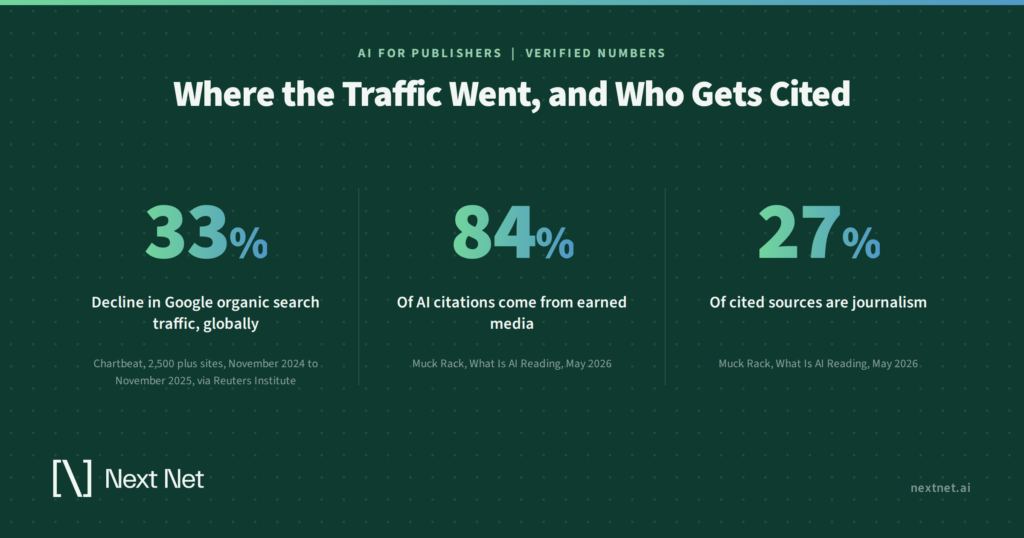
The traffic picture is sharper than the usage picture. Aggregate figures from Chartbeat, reported in the same institute’s trends work, put Google organic search traffic to more than 2,500 sites down by a third globally between November 2024 and November 2025, and down thirty-eight percent in the United States. Publishers surveyed expect search referrals to decline by a further forty-three percent over three years.
Here is the part that gets skipped. The report notes that hard news queries are mostly still excluded from Google AI Overviews. Which means the traffic that has already gone did not mostly go to AI answers. It went to platform drift, to video, to feeds, to a broad reduction in interest in news. Generative AI is arriving into a decline it did not start.
That matters for how you plan. If you treat AI as the sole cause, you will build the wrong response.
One more caution on numbers, because you will see both versions of this figure quoted as though they contradict each other. Among people who use AI assistants for news, forty-two percent say they always or often click through to the original source, which sits between the equivalent figures for social media and for search engines. Measured instead against every survey respondent, the same behavior lands at around four percent, because only a tenth of people use assistants for news at all. Both numbers are correct. They have different denominators. Anyone quoting one without the other is selling you something.
What a Click Was Measuring
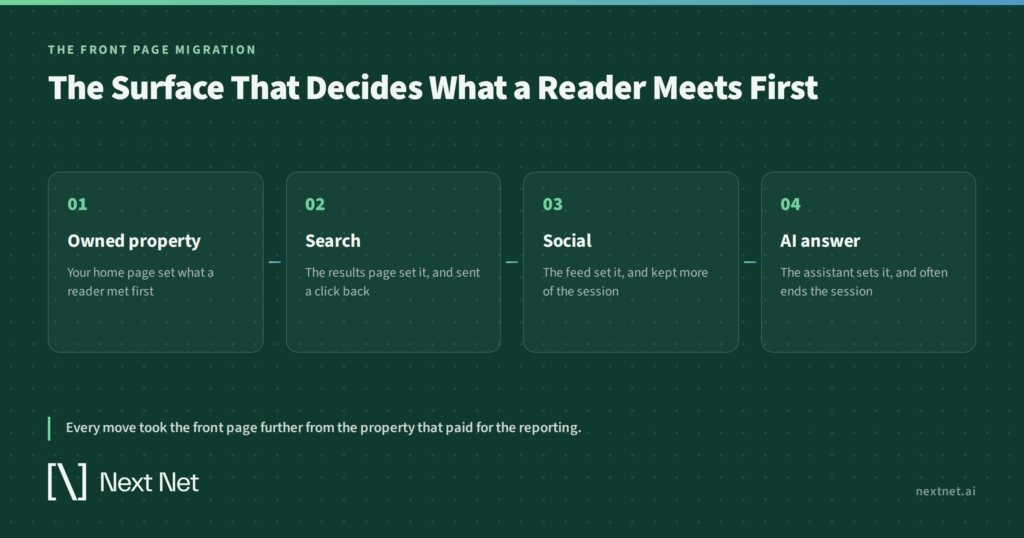
The front page used to do a specific job. It decided what a reader encountered before the reader had decided anything. Editors owned that decision, and they owned the surface it happened on.
Search took the front page and moved it onto someone else’s property. Social moved it again. For a growing slice of the audience, an AI answer is now the front page, and it is further from your control than either of the previous two.
At each move, the click survived as the measure. It survived because it kept working. A reader who encountered you somewhere else still had to come to you to read the thing.
There is a business consequence underneath the measurement one. The report puts the share of people paying for online news flat at seventeen percent across the markets it tracks for this, and connects that stall directly to the shrinking top of the funnel. Fewer arrivals on owned properties means fewer people who can be converted into subscribers, which is why reach loss shows up in revenue a year or two after it shows up in analytics.
The generative layer breaks that chain. The reader can encounter your work, absorb the part they needed, and never traverse the link. Traffic was never the value. Traffic was the record that value had changed hands. When the record stops being written, the temptation is to conclude the value stopped moving. It did not. Your reporting still resolved someone’s question. You simply lost the instrument that told you so.
Citation Is the Instrument That Replaced It
A citation is the AI-era version of that record: an instance where an engine draws on your work to build an answer, with or without a link back to you.
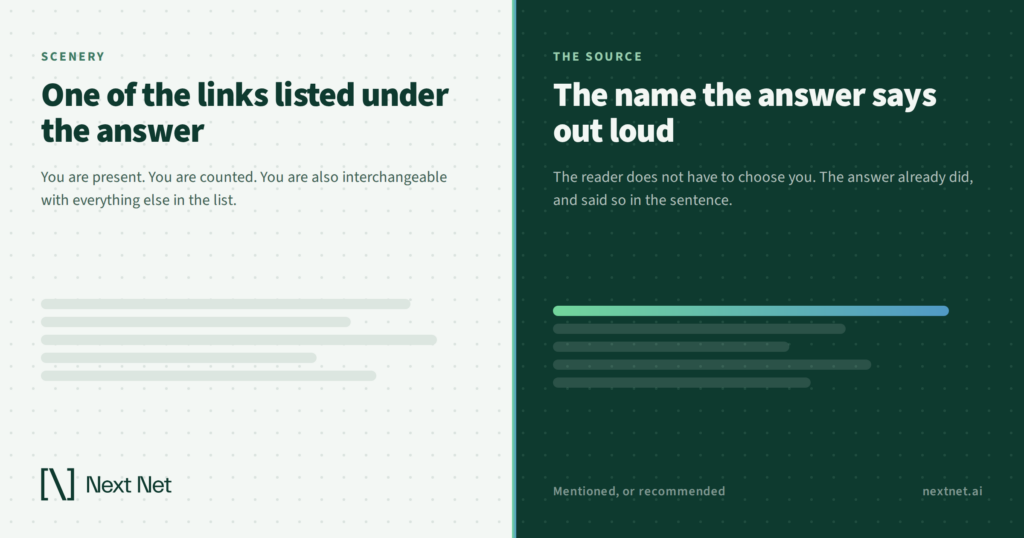
Not every citation carries the same weight, and this is where publishers need to get precise fast. Some appearances are scenery. Your article sits among eleven sources beneath a summary, present in the response, doing no work in the reader’s understanding of it. Other appearances are the answer itself. The assistant states your finding, attributes it to your masthead, and the reader walks away holding your reporting with your name attached.
Traffic told you who arrived. Citation tells you who was trusted.
The practical read has three layers. Whether you appear at all in the answers that matter to your coverage. Whether the appearance is linked or name-only. And where in the answer you sit, because depth and position in a generated response behave a lot like position on a results page used to.
Name-only mentions are the ones publishers undervalue most. They send no traffic, so they show up nowhere in analytics, and they are the clearest available evidence that an engine treats your masthead as authoritative on a subject. That is a brand asset, and it accrues the same way brand authority has always accrued for a masthead, through repetition in places the audience already trusts.

Publishers Are the Layer AI Is Reading
There is a version of this story where publishers are collateral damage in someone else’s product. The citation data says something closer to the opposite.
Muck Rack’s Generative Pulse team publishes a recurring study called What Is AI Reading?, which examines how generative systems cite sources in response to realistic prompts. The May 2026 edition analyzed more than 25 million links across three leading AI assistants and seventeen industries. Earned media accounted for eighty-four percent of all citations. Journalism on its own made up twenty-seven percent. Paid and advertorial content came to three tenths of one percent.
Those proportions have barely moved. Across three editions going back to July 2025, earned media has held between eighty-two and eighty-nine percent, and journalism between twenty-five and twenty-seven percent.
There is an asymmetry worth sitting with here. Trust in news overall sits at thirty-seven percent in the same Reuters Institute data, its lowest recorded level, while trust in answers from AI assistants sits at twenty percent. Readers trust the surface less than they trust you, and the surface is running on your reporting. Being named inside that answer is not a consolation prize. It is the mechanism by which the more trusted brand gets credit inside the less trusted container.
Read that as a publisher rather than as a marketer. The retrieval layer these systems run on is substantially your work. You are not incidental to AI answers. You are the substrate. Which is leverage, and it is leverage that stays completely invisible for as long as clicks are the only thing you count.
The same study found that more than half of journalism citations come from articles published within the previous twelve months, with citation volume dropping off sharply after the first six. Your archive is not doing the work here. Your current desk is.
How to Track Traffic From AI Overviews and AI Answers
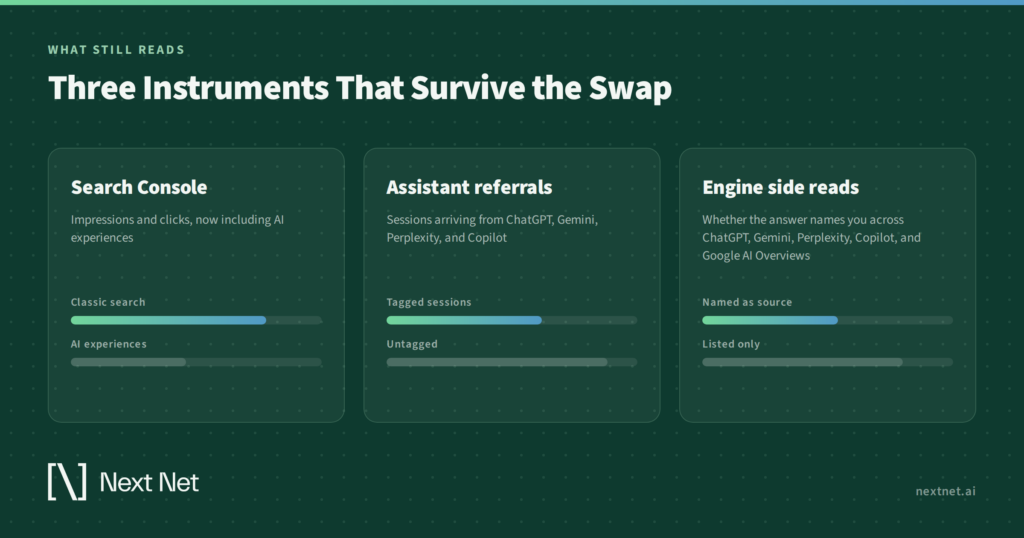
Three instruments exist today. None of them is complete, and using one alone will mislead you.
The Search Console generative AI report. Google introduced dedicated generative AI performance reports in Search Console in June 2026, giving site owners a separated view of impressions inside generative features on Search, including AI Overviews and AI Mode, as well as generative features in Discover. It rolled out to a subset of sites first, so check whether your property has it. Read it for what it is: an appearance measure, broken out from standard search rather than blended into it. An impression is not a visit and should never be reported as one.
Assistant referrals in your own analytics. The volume is small. It is also the highest-intent traffic on your site, because someone had to actively choose to leave a satisfying answer to go read the source. Segment assistant domains out of “direct” and “other” and give them their own line. If you do nothing else this quarter, do this one. It takes an afternoon and it stops you from throwing away the only first-party AI signal you have.
Engine-side reads. Ask the engines the questions your readers ask, across ChatGPT, Gemini, Perplexity, Copilot, and Google AI Overviews, and record which outlets come back. This is the only instrument that shows you the answers where you are absent, which is the more useful half of the picture and the half no analytics package will ever surface. Absence generates no data on your side. Doing it by hand works at twenty questions and stops working at two hundred, which is the point at which a platform earns its place.
Run them together and you get a rough but honest read: where you appear, how you appear, who appears instead of you, and how many of those appearances turn into a human on your page.
Turning the Read Into Decisions
Pick twenty questions first. Not keywords. Questions, in the form a reader would put them to an assistant, covering the beats you intend to own. Twenty is enough to see a pattern and few enough to check on a repeatable cadence.
Then work the composition rather than the presence, because which sources an engine trusts in a category tells you more than your own presence or absence does. If national outlets take every answer in a category you cover locally, that is a positioning problem, not a volume problem, and publishing more of the same will not fix it. If you appear but only as scenery, the gap is usually structural: the answer to the question is buried four hundred words into a piece that opens with a scene.
Watch the decay. Given how sharply citation volume drops after six months, a beat that is cited today and not in three quarters is telling you something about publishing rhythm, not about quality.
Report it at beat level. Site-wide citation share is a vanity number that will not survive contact with an editor. Per-desk, against named questions, it becomes something a section editor can act on.
And resist rebuilding your publishing around the machines. Google’s own guidance on optimizing for generative AI search is that this remains SEO, with no separate markup or special file required. The work that earns citations is mostly the work that earned rankings: clear structure, a real answer near the top, and reporting worth citing.
Where Publishers Get This Wrong
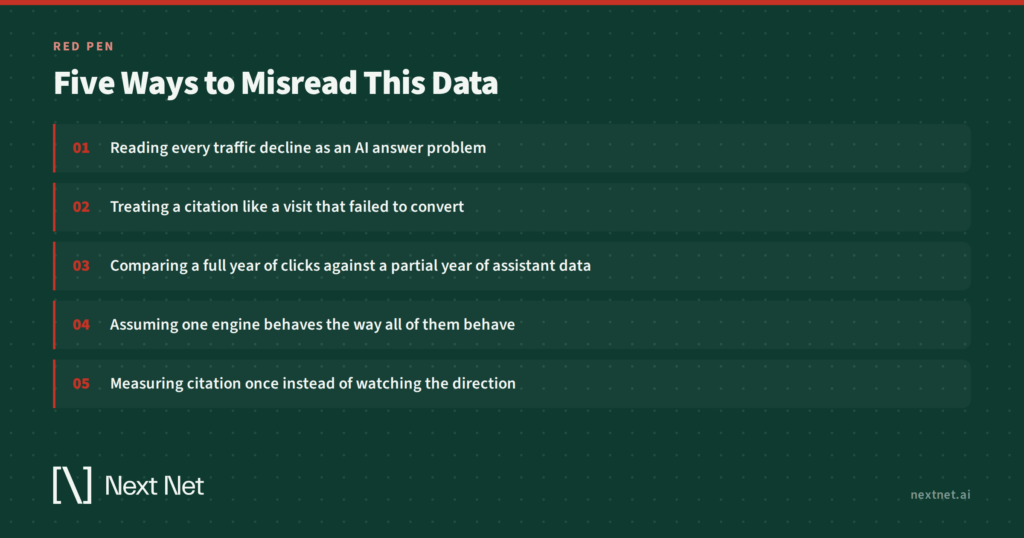
Reading a single run as a trend. Generated answers vary between runs on identical prompts. One check is an anecdote. A cadence is a measurement.
Mixing denominators. Doing what the two click-through figures above do, and comparing a share of users to a share of everybody, will make any movement look like whatever you want it to look like.
Treating absence as irrelevance. If you do not appear in an answer, the answer still happened, and someone else supplied it. Absence is a finding.
Blocking on reflex. Deciding what to allow AI systems to access is a real decision with real arguments on both sides, and it deserves its own analysis. Making it before you have measured what your current visibility is worth means deciding without the one input that matters.
Reporting decimals on thin samples. If the sample is twenty questions, say more or fewer. Do not say 3.4 percent.
Frequently Asked Questions
Does AI search reduce publisher traffic?
Some, but less than the discussion implies today. Publisher traffic is falling for several reasons at once, and the Reuters Institute data indicates that most of the loss so far traces to platform drift and declining interest in news rather than to generative answers, partly because hard news queries are still largely excluded from Google AI Overviews. The direction of travel points one way, so plan for the loss, but do not attribute the whole decline to AI.
How do I track traffic from AI Overviews?
Use three sources together. The Search Console generative AI report gives you impressions inside AI Overviews and AI Mode. Your analytics platform gives you referral sessions from assistant domains, if you segment them out rather than leaving them in “other.” Engine-side reads give you the appearances that never generate a click, which is the majority. No single one of these is sufficient.
Is a citation worth as much as a click?
Not in the same currency, which is why the comparison keeps stalling. A click delivers a session you can monetize and measure. A citation delivers attribution in front of a reader at the moment they are deciding what is true, which compounds into brand authority but pays on a longer horizon. The mistake is scoring citations on the click ledger and concluding they are worth nothing.
Do AI assistants cite news sites more than other sources?
Substantially more. Independent citation research has consistently found earned media making up the large majority of cited sources, with journalism alone accounting for roughly a quarter to a third, and paid placements accounting for almost nothing. Publishers are the layer these systems lean on hardest.
Should publishers block AI crawlers to protect traffic?
That decision depends on your licensing position, your traffic mix, and what your visibility is currently worth, and it deserves more than a paragraph. What is clear is the sequencing: blocking removes you from the answers as well as from the training, so measure what you would be giving up before you decide whether giving it up is worth it.
The Number to Put Next to the One That Is Falling
The referral chart is not going to recover, and treating it as the scoreboard means running a newsroom against a measure that gets less informative every quarter.
What replaces it is not softer. It is more specific. Which questions in your coverage area do the engines answer with your reporting. Which ones do they answer with somebody else’s. Where are you scenery and where are you the source. Those are editorial questions with editorial answers, and unlike a referral count, they point at something you can change.
The publishers who work this out first will not be the ones with the best traffic recovery story. They will be the ones who can say, precisely, where their journalism is the answer.
If you want a baseline reading of where your titles stand across ChatGPT, Gemini, Perplexity, Copilot, and Google AI Overviews, start with a Report Card. It is the fastest way to see the citation picture your analytics cannot show you.
Related Articles
On September 15, 2026, Cloudflare flipped a default that touches a large slice of the web. Training and Agent crawlers…

Every year or so a new file shows up at the root of publisher sites, and this cycle’s file is…
Every few weeks another headline lands: a publisher sues an AI company, an AI company calls the claim meritless, and…