
Three Times Publishers Built the Payment Rails for a New Technology

In May 1846 five New York newspapers that hated each other agreed to split the cost of a horse.
The Sun, the Herald, the Courier and Enquirer, the Journal of Commerce, and the Express were rivals in the loudest newspaper market in the world. But the war with Mexico was producing news faster than any one of them could carry it north, and a new machine called the telegraph had just made speed the whole game. So they pooled money for express riders, a mail coach, and a shared wire from Richmond to New York. The arrangement was soon called the associated press of the city. It is still called that.
That deal was not about journalism. It was about a transaction that did not yet exist: a way for many publishers to pay once for something a new technology made valuable and split the result. The telegraph did not come with a payment system attached. Nothing does.
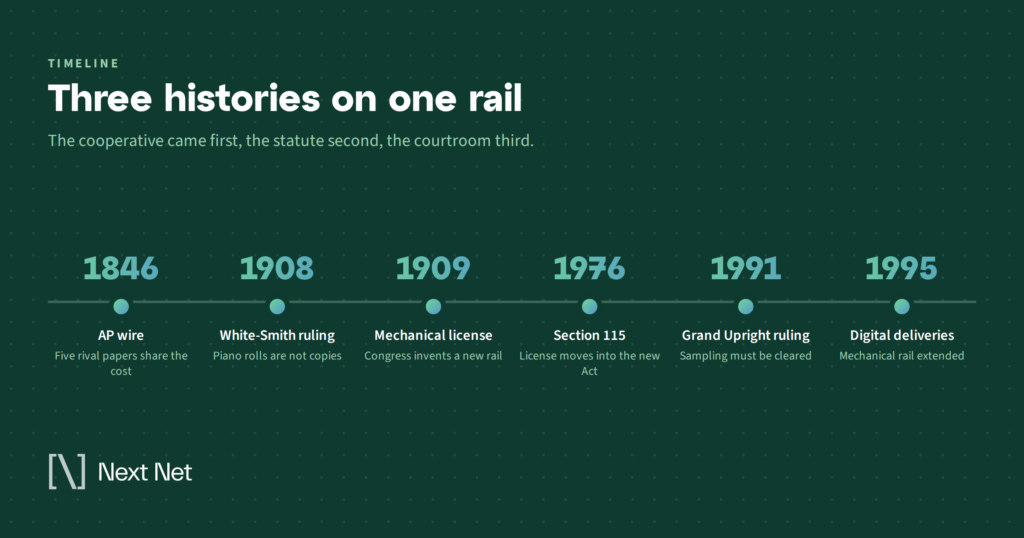
This post tells three of those stories. The AP wire, the mechanical license that player pianos forced out of Congress in 1909, and the sample clearance market that a 1991 court ruling created overnight. Each one is a case of content owners meeting a technology that used their work in a way no existing deal covered, and each one ended with a new kind of transaction that had not existed the year before. The three histories are the argument. AI is the fourth chapter, and it is being written now.
What Payment Rails Are, and Why Every New Medium Needs Its Own
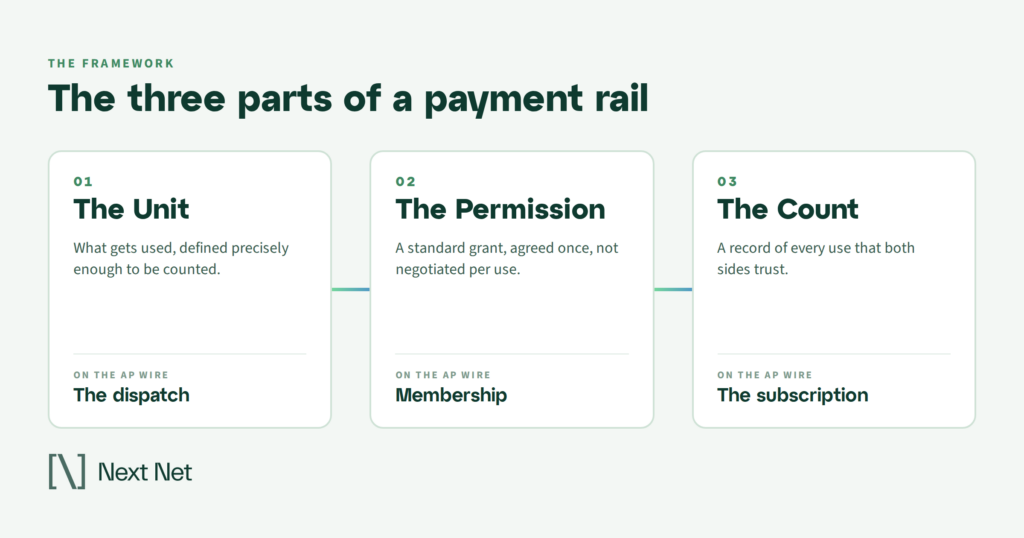
Payment rails, in the sense this post uses the term, are the standing infrastructure that lets many buyers pay many content owners for a specific kind of use without negotiating each transaction from scratch. They combine three things: a defined unit of use that both sides recognize, a standard way to grant permission for that unit, and a way to count uses so money can follow them. Every technology that consumes content at scale eventually gets a set of rails built for it, because the alternative is either unpaid use or a market so slow it never forms.
The word rails matters. Nobody negotiates with the railway each time they ship a box. The track is there, the price is known, the box moves. Rails turn a right you hold on paper into money you receive on a schedule.
Publishers hold the right today. What they mostly lack is the track.
1846: The Telegraph and the AP Wire
The telegraph did not steal from newspapers. It did something more disorienting. It made the newspapers’ own product, timely information, worth more than it had ever been, while making the cost of gathering it at speed too high for any single paper to bear.
Valerie Komor, who directs the AP’s corporate archives, describes the mechanics in an essay for New America. Dispatches left Veracruz by boat, landed at Mobile, and went by express rider to Montgomery, where they rejoined the mail to Richmond, the nearest telegraph head. The Sun’s publisher, Moses Yale Beach, refused to pay his riders unless they beat the mail by a full day. And he offered his four largest rivals an equal share in the whole scheme.
Komor makes a point that is easy to miss. If a telegraph office limited each sender to fifteen minutes on the wire, there was no reason for five agents to wait in line and send five copies of the same dispatch. The scarce resource was the line, not the news, and that rewarded cooperation.
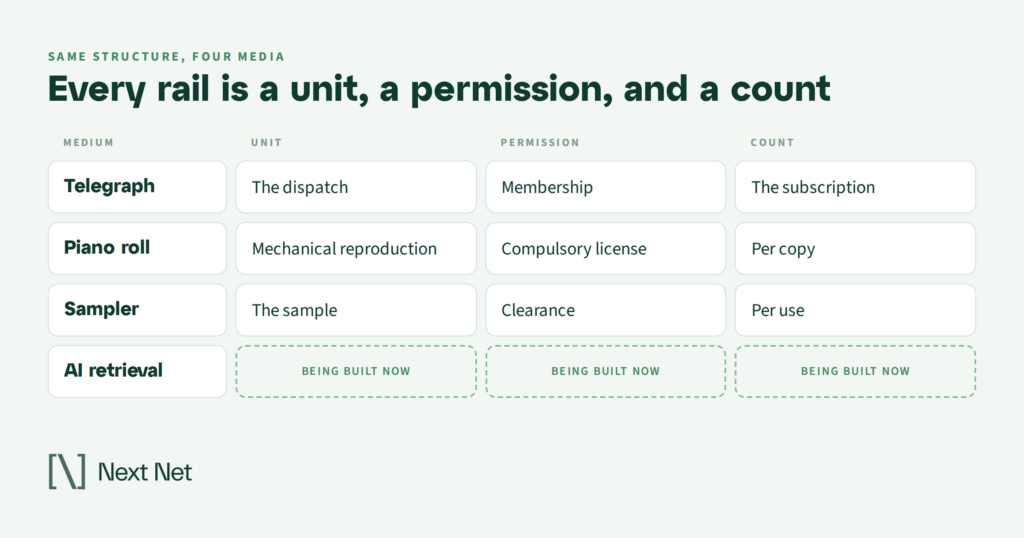
So the publishers built the rails together. As the wire spread west, the AP began selling telegraphic news to papers in other cities, and those papers paid their share and contributed their own local reporting back. The unit of use was the dispatch. The permission was membership. The count was the subscription. The AP’s own account of its 180th anniversary still describes the founding in those terms: a handful of executives looking to save money on coverage who ended up building the backbone of the industry.
Here is the part publishers should sit with. The AP is a not-for-profit cooperative owned by the newspapers that use it. The people whose work the telegraph made valuable ended up owning the infrastructure that carried it. They did not license the wire from someone else. They were the wire.
That is the best outcome any of these three stories reaches, and it came first, from the weakest position, with the least law on the publishers’ side. Nobody made the papers do it. The alternative was paying for the same thing five times.
1909: The Player Piano and the Mechanical License
Sixty years later a different technology arrived, and this time the content owners lost the first round.
A player piano reads a perforated paper roll. By the early 1900s the rolls were a mass market, and the companies punching them were reproducing popular songs without paying the people who wrote them. The songwriters sued. In 1908 the Supreme Court ruled in White-Smith Music Publishing Co. v. Apollo Co. that a piano roll was not a copy of the song at all. It was a part of a machine. Copyright covered sheet music a person could read, and a roll of holes was not that.
The composers had a right that the technology had walked around. The Register of Copyrights, Marybeth Peters, laid out what happened next in testimony before the House Judiciary Committee on the license’s history. Songwriters had been lobbying since 1905 for an exclusive right to authorize mechanical reproduction of their work. In the Copyright Act of 1909, Congress gave it to them.
Then Congress did something no one had done before. It worried that one company, already dominant in player pianos, could buy up exclusive mechanical rights to the popular catalog and control the roll market. So instead of a pure exclusive right, the 1909 Act created a compulsory license: once a copyright owner had allowed a first mechanical reproduction of a song, anyone else could make their own by paying a fixed statutory royalty per copy and filing a notice.
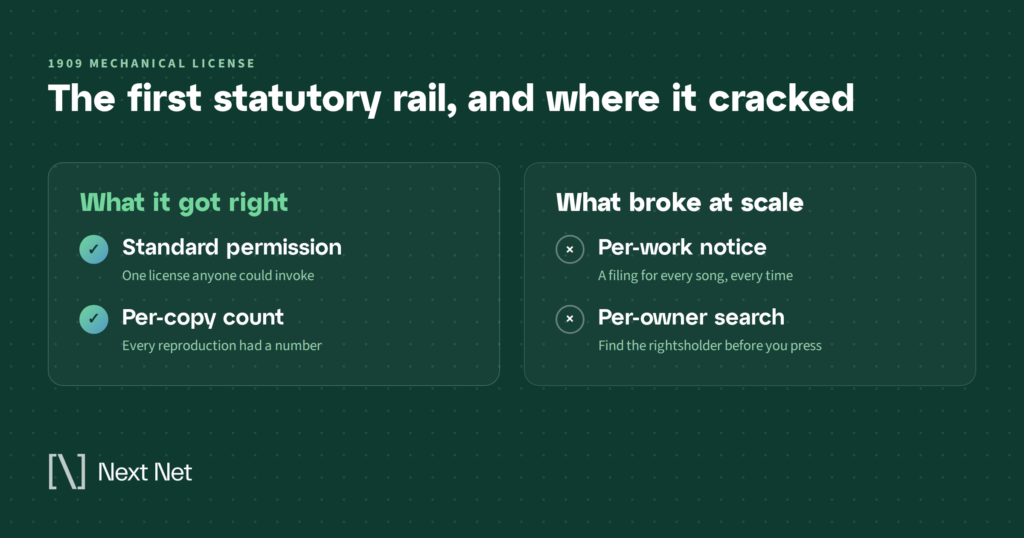
Read what that is. A new unit of use, the mechanical reproduction. A standard permission that did not require asking, only paying. A count, per copy manufactured. Congress invented a transaction type in one section of one statute, and it proved durable. The same license, moved to Section 115 of the 1976 Act and extended in 1995 to digital deliveries, is the reason cover versions exist. Peters told the committee the license had, over nearly a century, helped produce a strong and vibrant music industry.
She also told them what was wrong with it, and this is the part that matters for AI.
The 1909 rails were built for a world of dozens of roll manufacturers and thousands of songs. Every use required a separate notice served on each copyright owner, after a search of Copyright Office records to find them. Peters testified that in the year before her appearance, the Office had received notices covering a couple hundred song titles, against services offering hundreds of thousands. The license was legally available and practically unusable at scale. Her first choice, she said, would be to replace it with collective blanket licensing on the model the performing rights organizations use.
So the mechanical license teaches two things at once. A legislature can build rails when content owners cannot. And rails built around a per-item, per-owner notice will not survive a medium that consumes catalogs.
1991: Sampling and the Clearance Market
The third story is the fastest and the least tidy, and publishers will recognize themselves in it.
By the late 1980s digital samplers let a producer lift a few seconds of an existing recording and build a new track on top of it. The practice was everywhere in hip-hop, and the prevailing attitude was that everyone did it, so nobody paid. Then Biz Markie’s label released a track built on Gilbert O’Sullivan’s recording of “Alone Again (Naturally)” after O’Sullivan had declined to license it.
Judge Kevin Duffy’s opinion in Grand Upright Music v. Warner Bros. Records is short, and it opens with the Seventh Commandment. The defendants had argued, in effect, that unlicensed sampling was standard practice in their business and should therefore be excused. Duffy called that argument its own refutation. He granted the injunction and referred the matter to the United States Attorney.
Two details in that opinion matter more than the outcome. First, the label’s own lawyer had written to O’Sullivan’s agent asking for terms before the record came out, which the judge read as proof that everyone involved knew a license was required. Second, the court noted that Warner Bros. Records already had a department set up to obtain sample clearances. The transaction existed. The market was there. What the industry had been doing was skipping it because skipping it was cheaper.
After December 1991, skipping it was not cheaper. Sample clearance became a standard step in record production, with terms negotiated per use and revenue flowing to the owners of the recordings and compositions sampled. Sampling did not stop. It became a licensed input, and the catalogs being sampled became income they had not been before.
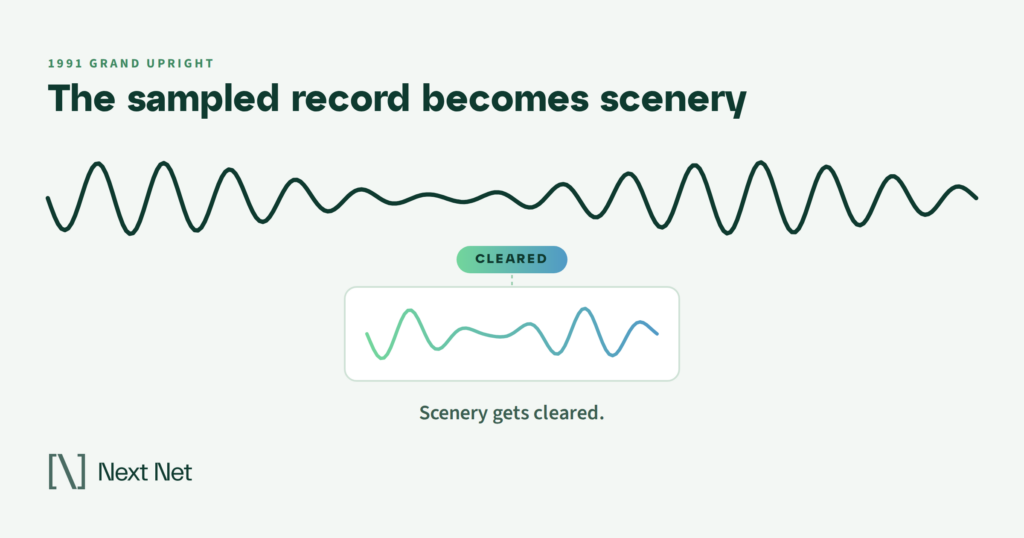
Look at what the sampled record is inside the new track. It is scenery. A loop under a verse, a horn stab in a chorus, the texture that makes the room feel like somewhere. The producer is not selling the old song. The producer is selling a new song that the old one furnishes. Duffy’s ruling said scenery gets cleared, and that the argument that the sample was just background was not a defense.
But notice what the sampling story did not produce. There is no compulsory sample license and no collective. Every clearance is a bilateral negotiation, and rights holders can refuse. That makes the sample market expensive and slow, and it favors artists with lawyers and labels with budgets. The rails were built by a court, one case at a time, and they still carry the marks of that.
What the Three Stories Have in Common
Set them side by side and the same shape appears three times.
The technology did not ask permission. The telegraph, the piano roll, and the sampler each used content in a way no existing arrangement covered, and each did so because it was easy, not because anyone had decided to cheat.
The existing law was not enough on its own. The AP had no law at all, only shared cost. The composers had a copyright the Supreme Court read narrowly. The sampled artists had a clear copyright that the market had been ignoring for a decade. Holding a right was never the hard part.
A new transaction type had to be built. The wire subscription. The mechanical license. The sample clearance. None of these were obvious in advance, and each one had a defined unit of use, a standard permission, and a count at its center.
The industry that got taxed grew. Newspapers became a national industry on the wire. Recorded music became a business under a compulsory license. Sampling survived clearance and became part of the mainstream of popular music.
And one thing that was different each time: who built the rails. The publishers built the AP. Congress built the mechanical license. A judge built the clearance market. The results ranked in that order. Cooperative infrastructure owned by the content side has outlasted everything, the statutory license worked until scale broke its notice machinery, and the litigation-built market remains the most expensive and least fair of the three.
Rails you build are an asset. Rails built for you are a bill.
AI Is the Fourth Chapter
Put the current situation into the same frame.
The technology is retrieval-augmented AI: systems that fetch web content to ground an answer they present as their own. The engines publishers deal with are ChatGPT, Gemini, Perplexity, Copilot, and Google AI Overviews, and the count keeps growing. Like the telegraph, the technology has made publishers’ work more valuable to someone else. Like the piano roll, it has walked around the existing legal categories. Like the sampler, it has treated everyone-does-it as a defense.
The existing law is being argued in court and this post does not predict the outcome. What the three histories say is that the outcome will not, by itself, settle anything. The composers won in 1909 and still needed a new license. The sampled artists won in 1991 and still needed a clearance department. A ruling tells you that you are owed. It does not build the track.
So the question is the one the New York publishers faced in 1846. What is the unit of use, what is the standard permission, what is the count, and who owns the infrastructure that connects them?
On the unit, the work is underway. Machine-readable rights standards are the emerging vocabulary for stating what a piece of content permits. We covered why that layer, the transaction rail, and the receipt are still missing in our post on the AI content payment gap, and how the pieces relate.
On the count, publishers have an advantage no previous generation had. The 1909 license needed paper notices. The performing rights organizations needed decades of logs and sampling to reach a usable census, a story we told in full in our post on radio royalties. AI retrieval already happens through software. A record of every use can be written at the point of use if the interface is built to write one. The meter that took the music business half a century is an engineering task now.
On who owns the rails, the histories are unambiguous. The AP outcome, where the content side owns the infrastructure, is the one to aim for. It requires publishers to do what the five New York papers did, which is to treat the transaction layer as shared infrastructure rather than as one more bilateral deal.
That is the design principle behind SAIL, the Standardized Agentic Intelligence Ledger. SAIL is built so that content travels as a rights-managed object carrying its own terms, so that policy is enforced at the point of retrieval rather than by contract after the fact, and so that every use is recorded to a verifiable ledger the publisher can read. It is meant to be the unit, the permission, and the count in one layer, compatible with the rights standards now emerging rather than a replacement for them. Next Net created SAIL, and the publisher page explains how it works.
What Publishers Can Do With This Now
The three histories reduce to a short list.
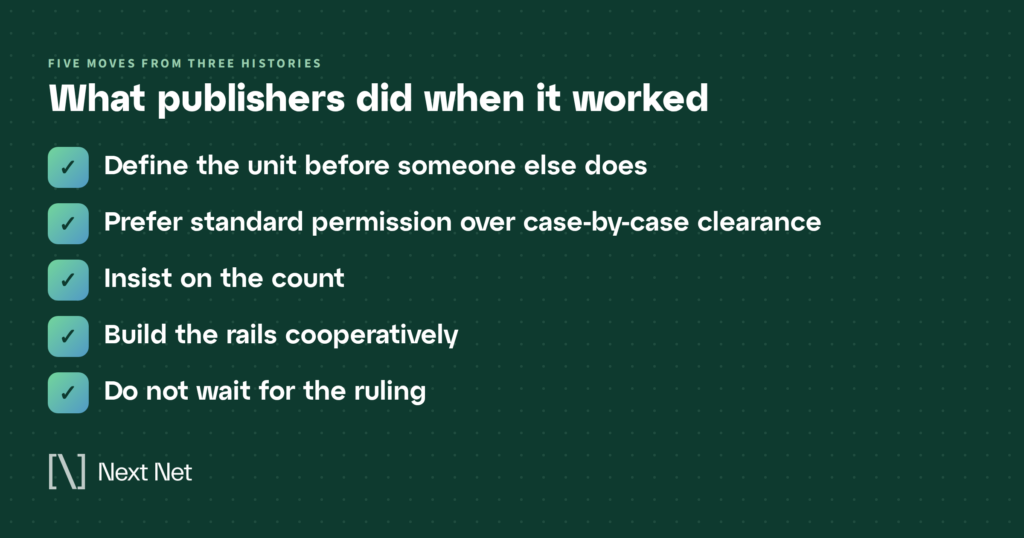
Define the unit before someone else does. The AP defined the dispatch. Congress defined the mechanical reproduction. Publishers should be defining the retrieval, the citation, and the answer-level use in terms a machine can read, because whoever defines the unit sets the terms of the count.
Prefer standard permission over case-by-case clearance. The sampling market is the warning. Bilateral clearance works, but it is slow, expensive, and tilted toward the largest players. A standard permission that any compliant system can accept, with a price attached, scales in a way negotiated deals never will.
Insist on the count. A license without usage reporting is the flat-fee deal, and it leaves you with no data at renewal. Every conversation about AI licensing should start with what gets recorded, not with the number.
Build the rails cooperatively, or at least compatibly. The five New York papers did not each build a wire. Publishers adopting the same rights vocabulary and the same ledger conventions are doing the 1846 move, and they are the ones who will own the infrastructure instead of paying rent on it.
Do not wait for the ruling. Every one of these stories has a court case in it, and in none of them did the court case build the rails. The composers were lobbying before White-Smith was decided. The AP had a working wire before anyone thought to litigate.
Frequently Asked Questions
What are payment rails for content?
Payment rails for content are the standing infrastructure that lets many users pay many content owners for a specific kind of use without negotiating each transaction individually. They consist of a defined unit of use, a standard permission covering that unit, and a count that lets money follow use. The AP wire subscription, the mechanical license for musical reproductions, and the sample clearance market are three historical examples, each built after a new technology began using content in a way no existing arrangement covered.
Why was the Associated Press founded?
The Associated Press was founded in May 1846 when five New York newspapers agreed to share the cost of moving news of the Mexican-American War north by express rider, mail coach, and telegraph. The telegraph had made speed decisive and the cost of speed too high for any single paper, so rivals pooled resources and split the result. The arrangement became a not-for-profit cooperative owned by its member newspapers, which is the structure the AP still has.
What is a mechanical license?
A mechanical license is the permission to reproduce a musical composition in a physical or digital recording. In the United States it is a compulsory license created by the Copyright Act of 1909 in response to player piano rolls: once a copyright owner has authorized a first recording of a song, anyone else may make their own recording by paying a statutory royalty per copy and serving notice. The license now lives in Section 115 of the Copyright Act and was extended to digital phonorecord deliveries in 1995.
What did Grand Upright Music v. Warner Bros. Records decide?
Grand Upright Music v. Warner Bros. Records, decided in the Southern District of New York in December 1991, held that using a portion of a copyrighted recording and composition in a new track without a license was infringement, and rejected the argument that widespread unlicensed sampling in the industry excused it. The court granted a preliminary injunction and referred the matter for possible criminal prosecution. The practical effect was that sample clearance became a required step in record production.
Does AI need a new kind of license?
Structurally, yes. Every previous technology that consumed content at scale ended up with a transaction type built specifically for it, because existing categories did not fit the new use. AI retrieval has the same problem: it is not a copy in the traditional sense, not a broadcast, and not a sale. The legal questions are being litigated, but the histories suggest that a ruling alone will not produce a market. A defined unit of use, a standard machine-readable permission, and a per-use count have to be built, and publishers do best when they build them together.
The Rails Came Before the Rulings
The five papers that founded the AP did not have a law on their side. They had a shared problem and a new machine, and they built the transaction the machine needed before anyone told them to. Sixty years later Congress had to build one for composers. Eighty years after that a judge had to build one for the people being sampled. The content owners who did best were the ones who built the rails themselves.
AI is the fourth time. The unit, the permission, and the count all have to exist before publishers get paid at scale, and the histories say the content side should own as much of that infrastructure as it can.
If you want to see what a rights-managed object with a ledger attached looks like for your catalog, that is what SAIL was built to do.
Related Articles
On September 15, 2026, Cloudflare flipped a default that touches a large slice of the web. Training and Agent crawlers…

Every year or so a new file shows up at the root of publisher sites, and this cycle’s file is…
Every few weeks another headline lands: a publisher sues an AI company, an AI company calls the claim meritless, and…