
What Radio Royalties Teach Publishers About Getting Paid by AI

In 1922 a radio station could play a hit song a dozen times in an afternoon and send the person who wrote it nothing. Not a check, not a notice, not a count. The composer found out the same way everyone else did: by turning on the radio.
The stations were not stealing, exactly. They were doing what the technology made easy, and there was no mechanism for doing anything else. Advertisers paid the station. The songwriter sat outside the transaction with no way in.
If that sounds like a description of AI answers built from your reporting, it should. The pattern is the same one, and this is the part most publishers have not heard: the music business solved it. Not by winning a lawsuit, or by refusing to be played, or by signing one-off deals with the biggest stations. It solved it by building a system, and the system made radio and music both larger than they had been before.
This post tells that story properly, because the details are where the lessons live: why no composer could fix the problem alone, the ruling that supplied the moral logic, how a blanket license broke the deadlock, why usage tracking turned a fee into a royalty, and where the AI script matches the radio script line for line.
What Radio Royalties Are, and Why They Took Thirty Years
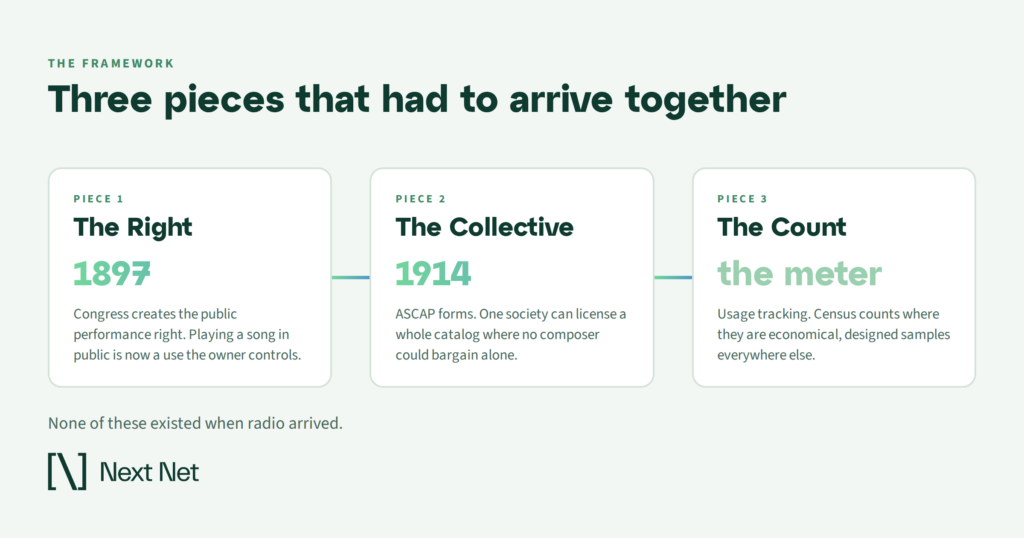
Radio royalties are the payments broadcasters make to songwriters and music publishers for playing their work on the air. They are collected through blanket licenses issued by performing rights organizations, which grant a station the right to play an entire catalog for a single fee, and they are distributed to individual rights holders according to tracked usage. The system rests on three pieces that had to arrive together: a legal right to be paid for a performance, a collective body that could license at scale, and a way to count what was played.
None of those pieces existed when commercial radio arrived. The legal right came first, and it was a paper right for a long time. The collective came next, and radio fought it for two decades. The counting came last, and it is the piece that made the whole thing fair.
Publishers today have some version of the first piece. They have almost none of the other two. That is the gap the rest of this post is about.
The Problem Was Scale, Not Bad Faith
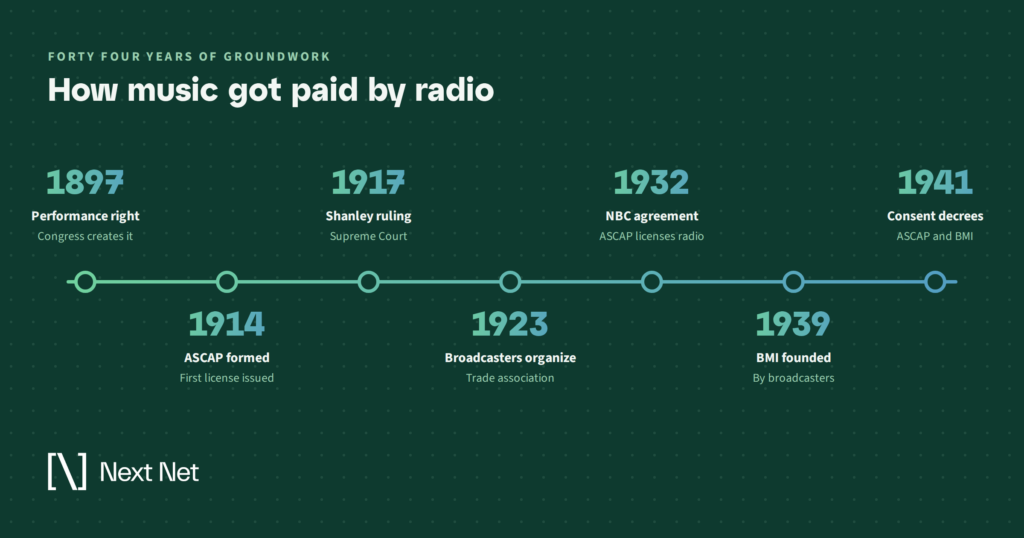
Congress gave songwriters the exclusive right to authorize public performances of their work in 1897, according to the Congressional Research Service. The right sat on the books for seventeen years before anyone built a way to enforce it, and the reason is worth sitting with, because it is the same reason publishers struggle now.
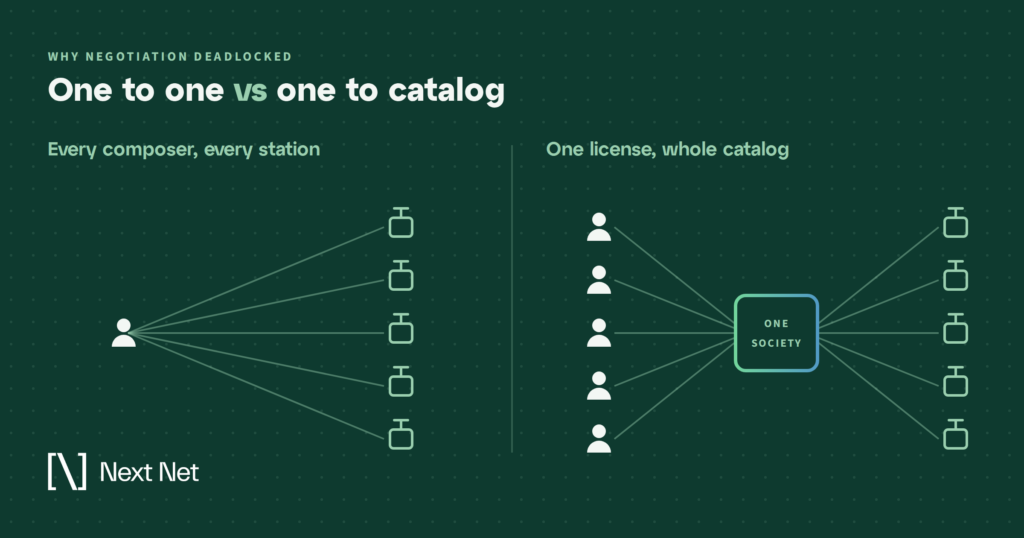
Songwriters in that era made their living from sheet music. A hit meant copies sold at the counter. The idea that a restaurant orchestra playing your song during dinner owed you something was legally true and practically unenforceable. There were thousands of restaurants, hotels, dance halls, and theaters. A composer would have needed to know where every performance happened, prove it, and then negotiate with each venue one at a time.
No composer could do that. Not Irving Berlin, not Victor Herbert, not John Philip Sousa. The most successful songwriters in America had a right they could not exercise, because exercising it required monitoring and negotiation at a scale no individual could reach.
So the venues played the music, profited from the atmosphere, and paid for the sheet music and nothing else. Nobody was refusing to pay. There was nothing to pay through.
Hold that against the current picture. Dozens of AI products retrieve web content to ground their answers, and the count keeps rising. A publisher wanting to be paid would need to know which systems used which articles in which answers, prove it, and negotiate with each one. The largest publishers have managed a few bilateral deals. Everyone else has the composer’s problem in 1910: a right on paper and no way to collect on it.
The Shanley Ruling Supplied the Moral Logic
In 1917 the Supreme Court took up two cases at once. In one, the Vanderbilt Hotel had its orchestra play a copyrighted march in the dining room during meals. In the other, Shanley’s Restaurant on Broadway had professional singers perform Victor Herbert’s song “Sweethearts” on a stage while diners ate. Neither business charged admission to hear the music. Both argued that since nobody paid at the door, no performance for profit had taken place.
Justice Oliver Wendell Holmes disagreed, and the opinion in Herbert v. Shanley Co. is short enough to read over coffee. The music was part of a total for which the public pays, Holmes wrote, and it did not matter that the price was nominally attached to the food. The object was a meal in surroundings that made it pleasant. If the music did not pay, the restaurant would give it up. If it did pay, it paid out of the public’s pocket. Whether it paid or not, the purpose of employing it was profit, and that was enough.
That last line is the moral logic of every royalty system built since. If content helps your business earn, you pay for the content. You do not get to argue that it was incidental, or that you charged for something else, or that the audience was really there for the food.
Notice what the orchestra was in that dining room. Scenery. The thing that made the room feel like somewhere worth sitting. Holmes ruled that scenery gets paid, because scenery is part of what the customer is buying.
An AI answer is the same kind of room. The user came for the answer, not for your article. Your article is in the walls, uncredited most of the time, doing the work that makes the answer worth reading. The argument that the article was incidental, that the user paid for nothing, that the system just happened to have it on hand: that is Shanley’s argument, and it lost in 1917.
The ruling did not create a payment system. It created the reason one had to exist.
The Blanket License Broke the Negotiation Deadlock
Three years before Shanley, in February 1914, a group of composers and publishers had formed the American Society of Composers, Authors and Publishers in New York. The Library of Congress holds the first ASCAP ledger book and the first license it ever issued, to Rector’s Restaurant in October 1914, permitting the house orchestra to perform anything in the ASCAP repertory.
That license is the invention. Instead of a composer negotiating with a venue over a song, a society representing thousands of composers negotiated over the whole catalog at once. One contract, one fee, everything covered. The society sat in the middle and did the part neither side could do alone.
Then radio showed up, and the fight started over.
Broadcasters in the early 1920s did not accept that the restaurant logic applied to them. A station reached far more people than any dining room, which made the fee larger, and the stations argued the exposure was doing songwriters a favor. Airplay sold sheet music and records. Why should the station pay for delivering an audience?
Station owners organized a trade association in 1923 largely to resist ASCAP’s fees, and the dispute ran through the decade. The Library of Congress exhibit includes ASCAP’s 1932 licensing agreement with the National Broadcasting Company, by which point the primary venue for music had moved from the restaurant floor to the radio studio and the society had followed it there.
The exposure argument is the one to underline. It is exactly the argument AI companies make now: retrieval sends you traffic, citation is a form of promotion, you should want to be in the answer. It was not a crazy argument in 1925 and it is not a crazy argument today. It was also not a reason to pay nothing. Radio did promote music. Radio also earned from music. Both were true, and the blanket license priced the second without denying the first.
Usage Tracking Turned a Fee Into a Royalty
A blanket license solves the collection problem. It does not solve the distribution problem, and the distribution problem is where fairness lives.
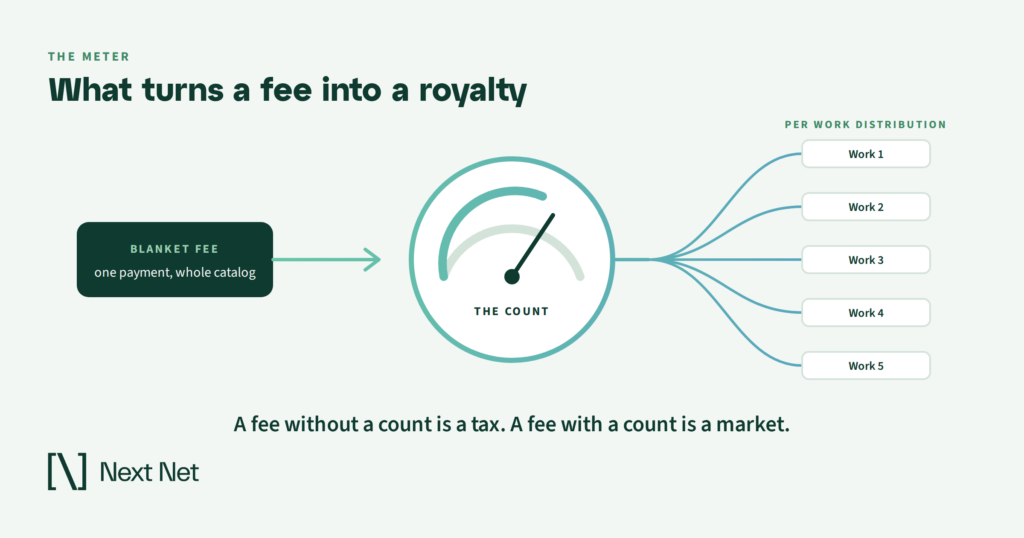
If a station pays one fee for the whole catalog, how does the money reach the songwriter whose work it played? A song played four hundred times should earn more than a song played twice, and the only way to know which was which is to record what went out over the air.
This is the piece people skip when they tell the ASCAP story, and it is the piece that matters most for publishers. ASCAP describes its own method plainly: whenever it is economically sensible, it conducts a census, a complete count, of performances in a medium, and where a census is impractical it runs a statistically designed sample that covers every region, every time of day, and every size of station. Royalties are then split among members based on play frequency, among other factors, as the Congressional Research Service summarizes it.
Early on the counting was crude: logs, cue sheets, sampled hours. It improved as technology got cheaper. The principle never changed. Money follows use, and use has to be measured to be followed.
A fee without a count is a tax. A fee with a count is a market.
Publishers today are being asked to accept the tax version. Flat licensing deals, where they exist, pay a lump sum for catalog access with no record of what was retrieved or how often. The publisher has no data on which to renew and no way to know whether the deal was good. We covered why that measurement is the piece everything else waits on in our post on the AI content payment gap. The radio history says the same thing from the other direction: the royalty system became fair the day it could count.
The Royalty System Grew the Industry It Taxed
Here is the takeaway the broadcasters of 1923 would not have believed.
Radio did not shrink under the weight of music licensing. It became the dominant medium of the century. Music did not shrink either. The performance right, once it could be collected, became a second income for songwriters alongside sales, and then a larger one.
The system also did not stay a monopoly. In 1939 broadcasters founded a competing rights organization, BMI, to gain leverage against ASCAP, and in 1941 both organizations entered antitrust consent decrees with the Department of Justice. The decrees, as the Congressional Research Service describes them, required the societies to hold only nonexclusive rights, so songwriters could still license directly if they chose, and to grant a license to any applicant on equal terms with similarly situated licensees.
Read that second condition again. Any station that wanted a license could get one. Nobody could be shut out of the catalog. The stations that had spent two decades fighting to avoid paying ended up with guaranteed access to everything, at rates a court could review, in exchange for paying at all.
That is what a working payment layer looks like from the licensee’s side. It is not a barrier. It is a door that is always open, with a price on it.
The competition mattered too. BMI signed writers ASCAP had overlooked, and whole genres that had been shut out of the licensing system started earning from airplay. The catalog got bigger because more people could get paid for contributing to it. More music, more stations, more listeners, more money in the pool. The tax grew the base.
There was a fight in the middle of all this. For most of 1941 the networks kept ASCAP music off the air rather than pay a rate increase, and listeners spent months hearing public domain standards and BMI’s new catalog. It ended in a compromise, and radio kept growing straight through it. Neither side could afford to walk away for long, because both were earning from the same thing.
Where the AI Script Matches the Radio Script
Set the two stories side by side.
No composer could negotiate with every station. No publisher can negotiate with every AI product. The scale problem is the same shape, and it rules out one-to-one deals as the answer for anyone but the very largest catalogs.
Exposure as compensation. Traffic as compensation. Both have some truth in them. Neither is a reason to pay nothing.
The blanket license. A standardized way for a system to acquire rights across a catalog without negotiating every item. Machine-readable rights standards are the emerging vocabulary for this. The web is roughly where music was in 1914: the first licenses are being written and most of the market has not signed one.
The count. The piece with the least progress. Radio needed decades of logs and sampling to reach a usable census. Publishers can skip that part, because retrieval already happens through software, and software can write a record of every use if the interface is built to do so.
Guaranteed access at a reviewable price. The consent decrees gave stations a license on demand. A working content payment layer will look similar from the AI side: any system that agrees to the terms gets in, and the terms are visible. That is a better deal than the current mess of blocks, lawsuits, and bespoke contracts.
The one place the analogy strains is speed. Radio’s fight ran from 1923 to 1941. Publishers do not have eighteen years, but they do not need them, because the hard part of the system is already understood. It has been running in another industry since before their grandparents were born.
What Publishers Can Do With This Now
The history gives you a checklist. Four items.
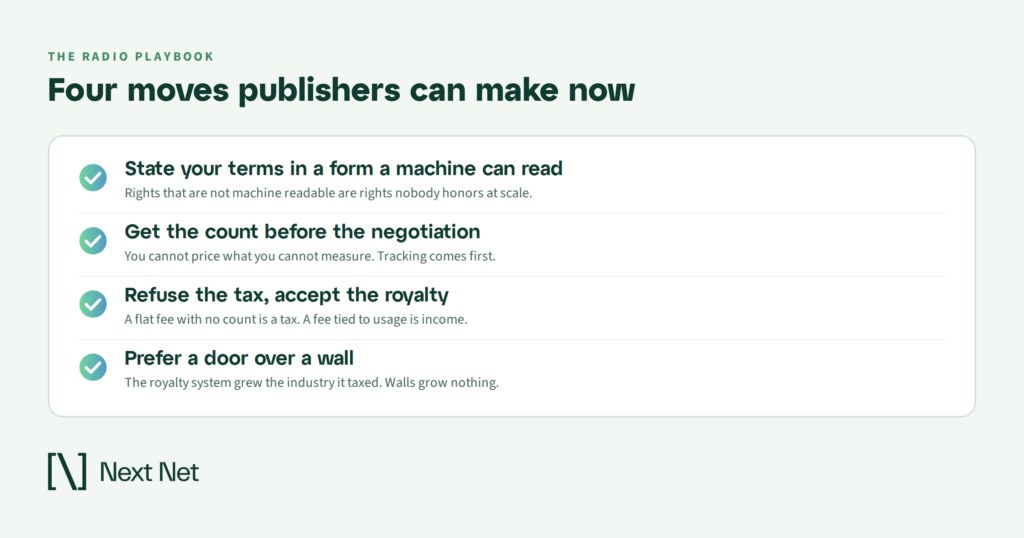
State your terms in a form a machine can read. The composers’ first move was to pool a catalog and attach terms to it. Publishers can do the equivalent at the object level, with rights that travel with each piece of content. Terms nobody can read are terms nobody will honor.
Get the count before the negotiation. Every licensing conversation you enter without usage data is a conversation you are having from the weaker side. Start by learning which sources AI systems already trust in your coverage area and where your content is showing up, so you are not guessing about your own leverage.
Refuse the tax, accept the royalty. A flat fee for open access is the 1910 deal. A fee tied to tracked use is the 1941 deal. If a licensing offer has no reporting attached, the reporting is what you should be asking for first, before the number.
Prefer a door over a wall. Blocking AI crawlers works today, and it also removes you from the fastest-growing discovery surface in media. The composers did not keep their music out of restaurants. They made the restaurants pay. Being present in AI answers on your own terms is the goal, and a door with a price on it gets you there.
That fourth point is what SAIL, the Standardized Agentic Intelligence Ledger, is designed to make possible: content carried as rights-managed objects, policy enforced at the point of retrieval, and every use recorded to a verifiable ledger that gives you the count. It is the meter and the license in one layer, built for compatibility with the rights standards now emerging. The details are on our publisher page.
Frequently Asked Questions
What are radio royalties?
Radio royalties are payments broadcasters make to songwriters and music publishers for playing their work on the air. In the United States they are collected mainly by performing rights organizations, which issue a blanket license covering an entire catalog for a single fee and distribute the money to rights holders based on how often each work was played. The system rests on a performance right Congress created in 1897, a 1917 Supreme Court ruling that a business profits from music even without charging admission to hear it, and decades of usage tracking.
How did ASCAP get radio stations to pay?
Slowly, through litigation, collective bargaining, and a license model that was easier to accept than to fight. ASCAP formed in 1914 and won the Shanley case in 1917, which settled the principle. Broadcasters organized in 1923 to resist the fees and disputed them for most of two decades, arguing that airplay promoted music. By 1932 the society had a licensing agreement with NBC. In 1939 broadcasters founded BMI as a competing society, and in 1941 both entered consent decrees requiring them to license any applicant on equal terms. The stations ended up with guaranteed access to the catalog in exchange for paying for it.
What is a blanket license?
A blanket license is a single agreement that grants the licensee the right to use every work in a rights organization’s catalog for a set fee, usually a flat amount or a percentage of the licensee’s revenue. It replaces item-by-item clearance with one contract, which is what makes licensing at scale possible. The licensee gets simplicity and certainty. The rights holders get collection they could never manage individually. Distribution of the pooled fee to individual works depends on tracked usage, which is why blanket licensing and performance monitoring developed together.
Does AI owe publishers royalties the way radio owes songwriters?
The legal question is being argued in court and this post does not answer it. The structural question has a clearer answer: the situations rhyme. An AI system that uses a publisher’s article to produce a paid or ad-supported answer is earning from that content the way a restaurant earned from its orchestra, and the argument that the content was incidental is the argument the Supreme Court rejected in 1917. What is missing is not the principle but the machinery: machine-readable terms, a license model that works at scale, and a record of what was used. Radio had to build all three. Publishers are earlier in that process than they should be.
What is a usage-based license?
A usage-based license ties payment to measured use rather than charging a flat fee for open access. In music, the blanket fee is collected up front but distributed according to how often each work was performed. For publishers dealing with AI systems, a usage-based license would pay according to how often and how heavily each piece of content was retrieved or relied on in an answer. It requires a reliable count of use, the same prerequisite the music industry spent decades meeting and the piece most publishers currently lack.
The Meter Came Before the Market
The composers of 1914 had a right they could not enforce, an audience that could not reach them, and a new technology that used their work constantly and paid for none of it. They did not fix that by winning an argument. They fixed it by building a collective that could license at scale, winning a ruling that said scenery gets paid, and counting what was played so the money reached the people who earned it.
The industry they taxed grew. So did theirs.
Publishers are at the 1914 mark with a 2026 clock. The right exists, the argument is familiar, and the machinery for licensing and counting can be built faster than the first time, because retrieval is already digital and the ledger is engineering rather than sampling hours off a broadcast.
If you want to see what a license with a meter attached looks like for your catalog, that is what SAIL was built to do.

Related Articles
Every year or so a new file shows up at the root of publisher sites, and this cycle’s file is…

Every few weeks another headline lands: a publisher sues an AI company, an AI company calls the claim meritless, and…
Ask a publisher whether AI is using their content and the answer is almost always yes. Ask them how, and…