
Add AI Visibility to Your Retainer Without Building the Tech

The request rarely arrives as a request. It arrives as a forwarded screenshot, or a line at the end of a status call: someone on the client side asked ChatGPT who the best provider in their category was, and the answer named three companies that were not them.
You already have the retainer. You already own their content, their technical work, and in a lot of cases their earned coverage. So the question is not whether AI visibility belongs to you.
It already does. The client decided that the moment they sent you the screenshot, and what you say in that first exchange sets the tone for everything after it.
The real question is what you have to build before you can answer them, and the honest answer is that most agencies badly underestimate it.
What It Means to Add AI Visibility Without Building the Tech
Adding AI visibility to a retainer without building the tech means folding AI answer measurement into an engagement you already hold, using a measurement layer you license rather than engineer. The agency keeps strategy, client relationships, and fulfillment in house. The infrastructure that queries AI engines on a schedule, parses the answers, and separates a mention from a recommendation is rented, the same way you already rent rank tracking and backlink data.
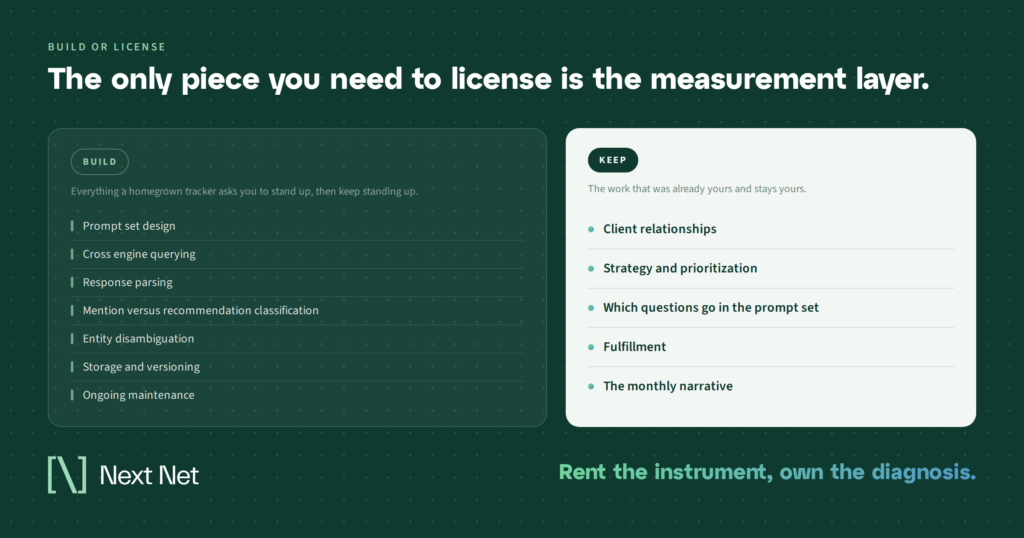
That definition draws a line most build-versus-buy conversations never draw clearly, so it is worth being precise about which side of it each piece of the work sits on.
Why This Lands on the Retainer and Not a New Line Item
There is a version of this post that tells you to package AI visibility as its own productized service with its own price. That version exists, and it is the right move for a lot of agencies. We wrote it.
This is the other version. The one where you have eleven active accounts, no appetite for a new sales motion this quarter, and a client who wants an answer before the next call.
Folding the work into an existing retainer has three practical advantages over launching a service line.
It requires no new sale. Expanding scope inside a live engagement is a conversation, not a proposal cycle, and the trust is already there.
It uses fulfillment you already run. The work that moves AI visibility is content built around the questions buyers really put to an engine, pages restructured so engines can parse and reuse them, and coverage on the sources engines already lean on in that category. If your retainer includes content and digital PR, you are looking at a targeting change rather than a capability gap.
And it protects the account. A client who forwards you an unflattering ChatGPT screenshot is a client testing whether you have an answer. Not having one is how retainers start to feel replaceable. The stakes are not theoretical either: Ahrefs research from December 2025 found that the presence of an AI Overview cuts the click-through rate for the top organic result by 58%, so a client who ranks first is already losing most of the clicks that position used to earn.
What none of that solves is measurement. You can retarget your content plan on Monday. You cannot tell the client what moved without a way to observe it, and observation is the part people assume is a weekend project.
What Building the Tech Really Involves
Almost every agency that considers building this pictures the same first version: a script that sends a list of questions to a few AI engines, saves the answers, and greps for the client’s name.
That version takes about a week and works about as well as it sounds.
Here is what sits between that prototype and something you would put in front of a paying client.
Prompt set design. The questions have to reflect how buyers in the category phrase things, cover the buying journey rather than one stage of it, and stay frozen once chosen, because a prompt set that drifts makes every trend line meaningless. This is judgment work, and it is the one part of the build worth doing yourself.
Cross-engine querying. ChatGPT, Gemini, Perplexity, Copilot, and Google AI Overviews each expose answers differently, and some of them do not expose them in a way a simple request can reach. Coverage across all five, on a schedule, without hitting rate limits or getting served a degraded response, is not a scripting problem.
Response parsing and classification. This is where naive builds break. A string match tells you the client’s name appeared. It does not tell you whether the engine recommended them, listed them as an also-ran, named them as an example of what to avoid, or was talking about a different company with a similar name.
Entity disambiguation is its own quiet nightmare, especially for clients with common brand names or a competitor operating in an adjacent vertical.
Storage, versioning, and comparison. Answers have to be stored in a shape you can diff, so that next month’s run can be compared against this month’s on the same axes. That means a schema decision you cannot easily unmake once you have six months of history in it.
And then maintenance, which is the line nobody puts in the estimate. Engines change their interfaces, their models, and their behavior on their own timetable. A tracker that worked in March is a tracker that quietly returns garbage in June unless someone owns it.
Every one of those is solvable. The question is whether a services business should be paying engineering salaries to solve a problem that is not the thing clients pay it for.
The Sampling Problem Nobody Scopes
Suppose you build all of it and it works. There is still a measurement problem underneath, and it is the one that makes homegrown trackers untrustworthy even when the code is fine.
AI answers are not stable the way a ranked results page is stable.
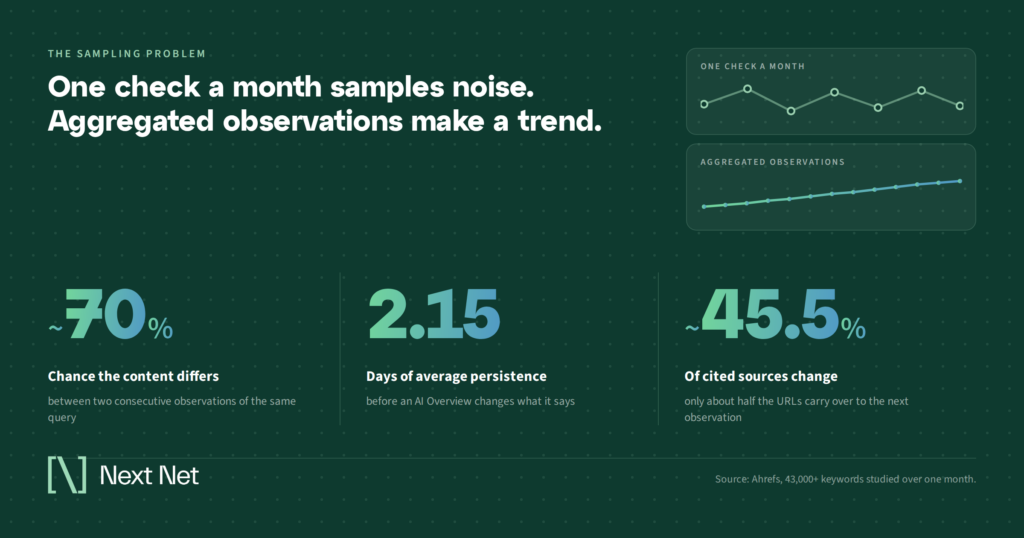
Ahrefs studied more than 43,000 keywords carrying AI Overviews over the course of a month and found that the content of an AI Overview has roughly a seven in ten chance of differing from one observation to the next, with an average persistence of about 2.15 days. Cited sources move at a similar rate: only about half the URLs carried over between consecutive observations of the same query.
Read that as an operating constraint rather than a curiosity.
If your tracker checks each question once a month, you are not measuring your client’s visibility. You are sampling a distribution one time and reporting the sample as if it were the distribution.
The client sees a number go up, then down, then up, with no relationship to anything your team did. Three cycles of that and they stop believing the report, which is worse than not having one.
The same research found the underlying meaning of those answers is remarkably consistent even while the surface churns, which is the useful half of the finding. Aggregate enough observations across enough questions and a real signal appears. Take one snapshot and you get noise wearing a chart.
That is a volume-of-queries problem, and volume of queries is an infrastructure problem. It is the specific reason a build that technically works still fails in front of a client.
What Search Console Gives You, and What It Does Not
There is one piece of this you do get for free, and it is worth knowing exactly where its edges are.
Google’s guidance on optimizing for generative AI search points site owners to the generative AI performance report in Search Console, which shows how content is performing in Google’s generative AI features. If your client has Search Console access, and they should, you have real data on one surface at no cost.
That surface is Google’s. It tells you nothing about ChatGPT, Gemini, Perplexity, or Copilot.
It also reports on your client’s pages rather than on your client’s brand. A page-level performance report cannot tell you that an engine recommended a competitor in an answer where your client was never mentioned, and that absence is usually the finding that matters most.
Google’s guidance is also direct about third-party tools that claim access to internal ranking systems: no outside tool has it. That is a healthy standard to hold any measurement layer to, including one you build. Report what you observed, at the resolution you observed it, and describe direction rather than promising outcomes.
Rent the Instrument. Own the Diagnosis.
The clean way to think about the split is to ask which parts of this work a client is paying you for.
They are not paying you for a query scheduler. They are paying you to know what the numbers mean and to do something about them.
So the things that stay yours are the ones that carry your judgment. Which questions belong in the prompt set, because you know the client’s buyers. Which gaps are worth working first, because you know what your team can move this quarter. What the movement means, and what you are doing about the parts that have not moved yet.
Client relationships stay yours. Fulfillment stays yours. The monthly narrative stays yours, and a white-labeled dashboard means the client logs into your brand rather than someone else’s.
What gets rented is the instrument. The scheduled querying across all five engines, the parsing, the difference between what AI links to and what it merely mentions, the stored history that makes a trend line possible.
You do not build your own rank tracker. This is the same decision with a shorter track record and a faster-moving target.
Folding It Into the Retainer You Already Have
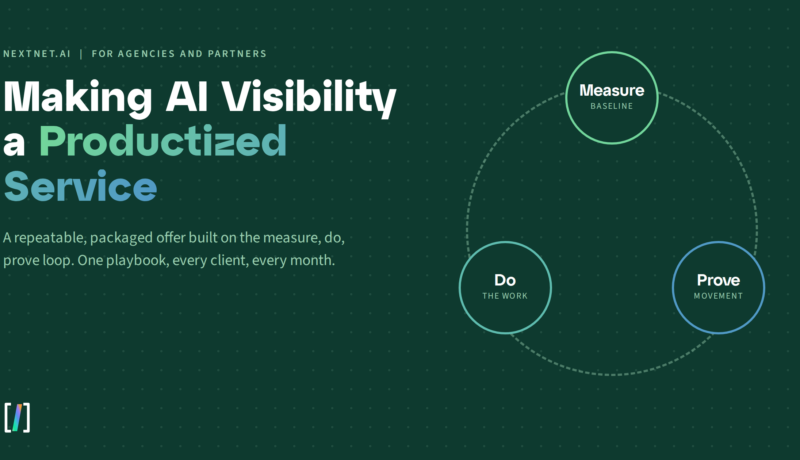
The operating pattern here is the measure, do, prove loop, and it works the same way inside an existing retainer as it does inside a standalone service. What changes is the sequencing, because you are absorbing rather than launching.
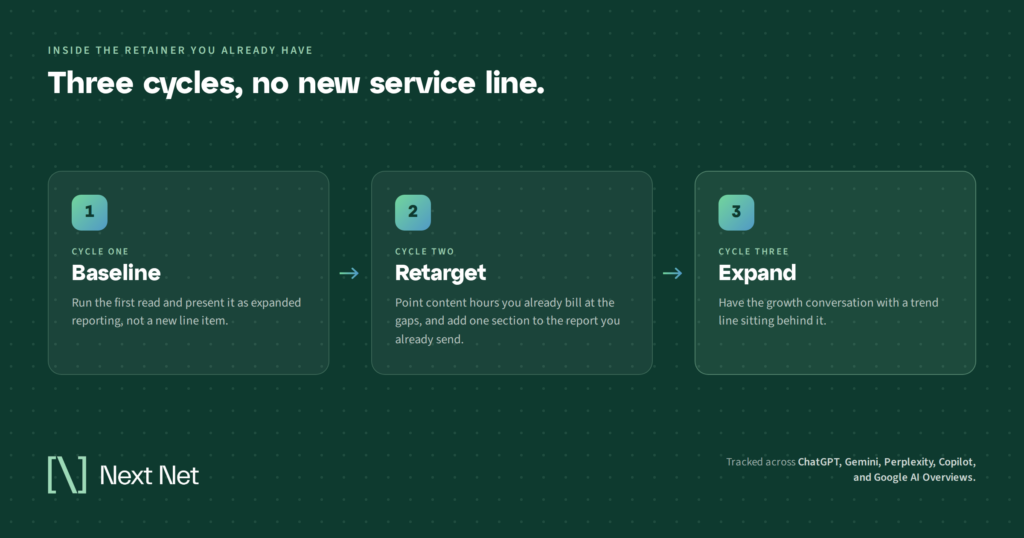
Start with a baseline in the first cycle and present it as an expansion of reporting rather than a new deliverable. Frame it the way it is: we have added visibility in AI answers to what we track for you, and here is where you currently stand.
Bring the client the gap, not the concept. Nobody needs a lecture on answer engines. They need to see the four questions their buyers ask where a competitor gets recommended and they are scenery.
Retarget existing hours before you ask for new ones. In most retainers, some share of the content calendar is already going to topics chosen by habit. Move that share to the topics the baseline flags as winnable, and the first cycle of AI visibility work costs the client nothing extra.
Add one section to the report you already send. A movement summary against baseline, the work that ran this cycle, and one thing the client would not have found on their own. Resist the urge to append thirty screenshots.
Then have the expansion conversation in cycle three, not cycle one. By then you have a trend line, at least one topic that moved, and a client who has watched it happen. That is a very different conversation from a proposal.
One thing to hold firm on: keep all three stages of the loop intact even at retainer scale. Measuring without doing turns the retainer into a subscription to bad news. Doing without proving puts you right back where you were, defending a line item on feel.
The Mistakes That Show Up in Month Three
Retainer integration has its own failure patterns, distinct from the ones that hit a standalone service.
Changing the prompt set mid-engagement. It is tempting, because you will think of better questions in month two. Do not do it. A changed prompt set resets your baseline and destroys the comparison the whole thing rests on. Park the better questions and add them as a labeled second set if you must.
Reporting a percentage the sample cannot support. If a topic segment rests on a handful of answers, call it a direction worth watching. A decimal point on thin data reads as rigor exactly until someone asks how it was calculated.
Letting the new work sit outside the retainer’s scope conversation. Silently absorbing measurement, analysis, and a new report section into a fixed fee is how margin disappears without anyone deciding to spend it.
Treating the baseline as the deliverable. A baseline is where the engagement starts. Clients who receive a document behave differently from clients who receive a service, and a one-time snapshot inside a retainer recreates the audit problem with extra steps.
Promising a number. Engine behavior is probabilistic, the surface moves every few days, and the moment you guarantee a share of voice figure you have staked your credibility on systems nobody controls.
Where NextNet Fits
NextNet is the instrument layer described above. Scheduled measurement across ChatGPT, Gemini, Perplexity, Copilot, and Google AI Overviews, run on a stable methodology, with baselines that separate being mentioned from being recommended and a stored history that turns cycles into a trend line.
Agency partners get white-labeled dashboards their clients log into directly, API-driven account and domain setup, and one admin view across every account on the roster. The strategy, the client relationship, and the fulfillment stay where they belong, which is with you.
The fastest way to evaluate any of this is on a real account rather than in the abstract. Run a free AI visibility report card on one client and see what the baseline conversation looks like. If you would rather talk through how we work with agency partners first, start there instead.
Frequently Asked Questions
Can an agency offer AI visibility without engineering resources?
Yes, and most agencies should. The work that moves AI visibility is content, technical structure, and earned coverage, all of which a services team already runs. The engineering-heavy part is measurement infrastructure, meaning scheduled querying across five engines, response parsing, and classification on a stable methodology. That part is licensed far more often than it is built.
How much does it cost an agency to build AI visibility tracking in house?
The build is not the expensive part. Ongoing maintenance is, because engines change interfaces, models, and behavior on their own schedule, and a tracker that stops matching reality returns confident nonsense rather than an error. Any honest estimate has to include a standing owner for that maintenance, not just the initial development window.
Does Search Console show AI visibility?
Partially. Search Console includes a generative AI performance report covering Google’s generative AI features, which is real data at no cost. It does not cover ChatGPT, Gemini, Perplexity, or Copilot, and it reports on your client’s pages rather than on how their brand is described in answers where their pages never appear.
How often should AI visibility be measured for a client?
More often than monthly at the query level, and reported monthly at the account level. Individual AI answers change every couple of days, so a single monthly check samples noise. Aggregating many observations across a fixed question set is what produces a trend line a client can trust.
Should AI visibility be a separate service or part of the existing retainer?
Both work, and the right answer depends on your sales capacity. A separate service line creates a new revenue product but needs its own pricing, packaging, and sales motion. Folding it into an existing retainer starts faster, uses fulfillment you already run, and gives you a trend line to point at when the expansion conversation comes up later.
The Bottom Line
Your clients are already being described, ranked, and skipped inside AI answers you are not looking at. That happens whether or not anyone at your agency has decided to have an opinion about it.
Deciding to cover it does not require an engineering team. It requires picking the right questions, licensing something that can watch them properly, and pointing fulfillment you already run at the gaps that come back.
Pick one account. Run the baseline. Bring the client the four questions where a competitor gets recommended and they do not come up at all.
That conversation is worth more than the tracker you were thinking about building.
Related Articles
It arrives as a Slack message on a Tuesday, or as an aside in the last five minutes of a…

Your clients have started asking whether they show up in ChatGPT. Most agencies answer with a one-time audit: run the…