
What Is AI Visibility? The Site Owner’s Definition and the Numbers Behind It

On August 31, 2026, Google finished rolling out a report that site owners had been asking about for two years. Open Search Console today and you can see how many times your pages appeared inside AI Overviews and AI Mode, split by page, country, device, and date. For the first time, Google is putting a number on your presence in its AI answers.
It’s a useful number. It’s also a small one.
The report shows impressions only, with no clicks, no queries, and no position. It covers Google’s AI features and nothing else. ChatGPT, Gemini, Perplexity, and Copilot don’t appear in it, and those are the assistants your buyers are increasingly asking before they ever open a search results page.
That gap is what AI visibility is about. This post gives you a working definition you can use in a planning meeting, explains the numbers that make it up, walks through what Google now reports and what it leaves out, and ends with a checklist you can run on your own site this week.
What AI visibility means
AI visibility is the degree to which your brand, products, and pages appear in the answers that AI assistants generate for the questions your customers ask. It is measured across ChatGPT, Gemini, Perplexity, Copilot, and Google AI Overviews, and it has three parts: whether you are mentioned at all, whether your pages are cited as sources, and whether you are recommended as the answer. Unlike a keyword ranking, it is a share of answers rather than a position on a page, so it is tracked against a defined set of prompts and compared over time and against competitors.
That definition does a lot of work, so it’s worth pulling apart.
It’s a share, not a rank. An AI answer doesn’t have ten blue links. It has one response, and you are either in it or you aren’t. Your visibility is the percentage of relevant answers that include you, which is why the series on this blog treats AI share of voice as the headline metric.
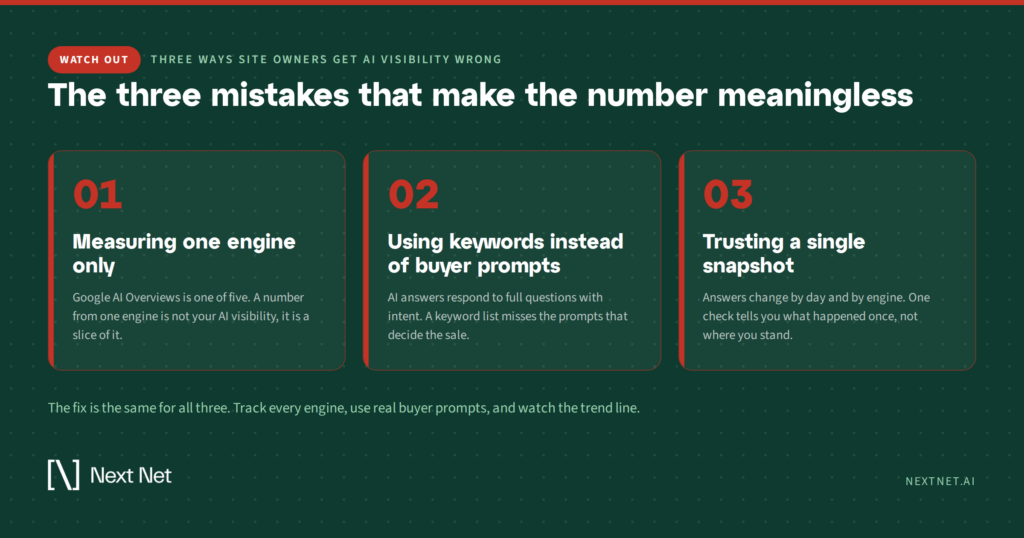
It’s measured against prompts, not keywords. People type “best commercial HVAC contractor for a warehouse in Phoenix” into ChatGPT, not “hvac phoenix.” The prompt set you measure against has to reflect how buyers phrase real questions, or the number is meaningless.
It’s per engine. The five assistants pull from different sources, weight them differently, and refresh on different schedules. A brand can be a regular in Perplexity answers and invisible in Gemini. One blended score hides that.
Why the old numbers stopped telling the whole story
For twenty years, the scoreboard was simple: rank, get the click, count the visit. AI answers broke the middle step.
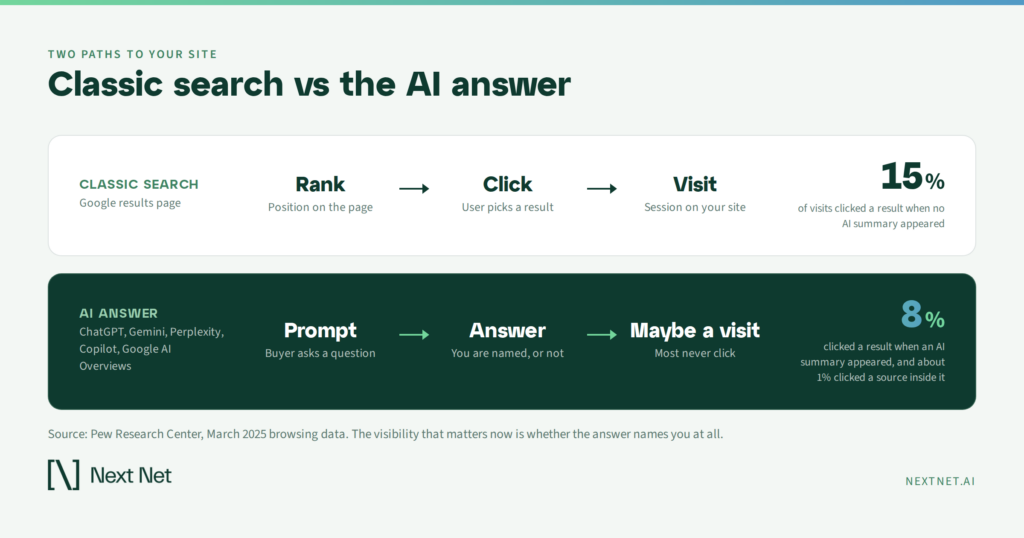
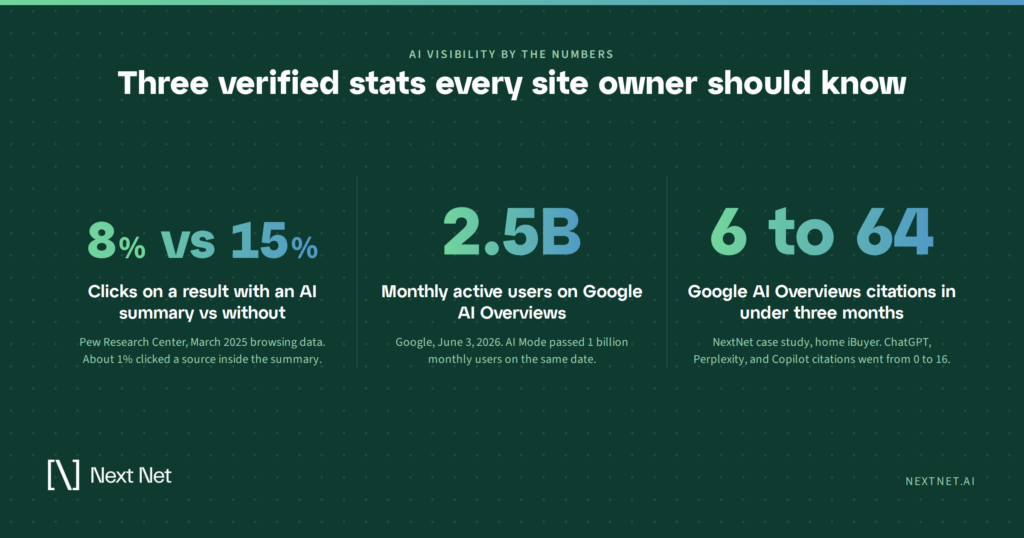
Pew Research Center tracked the real browsing data of 900 U.S. adults during March 2025 and found that when a Google results page included an AI summary, users clicked a traditional result on 8% of visits. Without a summary, the click rate was 15%. Clicks on the sources linked inside the summary itself happened on about 1% of visits. Pew’s analysis of Google AI summaries also found that people were more likely to end their session entirely after seeing an AI summary.
None of that audience disappeared. It moved somewhere your analytics can’t follow. Google reported in June 2026 that AI Overviews now has more than 2.5 billion monthly active users and AI Mode has passed one billion. Add the standalone assistants and you have a very large number of buying decisions being shaped inside answers that never produce a visit you can see in analytics.
Here’s what that looks like from a site owner’s chair. Your rankings hold. Your impressions in the classic report may even rise. And your organic sessions drift down quarter after quarter, because a growing share of the people who saw you got their answer without visiting.
You are on the page, but you’re scenery. The user’s eye went to the answer, and the answer may or may not have mentioned you.
The three layers of AI visibility
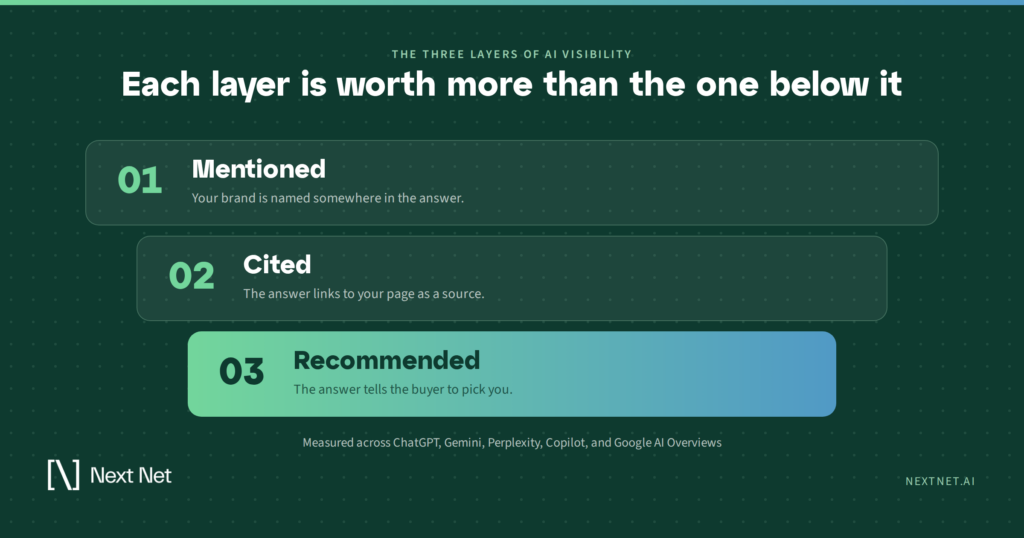
Every AI answer puts a brand in one of three roles, and the roles are not equal.
Mentioned. Your name appears somewhere in the response. Maybe it’s in a list of eight options, maybe it’s a passing reference. You’re in the frame, but you’re scenery.
Cited. One of your pages is linked or credited as a source the assistant drew from. This is the layer Google’s new report measures, and it’s the layer most closely tied to whether your content is trusted. The AI citation footprint post covers how to map it.
Recommended. The assistant names you as the answer, or one of two or three, in response to a buying question. This is the layer that moves revenue.
Mentions decorate the answer. Recommendations decide it.
When you measure AI visibility, track all three, and track them separately. A brand that is mentioned in 60% of answers but recommended in 4% has a very different problem from a brand that is recommended in 30% of the answers it appears in but appears in only a tenth of them. The first needs positioning work. The second needs reach.
What Google now reports, and what it leaves out
Google’s Search Console team introduced the generative AI performance report in June 2026 and made it available to all properties worldwide at the end of August. It’s worth opening before you do anything else, because it is the only first-party data on AI presence that any engine currently gives site owners.
What it shows, according to Google’s help documentation for the report: impressions of your links inside AI Overviews and AI Mode, grouped by page, country, device, and date. Impressions are aggregated by property, so two of your pages in the same answer count once in the chart.
What it doesn’t show: clicks, click-through rate, average position, or the queries that triggered the impression. It also doesn’t separate AI Overviews from AI Mode, and it says nothing about ChatGPT, Gemini, Perplexity, or Copilot.
So the report answers “did Google’s AI show me” and stops there. It can’t tell you what role you played, what question you were answering, or whether a competitor was in the same response with a stronger recommendation. Treat it as one column in a larger table, and a column that only covers one engine.
One more thing Google has said plainly. In its guide to optimizing for generative AI features, published in May 2026, Google states that there are no additional requirements to appear in AI Overviews or AI Mode beyond the technical requirements for Search, and that content people find unique, compelling, and useful will likely influence your presence in generative AI search more than anything else in the guide. That is Google describing its own system. The other four assistants publish nothing comparable, which is part of why measurement matters more than theory.

The numbers behind AI visibility
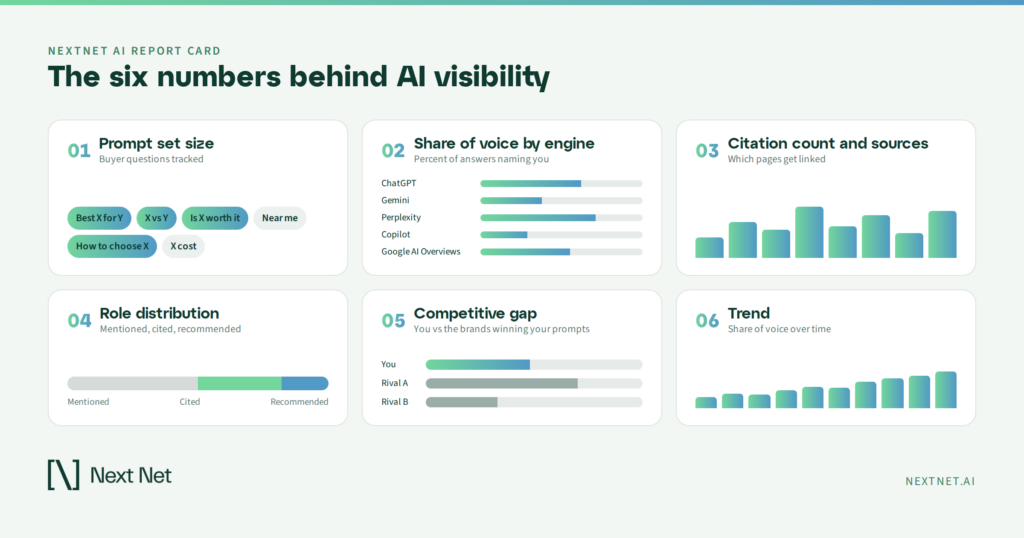
A useful AI visibility measurement is a small set of numbers, each answering a different question. Here is the set the site owners we work with end up using.
Prompt set size. How many buyer questions you’re measuring against. Twenty is enough to start. Two hundred is enough to spot patterns by topic, and the AI topical map post shows how to organize them.
Share of voice by engine. The percentage of prompts where you appear, calculated separately for ChatGPT, Gemini, Perplexity, Copilot, and Google AI Overviews. This is the number that goes on the dashboard.
Citation count and citation sources. How many of your URLs get cited, and which third-party pages the assistants are citing instead of you when they talk about your category. The AI citation sources post explains why the second half of that matters as much as the first.
Role distribution. Of the answers you appear in, what share mention you, cite you, and recommend you.
Competitive gap. The same numbers for the two or three brands that show up most often in your prompt set, which is the subject of the AI competitive analysis post. You don’t need a long list. You need to know who is standing where you want to be standing.
Trend. All of the above, sampled on a schedule. AI answers change week to week, and a single snapshot tells you very little.
Together these turn a vague worry (“are we in ChatGPT?”) into a report you can act on (“we’re cited in 22% of Perplexity answers and 3% of Gemini answers, and the gap is on our pricing pages”).
What the numbers look like when they move
A home iBuyer brand came to our team competing in specific U.S. cities against larger national names, both in organic search and in AI answers. The program combined a technical audit focused on structured data and machine-readable content, tighter landing and location page copy, a set of long-form blog posts built around the questions buyers were asking, and links from trusted news publications.
In under three months, the brand’s citations in Google AI Overviews went from 6 to 64, and its citations across ChatGPT, Perplexity, and Copilot went from zero to 16. Top-ten keyword rankings rose alongside them.
The point isn’t the specific figures. It’s that all three layers moved together once the site started publishing content that answered real questions and earned references from sources the assistants already trust. That’s the pattern we see repeat, and it’s the pattern Google’s own guidance points at.
How to check your AI visibility this week
You can get a first read without any tooling. It won’t be precise, but it will be honest, and it takes an afternoon.
- Open the Search Console generative AI report. Note which pages earn AI impressions and which of your important pages earn none. That second list is your starting point.
- Write twenty prompts the way a buyer would. Not keywords. Full questions, with the qualifiers a real person adds: location, budget range, use case, the comparison they’re already making. Pull them from sales calls, support tickets, and your own site search logs.
- Ask all five assistants. Run each prompt through ChatGPT, Gemini, Perplexity, Copilot, and Google AI Overviews, in a fresh session, logged out where possible. Log the answer.
- Score each answer on the three layers. Mentioned, cited, recommended. Put a name next to every brand that appears, including yours.
- Tally by engine. You’ll get a rough share of voice for each assistant and a first look at your role distribution. Expect the numbers to differ sharply across engines. That’s normal, and it’s the first useful thing you’ll learn.
- List the pages that got cited, yours and everyone else’s. The competitor and publisher pages that show up repeatedly are telling you what the assistants consider trustworthy in your category.
- Repeat in thirty days. A single sample is a photograph. Two samples are the beginning of a trend.
If the manual version convinces you the numbers matter, that’s the moment to move to a tracked prompt set and automated sampling, because the manual version doesn’t scale past a few dozen prompts and it can’t run every week.
What moves AI visibility
The plain answer is that the assistants don’t publish their weighting, and anyone who tells you they’ve reverse-engineered it is guessing. What we can say is what has moved the numbers for the sites we track, and where it lines up with what Google has put in writing.
Being eligible. Google’s guide is explicit that a page has to be indexed and eligible for a snippet to appear in AI Overviews or AI Mode. Blocked crawlers, thin rendering, and canonical confusion take you out before content quality is even considered. The same technical hygiene applies to the assistants that crawl the open web.
Answering the question in the first paragraph. Assistants extract. A page that states the answer clearly, then supports it, gets pulled into responses far more often than a page that builds to the answer over 1,500 words. This post opened with a definition block for exactly that reason.
Publishing what a model can’t write itself. Google’s phrase is “unique, compelling, and useful,” and it contrasts that with content a generative model could produce on its own. Original data, first-hand experience, specific numbers, and clear opinions are what get cited. Generic summaries of well-known advice are what get skipped.
Being referenced by sources the assistants already trust. Citations cluster around a small set of publishers, forums, and reference sites in every category. Earning mentions and links from those sources moves you from scenery into the answer more reliably than any on-page change.
Consistency across the web. Assistants cross-check. If your product description says one thing on your site and another on a directory listing, you lose confidence, and confidence is what a recommendation is made of.
None of this is a trick. Most of it is the SEO fundamentals you already know, aimed at a new reader that happens to be a language model. Google says as much in its guide, and describes optimizing for its AI features as still being SEO.
Where NextNet fits
NextNet AI measures the numbers in this post across ChatGPT, Gemini, Perplexity, Copilot, and Google AI Overviews, on a tracked prompt set, with the competitive set and citation sources alongside your own. The platform features page walks through the dashboards. If you’d rather start with a single snapshot of where you stand, you can request an AI visibility report card and we’ll run your category through all five engines.
For brands that want the measurement and the work behind it, AI Discover is the fulfillment side: the content, technical, and reference-building program that produced the results described above.
Frequently asked questions
What is AI visibility?
AI visibility is how often, and in what role, your brand and pages appear in the answers generated by AI assistants such as ChatGPT, Gemini, Perplexity, Copilot, and Google AI Overviews. It’s measured as a share of relevant answers rather than a ranking position, and it’s broken down by whether you were mentioned, cited as a source, or recommended.
How can I check my AI visibility?
Start with the generative AI performance report in Google Search Console, which shows impressions inside AI Overviews and AI Mode. For the other assistants, write a set of buyer-style prompts, ask each engine directly, and log whether you appear and in what role. A tracking platform automates the same process on a schedule and across a much larger prompt set.
What is a good AI visibility score?
There’s no universal benchmark, because the score depends on your prompt set, your category, and the engine. The useful comparison is against the two or three competitors that appear most often for your prompts, and against your own numbers thirty days ago. A rising share of recommendations in the engines your buyers use most is the direction to report.
What are AI visibility services?
AI visibility services measure your presence in AI answers and do the work that improves it: content built around real buyer questions, technical fixes that keep pages eligible, and references from sources the assistants already trust. Some providers only measure, some only optimize, and some do both.
Is AI visibility the same as SEO?
No, but they overlap heavily. Google describes optimizing for its own AI features as still being SEO, and the fundamentals carry over. AI visibility is broader because it spans assistants that don’t use Google’s index, and it’s measured differently, as a share of answers rather than a rank. Strong SEO is the floor, and AI visibility is what you build on top of it.
The scoreboard changed
For a long time you could tell how you were doing by looking at rankings and traffic. Now a large share of the decisions that used to start with a click start with an answer, and you can be a regular part of that answer or you can be scenery behind it.
Google’s new report is a real step, and you should open it today. Then measure the rest, because the rest is where most of the answers are being written.
If you want to see your own numbers across all five engines, request a report card and we’ll show you where you stand.
Related Articles
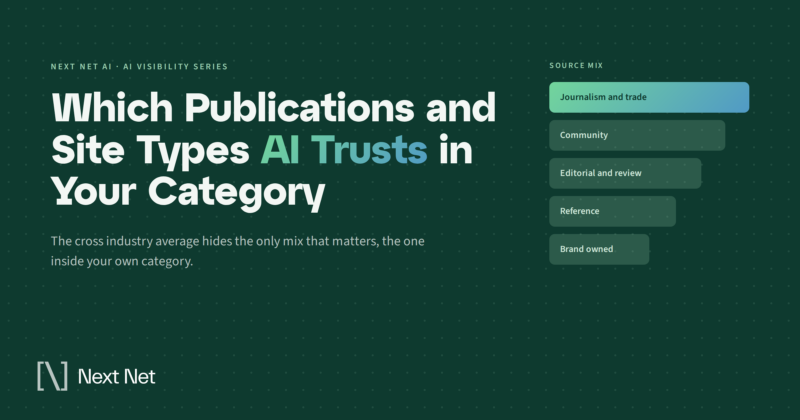
There is a number you have probably seen quoted in five different decks this year: 84% of AI citations come…

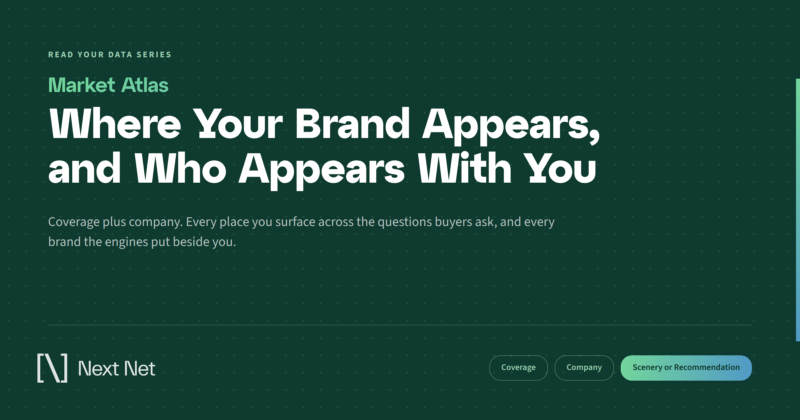
You ask an engine a question in your category. Your brand comes up. That feels like a win, right up…

Most teams working on AI visibility end up holding two reports that never quite meet. One is a keyword export.…