
Should Publishers Block AI Crawlers? What You Gain and What You Lose

Somewhere in your organization, a browser tab is open to a CDN bot settings page, and someone is hovering over a toggle labeled Block AI Bots.
The impulse behind that hover is sound. Your archive took years and real budget to build. AI systems are reading it, answering questions with it, and sending back a fraction of the traffic that search once sent. Blocking feels like the one lever you control outright.
It is a lever. It is not a simple one.
Flipping it does three things at once, and only one of them is the thing you meant to do. You stop some crawling. You also remove yourself from surfaces where readers still find publishers. And you leave a whole category of access untouched, because the toggle covers less than most people assume.
What follows is the tradeoff in order: what a block buys, what it costs, where it quietly fails, and why the publishers who handle this well end up with a tiered policy rather than a single switch. The useful mental model is a toll road, not a road closure. Some lanes stay open. Some close. One of them collects.
What blocking AI crawlers does, and what it does not
Blocking AI crawlers means adding rules to your robots.txt file, your CDN or firewall, or both, telling named AI bots not to fetch your pages. Robots.txt is a request that compliant crawlers honor voluntarily. A CDN or firewall rule is enforcement, refusing the request at the edge whether the bot agrees or not. The two operate at different layers, and treating them as interchangeable is where most publisher blocking policies come apart.
Google states the limitation plainly in its own crawling documentation: the instructions in a robots.txt file cannot compel crawler behavior, and while well-behaved crawlers obey them, others may not.
A robots.txt block is a policy statement. A CDN block is a door.
You want both, and you want them saying the same thing. A robots.txt file that welcomes a search crawler while a firewall rule quietly returns errors to that same crawler is a common and expensive misconfiguration.
What AI scraping is, and how it differs from search crawling
AI scraping is the automated collection of published web content for use in AI systems, usually to train a model or to supply an answer inside an AI assistant. Mechanically it is indistinguishable from search crawling: a bot requests a page, reads the markup, and moves on. The difference is what happens after. A search crawler indexes your page so it can send someone to it. A training crawler absorbs your page so a model can answer without sending anyone anywhere.
Training is only one of the uses, which is why a single block is such a blunt response. We break down the four ways AI systems use your content in more detail elsewhere, but the short version is that crawling, training, live retrieval, and licensed access are separate events with separate controls.
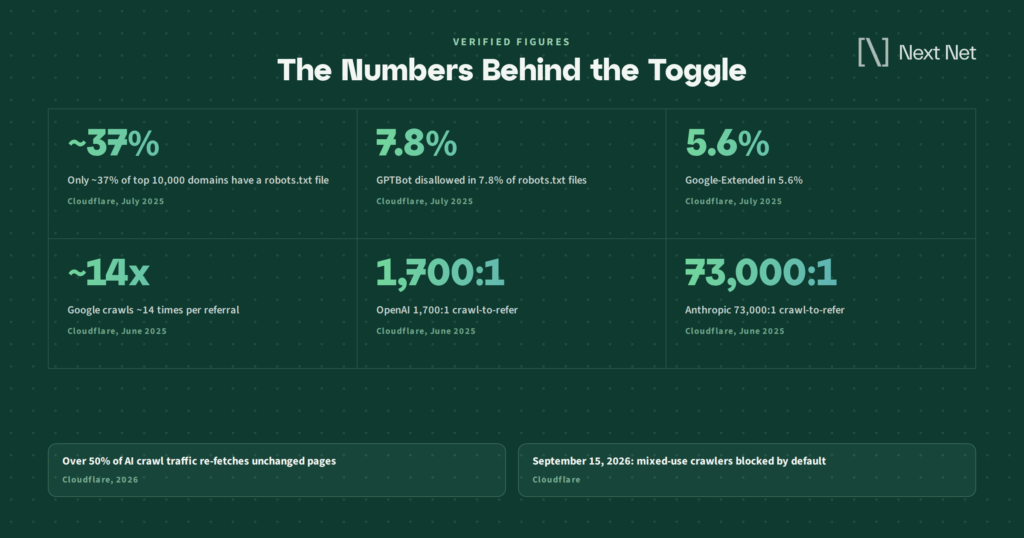
That asymmetry is measurable. Cloudflare compared crawl volume against referral volume across sites on its network and reported that as of June 2025, Google crawled roughly fourteen times for every referral it sent, while the ratio for OpenAI was 1,700 to 1 and for Anthropic 73,000 to 1.
Read those figures as direction rather than as a scoreboard. They move, and Cloudflare notes that traffic referred by native apps may not carry a referrer header, which affects the count.
The direction is what matters. The exchange that made crawling worth allowing, access traded for traffic, no longer holds in the same shape.
Why the free-crawl era is closing on its own
Publishers who never touch a bot setting are about to have part of this decision made for them.
Cloudflare announced on July 1, 2026 that starting September 15, 2026, its default settings will block mixed-use crawlers, the ones that blend search indexing, agent activity, and training into a single user agent, on any page that serves ads. The new defaults apply to new Cloudflare customers, new sites added by existing customers, and all existing free-plan customers.
Chief executive Matthew Prince framed the change around a threshold the web crossed earlier than expected, with most internet traffic now non-human.
The company also reported that more than half of AI crawler traffic is spent re-fetching pages that have not changed, and said its Pay Per Crawl marketplace is evolving into a Pay Per Use model, where publishers are paid when their content creates value rather than when it is merely fetched.
Set aside the question of whether one infrastructure provider should be making that call. The signal matters more than the source. The era of ambiguous, unpriced crawling is ending, and what replaces it is negotiated.
Not every AI crawler wants the same thing
The largest error in publisher bot policy is treating AI crawlers as one population. They are not, and the operators say so in their own documentation.
OpenAI runs four named agents with four jobs. GPTBot collects content that may be used to train foundation models. OAI-SearchBot surfaces sites inside ChatGPT search. ChatGPT-User fetches pages when a person asks ChatGPT to look something up. OAI-AdsBot checks landing pages submitted as ads.
OpenAI’s documentation is explicit that each setting is independent. You can allow OAI-SearchBot so you appear in ChatGPT search results while disallowing GPTBot to signal that your content should not be used for training. The same page notes that sites opted out of OAI-SearchBot will not appear in ChatGPT search answers, though they can still show up as navigational links, and that a robots.txt change can take around 24 hours to register for search.
Google splits the same way, with a wrinkle that defeats log-based verification.
Google-Extended is a control token, not a crawler. Google’s documentation states it has no separate user agent string, because the crawling is done with existing Google user agents and the token is used only in a control capacity. Disallowing it tells Google not to use your content to train future Gemini models, and not to use it for grounding, which is the process of feeding content from the Search index to the model at prompt time. Google says the choice has no effect on your inclusion in Search and is not a ranking signal.
Googlebot, meanwhile, is the crawler you cannot block without leaving Google Search, and it fetches for Search including AI Overviews and AI Mode.
That is the shape of the problem in one paragraph. The bot you must allow feeds the AI surface you may want to opt out of, and the token that opts you out will never appear in your access logs.

What you gain when you block
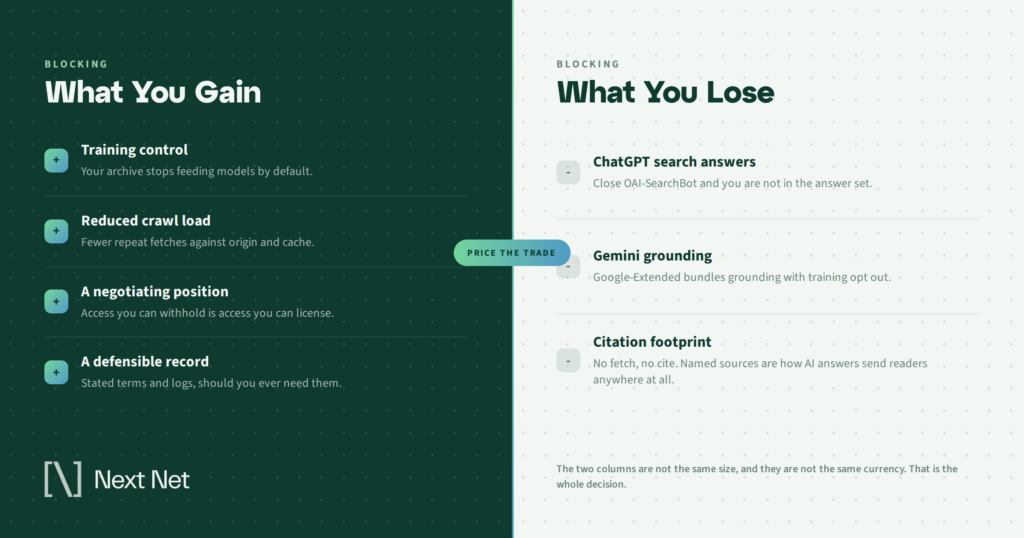
Four things, and each of them is real.
Control over future training use. A disallow directive aimed at a training crawler is a documented, machine-readable statement of preference. It does not reach back and remove anything already ingested, but it governs what happens next.
Reduced load. If more than half of AI crawler traffic is re-fetching unchanged pages, blocking bulk training crawlers returns bandwidth and origin compute that were buying you nothing.
A negotiating position. You cannot license access you have already given away. Publishers who have closed the open lane have something to sell that publishers who left it open do not.
A defensible record. When a licensing conversation or a legal question arrives, a dated and consistently enforced bot policy is a better answer than a shrug.
What you lose when you block
The cost is visibility, and it lands unevenly depending on which switch you throw.
Block OAI-SearchBot and you are out of ChatGPT search answers, by OpenAI’s own description. Block Google-Extended and you exit Gemini grounding, which is the live retrieval path and not just the training corpus. Block broadly at the CDN and you can lose surfaces you never intended to touch, because a wildcard rule does not read your intent.
Here is the part that gets lost in the debate. Blocking does not move you from scenery to recommendation. It removes you from the scenery.
An AI answer assembles a backdrop of sources, and out of that backdrop a few names get promoted into the recommendation itself. Every citation, every mention, every appearance in the supporting set is a chance at that promotion. A blocked publisher is not competing for the promotion and losing. A blocked publisher is not in the room.
There is a second-order cost as well. Assistants build their sense of who you are from what they can read from you and about you. Cut the direct path and the picture gets assembled from everyone else’s coverage of you, which is a description you no longer author.
This compounds a decline that is already underway for most publishers. We covered what publishers lose when readers ask AI instead of clicking separately, and the relevant point here is that a block subtracts from what is left rather than from what you used to have.
None of this argues against blocking. It argues against blocking without pricing the loss.
The mistakes that make a block useless
Most blocking policies fail quietly. They look correct in the file and do nothing in practice.
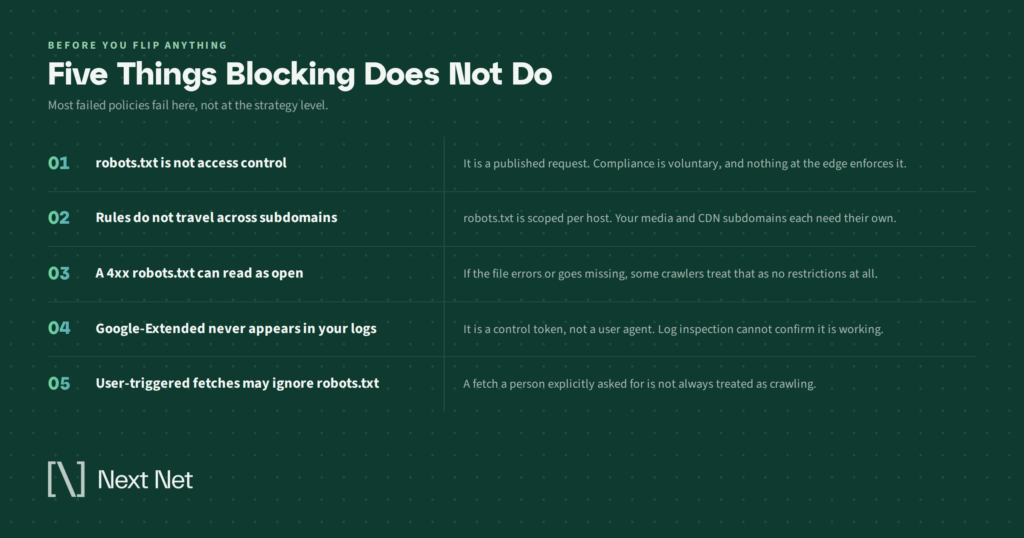
Robots.txt gets treated as access control. The Robots Exclusion Protocol, formalized as RFC 9309, specifies the syntax and precedence of these directives, and as Cloudflare’s own explanation stresses, compliance with them is voluntary and does not constitute access control. If a crawler ignores the file, only enforcement at the edge will stop it.
Scope gets assumed. A robots.txt file governs only its own host, protocol, and port. The file at your root domain does not cover your subdomains, and a file placed in a subdirectory is not read at all.
Error handling gets ignored. Google treats every 4xx response except 429 as though no robots.txt file exists, which means it assumes no crawl restrictions at all. A robots.txt that returns a 404 is not a strict policy, it is the absence of one.
Server errors mislead. If Google finds your robots.txt but cannot fetch it, it stops crawling for the first twelve hours, then falls back on the last good version for up to thirty days while it keeps retrying.
Verification looks like failure. Because Google-Extended never appears as a user agent in your logs, a team checking logs to confirm the block worked will find nothing and reasonably conclude that it did not.
User-triggered fetches slip through. OpenAI states that because ChatGPT-User actions are initiated by a person, robots.txt rules may not apply to them. A reader pasting your URL into an assistant is a different event from a crawler sweeping your archive, and your policy should not pretend otherwise.
The baseline is also thinner than most people assume. Cloudflare found that only about 37 percent of the top 10,000 domains on its network had a robots.txt file at all, and among those that did, GPTBot appeared in a disallow directive in 7.8 percent, with Google-Extended at 5.6 percent and several other major AI crawlers under 5 percent.
The gap between publishers who intend to block and publishers who have configured a block that works is wide.
A tiered bot policy beats a binary switch
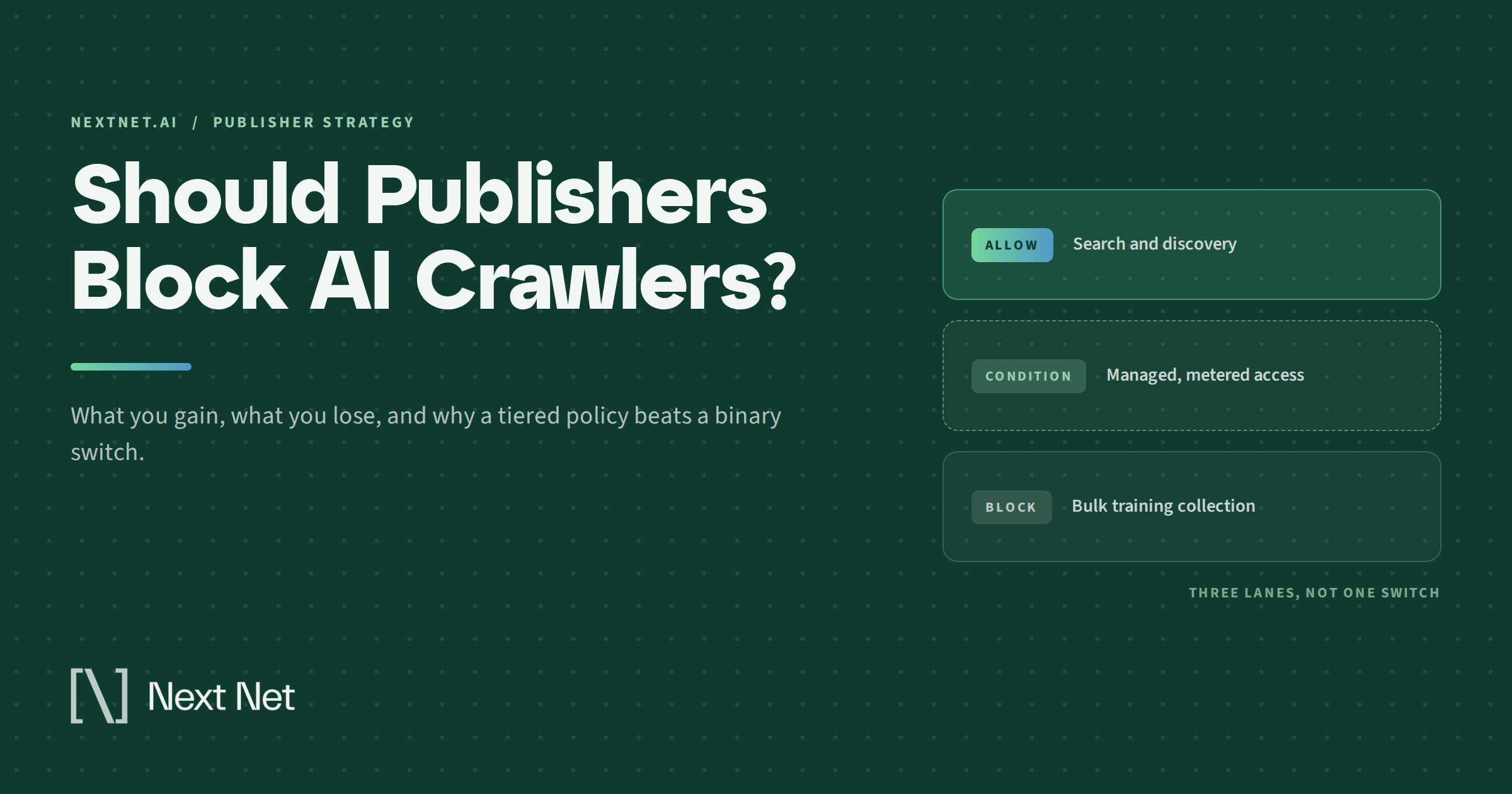
Three lanes, not two positions.
Allow the crawlers that put you in front of readers. Search and discovery agents earn their access by putting you in the scenery where a recommendation can happen. Blocking them to protest training use is a tax you pay to yourself.
Block bulk training crawlers wherever you have decided your archive is not free input. This is the lane where a disallow directive and edge enforcement belong together, because the directive alone is a request.
Condition everything else. Rate limits, path-level rules that open documentation while closing premium archives, allowances tied to a licensing agreement. Conditional access is where most of the interesting policy lives, and it is the lane a single toggle cannot express.
A worked example, in plain terms: allow search agents sitewide, disallow training agents sitewide, permit assistant retrieval on your evergreen explainers while restricting it on your investigative work, and enforce all of it at the edge rather than trusting the file to do the work alone.
The specific configuration matters less than the shape. Access is a dial with a setting per section, not a switch with two positions.
The third lane: managed access, and metadata before content
The most interesting option barely existed two years ago. You can let systems see that your content exists and what it covers, without handing over the full text for free.
Metadata before content is the shape of it. Structured summaries, licensing terms, and access signals reach the systems that need to know you cover a topic, while the article itself sits behind terms. Cloudflare’s Content Signals work and its move from Pay Per Crawl toward Pay Per Use both point at the same destination, where access is priced by the value it creates downstream rather than by the fetch.
This is where blocking and monetization stop being opposites. A closed lane with a toll booth is worth more than an open lane, and worth more than a wall.
If you are working out what a licensable unit of your content looks like, our guide to rights-managed content objects covers the structure, and our piece on how AI systems will pay for content walks through the models currently being tested. Building the metadata layer that makes managed access possible is a large part of how Next Net works with publishers.

How to decide, and what to watch afterward
Answer these in order, because each one narrows the next.
Where does your revenue come from? Ad-supported archives and subscription archives have opposite exposures, since reach and scarcity pull against each other.
Which surfaces send you readers today? Not the ones you resent. The ones that show up in your referral data.
Which sections would you license if someone asked? Those are the sections to close first, because closing them is what makes the ask possible.
What can you enforce? A policy you cannot enforce at the edge is a preference, and it should be labeled as one internally so nobody mistakes it for protection.
Then watch what moves. Crawl volume by user agent tells you whether the block is holding. Referral traffic from assistant surfaces tells you what the block cost you. Citation and mention volume across ChatGPT, Gemini, Perplexity, Copilot, and Google AI Overviews tells you whether you are still in the scenery on the topics you own.
That last measurement is the one most publishers do not have, and it is the one that turns this from a guess into a decision you can revisit with evidence. A Report Card from Next Net gives you a read on where you currently appear across those five engines, so you can set a baseline before you change anything rather than after.
Run the baseline first. A block whose effect you cannot see is a decision you have no way to revisit.
Frequently asked questions
Does blocking AI crawlers hurt my Google Search rankings?
Blocking Google-Extended does not. Google states that Google-Extended has no effect on a site’s inclusion in Google Search and is not used as a ranking signal. Blocking Googlebot is a different matter, since that is the crawler Google Search depends on, and disallowing it removes your content from Search while still allowing your URLs to be indexed without a snippet.
Will blocking GPTBot remove my site from ChatGPT?
No, and this is the most common misconception in publisher bot policy. GPTBot governs training use. ChatGPT search visibility is governed by OAI-SearchBot, which OpenAI documents as an independent setting. You can disallow GPTBot and allow OAI-SearchBot, which keeps you visible in ChatGPT search while opting out of training.
Is robots.txt legally binding?
It is a voluntary protocol rather than an access control mechanism. RFC 9309 formalizes the syntax and precedence of robots.txt directives while stressing that compliance is voluntary, and Google’s documentation says the same. Legal weight comes from your terms of service and your licensing agreements, not from the file. Treat robots.txt as the machine-readable statement of intent that sits underneath those.
How long does a robots.txt change take to take effect?
Google generally caches robots.txt for up to 24 hours, though it may cache longer when it cannot refresh the file. OpenAI notes that changes affecting ChatGPT search can take roughly 24 hours to register. Plan on about a day for compliant crawlers, and remember that edge rules take effect at once, because they do not depend on a crawler reading anything.
Should smaller publishers block AI crawlers?
The calculus differs from large archives. If discovery still drives most of your growth and you have no licensing conversation underway, a full block trades a real asset for a symbolic one. A more useful starting position is to disallow bulk training crawlers, keep search and discovery agents open, and measure your citation footprint before deciding whether to close further.
The decision underneath the toggle
The question was never whether to block AI crawlers. It is which access is worth what, and to whom.
That reframing is the whole shift. Access used to be free because it bought traffic. Now some access still buys traffic, some access buys nothing, and some access is worth money you are not yet charging for. Those three deserve three different answers, and one toggle can only give you one.
Start with a baseline of where you currently appear. Sort your sections by what you would license. Set the lanes, enforce them at the edge, and watch the numbers move for a full quarter before you touch anything again.
The publishers who come out of this period in good shape will not be the ones who blocked first, or the ones who stayed open longest. They will be the ones who knew what each lane was worth.
Related Articles
On September 15, 2026, Cloudflare flipped a default that touches a large slice of the web. Training and Agent crawlers…

Every year or so a new file shows up at the root of publisher sites, and this cycle’s file is…
Every few weeks another headline lands: a publisher sues an AI company, an AI company calls the claim meritless, and…