

Turning AI Visibility Into an Ad Product Publishers Can Sell

The revenue meeting has a new column in it. Not a bigger one. A new one.
For most publishers, the last two years of that meeting have been an exercise in subtraction. Search referrals down. Discover down. Social flat at best. Nearly every line on the sheet describes something that used to be larger, and the conversation turns into a negotiation over how hard to squeeze what remains.
Here is the part that keeps getting missed. The same shift that took the traffic created a question your advertisers cannot answer on their own, and you are already sitting on the raw material to answer it.
When a buyer in your category asks ChatGPT, Gemini, Perplexity, Copilot, or Google AI Overviews which brand to choose, somebody gets recommended. Somebody else shows up as scenery in the same answer. Most of your advertisers do not know which one they are.
You can find out. You can package what you find. You can put it on the rate card as a line item with a name, a deliverable, a method, and a renewal date.
What an AI visibility ad product is
An AI visibility ad product is a paid offering a publisher sells to advertisers that measures how those advertisers’ brands appear inside AI-generated answers in the publisher’s category, reports what those answers say, and points to what should change. It is sold the way any other placement is sold: named deliverable, defined scope, disclosed method, set cadence, renewal date.
Nothing is served and nothing is impressed. No inventory changes hands. What the advertiser buys is a trustworthy read on a surface they cannot purchase their way into, produced by the publisher whose content that surface already draws on.
That is the awkward part at first. Publishers are practiced at selling access to an audience. This sells understanding of a place where audiences now form opinions before they ever arrive.

Why publisher monetization needs a new line, not a bigger one
The Reuters Institute surveyed 280 senior editors, chief executives, and digital leaders across 51 countries in late 2025 for its Journalism, Media, and Technology Trends and Predictions 2026 report. Publishers in that sample expect traffic from search engines to fall by more than 40 percent over the next three years.
The measured picture is already moving that way. Analytics data sourced for the same report covers more than 2,500 news sites and shows Google organic search traffic down by about a third globally between November 2024 and November 2025, and down 38 percent across the US sites in that set. Referrals from Facebook and X fell 43 percent and 46 percent over the preceding two and a half years.
Those declines are not evenly felt, and the report is careful about how much of the search drop can be attributed to any single cause. The direction is the useful part.
What matters commercially is where the same executives think growth comes from. Roughly a third named new products and new revenue streams as their key focus for the year, and more than six in ten said media companies are not investing enough in future models. Paid content leads the priority list, with display and native advertising close behind, so a new advertising line does not have to displace anything. It sits beside what the sales team already carries.
Licensing is the other new line most publishers are watching, and the same survey is sober about it. Getting platforms to pay for content is the single biggest new growth opportunity in the data, and interest in it has nearly doubled in two years. But only about one in five respondents expect that money to be substantial. Half expect a minor contribution. Another fifth, weighted toward local publishers and smaller markets, expect nothing at all. Licensing is worth pursuing and it is not a plan on its own.
Optimizing existing lines harder does not close a gap that size. Adding a line might.
The demand is already sitting on the buy side
Publishers tend to assume they would have to create this appetite. They would not. The IAB surveyed more than 200 brands and agency buyers for its 2026 Outlook Study and found that 73 percent of marketers are prioritizing content optimized for AI-generated answers.
Two other findings in the same study matter more than the headline. Cross-platform measurement climbed to 72 percent of buyers, up from 64 percent a year earlier. And 38 percent named understanding generative AI as a major investment challenge, up 14 points from 2024.
Read those three together and the offer writes itself. Buyers want the outcome. They are raising their standards on measurement at the same time. And a meaningful share of them say plainly that they do not fully understand the mechanism.
Your advertisers do not need another dashboard. They need someone who knows their category to tell them the truth about it.
The Reuters Institute report saw the same gap from the other side and predicted that services built around answer engine optimization would proliferate through the year, driven partly by brands wanting to track their visibility. That prediction has held. What has not arrived in the same volume is a source the advertiser already trusts.
That is a role a publisher is unusually well placed to fill. You already publish the category coverage these systems draw on. You already sit in the quarterly meeting. You already have the relationship that makes an uncomfortable finding land as help rather than as a pitch.

The standard that made this sellable
Until this month there was a real objection waiting at the end of every version of this conversation: how would the advertiser know your numbers were any good?
On August 3, 2026, the IAB published Measuring Visibility in the AI Era, a standardized set of measurement guidelines for tracking brand and publisher visibility in AI-powered discovery. The trade body’s stated reason for writing it is the problem itself: more than 20 companies now sell AI visibility measurement tools, using different methods that can return different answers about the same brand.
The framework organizes metrics into what it calls the four P’s of AI visibility.
Presence asks whether the brand appears in an AI response at all, through metrics including mention rate, citation rate, share of voice, and visibility momentum.
Prominence asks where and how strongly it appears, capturing placement, ranking order, and whether content is drawn on substantively or cited in passing.
Portrayal asks in what context and with what accuracy, through sentiment, framing, hallucination rate, and factual inaccuracy rate.
Persuasion asks whether visibility drives action, through recommendation strength and post-citation click-through rate.

Presence is where scenery and recommendation start to separate. Prominence and Portrayal are where the separation becomes obvious, and where an advertiser stops nodding along and starts asking what to do about it.
The second half of the framework is the part that changes how you sell. It introduces a two-tier quality classification. Directional measurement identifies patterns and signals trends, which supports early detection and competitive awareness but is explicitly not sufficient for budget allocation or executive strategy. Decision-grade measurement meets a higher bar across query volume, sample size, prompt type coverage, testing cadence, reproducibility, and platform coverage, and is the standard required before budget or strategy decisions.
Before a standard exists, you are selling a report nobody can evaluate. After one exists, you have a spec sheet, and so does the buyer sitting across from you.
The framework names publishers directly as beneficiaries. It gives them standardized visibility and disclosure metrics to quantify how their content is ingested and surfaced by AI platforms, and to carry that data into licensing conversations. The same measurement you sell to an advertiser strengthens your own hand elsewhere.

What goes in the product
Three shapes work, and they stack in order of commitment.
The AI visibility audit. One advertiser, one category, a fixed set of the questions their buyers ask, run once across ChatGPT, Gemini, Perplexity, Copilot, and Google AI Overviews. The deliverable is short: where they appear, where a rival appears instead, what the answers say about them, and which three findings are worth acting on. This is the door opener. It is also the cleanest thing to lead a pitch with, because it produces a specific and often uncomfortable fact about a brand the buyer knows better than you do.
The standing report. The same read on a set cadence, with movement between runs called out. AI visibility reporting becomes measurement rather than a one-time diagnostic at exactly the point where a second data point exists. Advertisers who found the audit interesting tend to find the second run necessary.
The campaign-attached read. A baseline before a flight, tracking during, and a read after. Tie it to placements the advertiser already buys so the report explains the campaign instead of sitting next to it in a separate folder. This is also the version that renews most naturally, because it is scheduled by something already on the calendar.
Across all three, report direction and let the advertiser draw the conclusion. Do not promise a position in an answer, a share percentage, or a timeline to reach either. These systems are probabilistic and they change without notice. A publisher that overstates once does not get asked back.
Structuring the line item so it survives procurement
A good report dies in procurement when it arrives looking like a favor rather than a product. Five details prevent that.
Name the deliverable in the framework’s language rather than in vendor jargon. A buyer who has read the IAB guidelines recognizes Presence, Prominence, and Portrayal. Nobody has to be trained on your vocabulary before they can approve the spend.
State the tier on the cover. If the read is directional, say so and say what it is good for. Selling directional data into a budget decision is the fastest way to lose a renewal, and the fastest way to earn one is to be the vendor who volunteered the limitation before anyone asked.
Disclose the method in the report itself: which engines were covered, how many prompts, what types of prompts, when the run happened, and how often it repeats. Disclosure is not a caveat here. Under the new framework it is part of the spec.
Define what triggers the next one. A quarter, a campaign flight, a product launch, a competitor move. An undated report is a document. A dated one is a subscription.
Put it on the same insertion order as the placements. A separate invoice from a separate team reads as a side project, and side projects are what gets cut first when a budget tightens.
One more thing helps, and it is not on the insertion order. Decide in advance who presents the findings. A report emailed to a marketing coordinator gets skimmed. The same report walked through by someone who can answer a follow-up question about the category turns into a conversation about next quarter. The interpretation is the product, and the meeting is where the interpretation gets delivered.

What you tell an advertiser to do about a bad read
Selling the measurement means owning the next question, which arrives immediately and sounds like: fine, so what do we do?
The reassuring answer is that the work is familiar. Google Search Central’s guidance on optimizing for generative AI features states that from Google Search’s perspective, optimizing for generative AI search is optimizing for the search experience, and is therefore still SEO. The same guidance says there is no need to create new machine-readable files, AI text files, or markup to appear in these features.
That matters for a publisher building this offer, because it means you are not committing to build technology. The remedies are content, coverage, corroboration, and the kind of category authority you were already producing before anyone used the phrase AI visibility.
It also means some of the remedy sits on your own site. Substantive category coverage that engines draw on is what you make. Be careful with the shape of that claim: a placement does not buy a citation, and saying otherwise turns a credible product into a bad one. What you can say is that the same qualities that earn attention from readers are the qualities engines are looking for when they pick sources. Our guide on how to get cited by AI goes deeper on what those qualities look like in practice.
Where publishers get this wrong
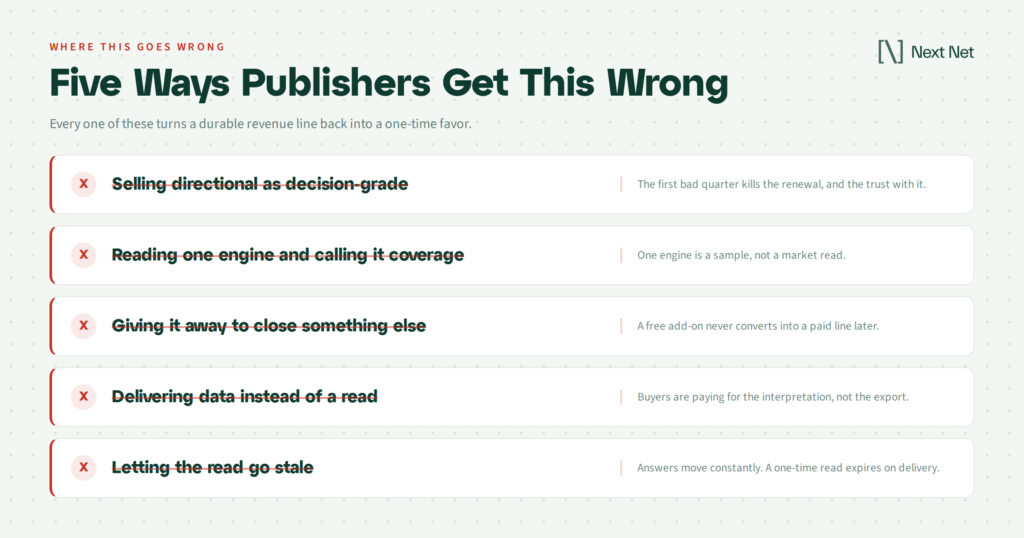
Selling a directional read as a decision-grade one. This is the mistake with the longest tail. A thin sample dressed up in decimal places looks authoritative right up until the advertiser runs their own check.
Reading one engine and calling it AI visibility. ChatGPT, Gemini, Perplexity, Copilot, and Google AI Overviews do not agree with each other, and a brand that looks healthy on one can be missing from another. Cover the set or say which part of the set you covered.
Giving it away to close something else. A report thrown in to save a display renewal has been priced at zero forever. If it is worth a line item next year, it needs to be one this year.
Delivering data instead of a read. An export of every prompt and response is not the product. The interpretation is. The advertiser is paying for someone who knows the category to tell them which three findings matter.
Letting the read go stale between meetings. These answers move. A report built in one quarter and presented in the next has a credibility problem the moment someone opens a chat window in the room.
Frequently asked questions
What is publisher monetization in the context of AI search?
It is the set of revenue lines a publisher can build when audiences reach answers without reaching the site. Selling AI visibility measurement to advertisers is one of those lines. Content licensing is another, and the two reinforce each other, since the same standardized visibility metrics that support an advertiser report also support a licensing conversation.
Do we need to build our own technology to sell this?
No. The measurement layer can be supplied by a partner while the publisher supplies the category expertise, the advertiser relationship, and the interpretation. What you cannot outsource is the read. A report that arrives without a point of view from someone who knows the category is the version that does not renew.
How is this different from selling an SEO service?
The remedies overlap heavily, and Google’s own position is that optimizing for generative AI search is still SEO. The difference is the product being sold. This is a measurement and interpretation product about a specific surface, delivered by a publisher inside an existing advertiser relationship, rather than an ongoing optimization engagement.
Which engines should the report cover?
Cover ChatGPT, Gemini, Perplexity, Copilot, and Google AI Overviews, and disclose coverage plainly if you cover fewer. Under the IAB framework, platform coverage is one of the criteria separating a directional read from a decision-grade one, so partial coverage is a labeling question rather than a disqualifying one.
How often should it run?
Often enough that movement between runs means something, and on a cadence the advertiser can plan around. Quarterly suits most standing reports. Campaign-attached reads follow the flight. Whatever you choose, hold it steady, because comparability between runs is most of the value after the first one.
Start with one category
This does not need a product launch. It needs one audit.
Pick the advertiser vertical where you publish the most authoritative coverage. Write down the ten questions a buyer in that category asks before they choose. Run them. Look at who gets recommended, who turns up as scenery, and what the answers say about the advertiser you were going to call anyway.
Then take it to one buyer, with the tier labeled and the method disclosed, and see what happens to the meeting. A publisher who walks in with a specific finding about a brand is having a different conversation than a publisher who walks in with a rate card.
The first one will be rough. The prompt set will be wrong in places, the engines will disagree with each other, and you will find at least one finding you are not sure how to explain. That is normal, and it is a good deal less risky than the alternative, which is waiting until the category has a settled playbook and arriving to sell it fourth.
If you want to see the shape of the deliverable before you build one, start with a free AI visibility report card for a brand in your category, or read more about how we work with publishers and partners.
Related Articles
On September 15, 2026, Cloudflare flipped a default that touches a large slice of the web. Training and Agent crawlers…

Every year or so a new file shows up at the root of publisher sites, and this cycle’s file is…
Every few weeks another headline lands: a publisher sues an AI company, an AI company calls the claim meritless, and…