
What AI Says About Your Brand: How to Read Your AI Insights Claims

Somewhere this morning, a buyer in your category typed a question into an engine and got a short paragraph back. Not ten blue links. A paragraph.
That paragraph made claims about you. It said you were reliable, or expensive, or better suited to enterprise teams, or hard to reach after hours. The buyer read it and moved on without clicking anything.
Most brands measuring AI visibility are counting how often that paragraph names them. The number is easy to pull and easy to put in a deck. It cannot tell you whether the answer recommended you or just listed you.
AI Insights is the part of the platform that reads the paragraph instead of counting the name in it. This post covers what the claims database holds, how to filter it before you trust a single row, and how to turn the least comfortable rows in it into a content plan and a sales plan.
What is AI Insights?
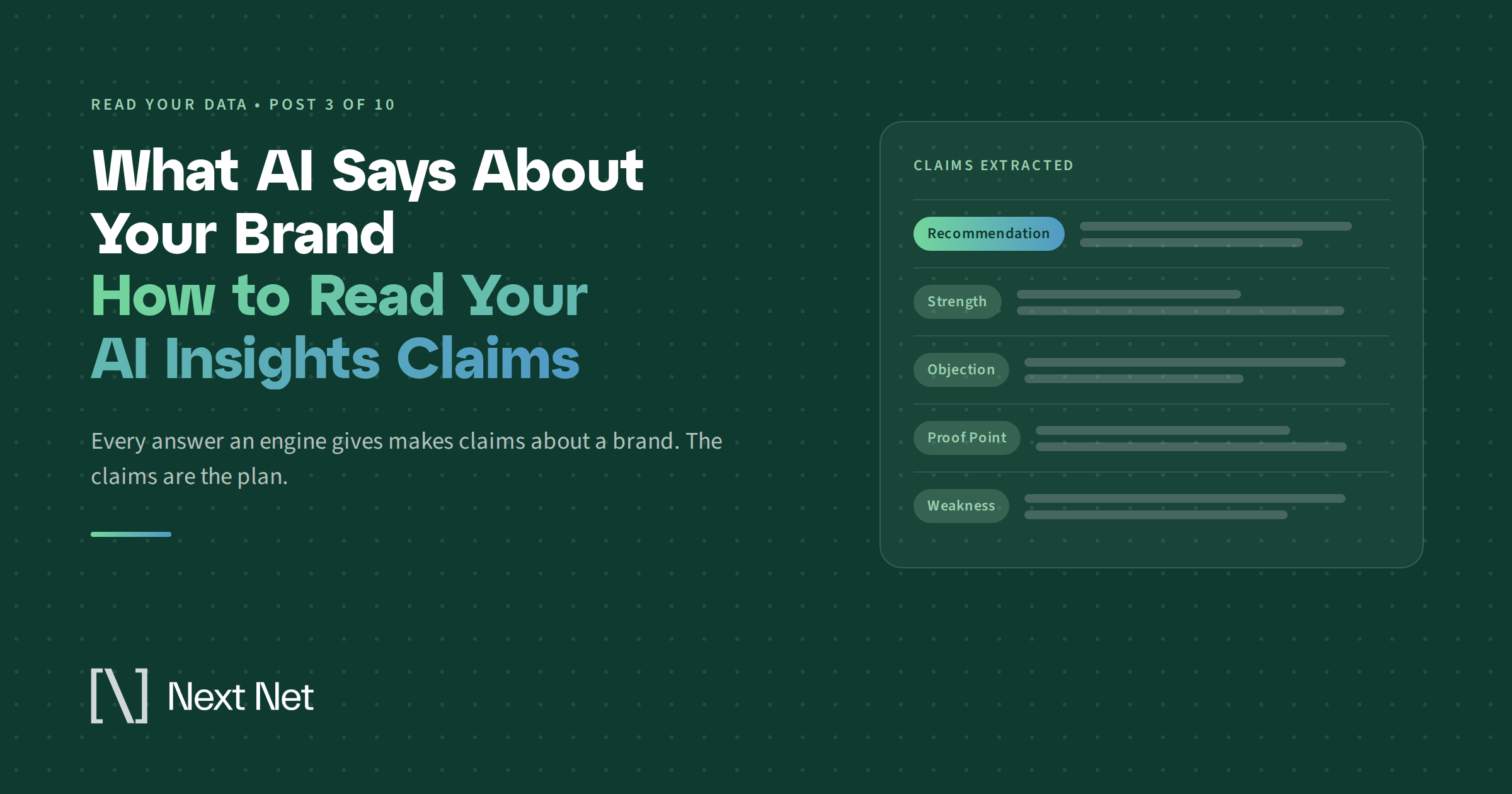
AI Insights is a claims database. Every time an engine produces an answer in your category, the platform extracts the specific assertions that answer makes about a brand and files each one by type: Strength, Weakness, Recommendation, Proof Point, Objection, and Comparison. The result is a searchable record of what ChatGPT, Gemini, Perplexity, Copilot, and Google AI Overviews are repeating about you, in their words, sorted by the job each claim does inside the answer.
The answer is the impression
Claim-level data matters more than it used to because the answer has become the destination rather than the doorway to one.
Pew Research Center tracked the browsing behavior of 900 US adults across roughly 69,000 Google searches in March 2025. When an AI summary appeared, people clicked a traditional result in 8 percent of visits, against 15 percent when no summary appeared. Clicks on the sources cited inside the summary happened in 1 percent of visits. People were also likelier to end the session outright after a page with a summary, 26 percent against 16 percent. The Pew analysis also found the summaries were short: a median of 67 words, with 88 percent of them drawing on three or more sources.
So the picture is a 67-word paragraph, stitched from several places, that most people read and act on without visiting any of the sites underneath it. Whatever that paragraph says about you is, for most of your audience, the entirety of what they learn about you. There is no landing page waiting to rescue the impression.
Which is why counting mentions is scenery work. Knowing your name appeared tells you the camera pointed your way. It does not tell you whether the line delivered was “well regarded for complex commercial work” or “affordable, though clients report slow response times.”

The six claim types, and what each one is telling you
Strength
A Strength is an attribute the engine attaches to you approvingly. Deep specialization, a long track record, strong service in a particular region.
Read strengths for two things. First, whether the engines are repeating the strengths you market, or something adjacent to your positioning, or a legacy strength the company moved past two years ago. Second, whether the strength is specific enough to do any work. “Good customer service” is a claim every competitor in your category also carries. “Handles multi-site rollouts for franchise operators” is a claim that wins an answer.
A strength that shows up consistently and matches your positioning is the line to reinforce with proof, not the one to worry about.
Weakness
A Weakness is an unflattering attribute the engine attaches to you. Price, availability, breadth of service, geographic reach, onboarding time.
These are the rows most teams want to argue with, and the rows worth the most. Each one is something a buyer is being told before they ever reach your site. Some will be wrong. Some will be fair and simply unaddressed anywhere on your own properties, which means the only voices on the subject belong to other people.
The distinction to draw while reading: is this claim inaccurate, or is it accurate and unanswered? The two have different fixes, and only one of them is a correction.
Recommendation
A Recommendation is the engine putting you forward as the answer for a specific situation rather than listing you as one option among several. Everything else the answer says about you is scenery around that one line.
Read recommendations by context, not by count. The useful question is not how many you have but which situations trigger them. Brands routinely find they are recommended inside one narrow use case and merely named everywhere else in their own category, which points straight at where the coverage is thin.
Recommendations also tell you what evidence the engine found persuasive, because a recommendation usually arrives with a reason attached.

Proof Point
A Proof Point is the evidence the engine cites when it makes a claim. A certification, a years-in-business figure, a case result, a review volume, an award, a named client.
Audit these carefully. They are the likeliest place for a stale or misattributed fact to lodge. An engine repeating a headcount you outgrew, or a service area you have since expanded, found that somewhere. Track it back to the source.
Proof points also show you which kind of evidence carries weight in your category. If the engines consistently reach for third-party review counts rather than your own case studies, that is a signal about which assets deserve the next round of investment.
Objection
An Objection is a reason not to choose you, stated inside the answer. It sits close to a weakness but does more work, because it is framed as a caution to the buyer.
For a sales team this is the most directly usable row in the database. An objection in an AI answer is an objection your reps are already hearing on calls, except here you can see the exact wording and the frequency, and you know it is also reaching buyers who never called at all.
Objections are the cleanest input to a content plan too, since each one names a question your own properties have not answered.
Comparison
A Comparison is the engine placing you beside another brand and drawing a distinction.
Read these for the axis, not the verdict. The engine picks a dimension on which to separate you: price, scale, specialization, speed, geography. That axis is your category’s decision criteria as the engines currently understand them. If the axis they keep choosing is not the one you compete on, your positioning has not landed.
None of this is an argument for naming rivals in your own content. Note the axis, then make sure your pages are unambiguous about where you sit on it.

Filter before you read anything
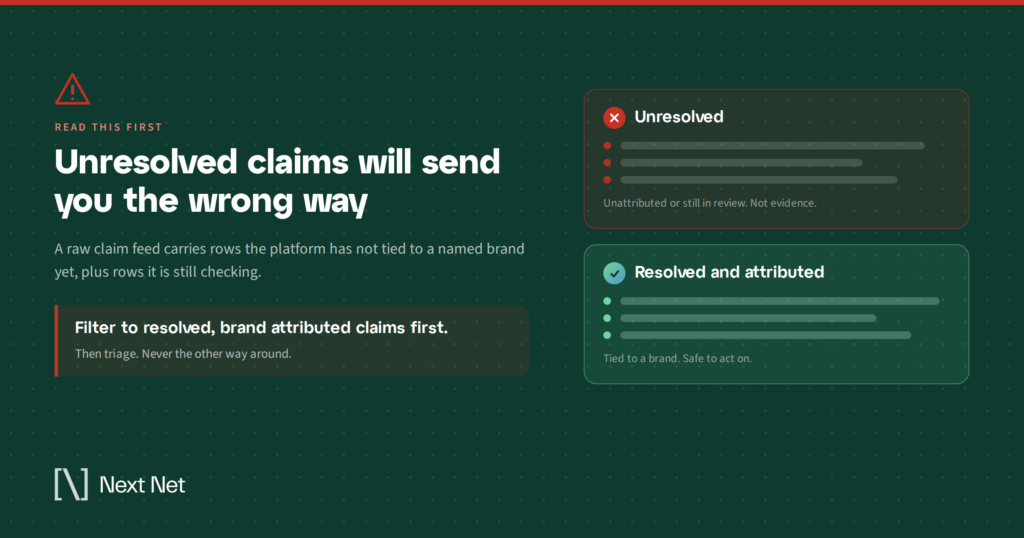
Before any of this is worth acting on, filter the view down to resolved, brand-attributed claims.
An engine discussing your category produces claims about many entities, and not all of them resolve cleanly to a brand. Some attach to a business name that several companies share. Some attach to a product line rather than the company behind it. Some attach to an entity nothing has been matched to yet. A large share of raw claims can sit against an unresolved entity today, and reading those as though they were about you will send you fixing problems you do not have.
So: resolved entities only, and confirm the resolution is your brand rather than a near-name riding on it. Then read.
Two habits keep the reading honest after that. Report direction rather than precision, because claim counts move with sampling and a shift from nine to eleven is not a trend. And check the spread across engines before acting on anything, since a claim appearing in one engine’s answers and nowhere else is a different problem from one repeating across ChatGPT, Gemini, Perplexity, Copilot, and Google AI Overviews.
Turning weaknesses and objections into a content plan
Your topical map answers a different question than your claims database, and the two are worth keeping apart. The map shows topics buyers ask about where you have no presence. The claims database shows statements already circulating about you that you have never answered. The first is a coverage gap. The second is a rebuttal gap, and it is usually the faster win, because the demand is already proven: something in the source material caused an engine to keep saying this.
The workflow is short. Pull every Weakness and Objection appearing at more than incidental frequency, sort them by how close they sit to a buying decision, then sort each one into three buckets.
Inaccurate. The claim is wrong and traceable to a source that is out of date or mistaken. The fix is corrective: publish the current facts somewhere crawlable, update the third-party profiles and listings that carry your business details, and make the correction easy to find.
Accurate but unanswered. The claim is fair and you have never addressed it in public. The fix is a page. Write the honest version, with the reasoning and the tradeoff, on your own site.
Accurate and structural. The claim reflects a real constraint you are not going to change. The fix is qualification rather than rebuttal. Say plainly who you are for and who you are not for.
Google’s guidance on optimizing for generative AI search is direct about what earns a place in these answers: a unique point of view and non-commodity content beat restatements of what everyone else has already published. That fits objection content unusually well, because nobody else can write your answer to a criticism of your business.
The same guidance notes that generative AI features can surface what is being said about products and services across the web, including in blogs, videos, and forum discussions, and it warns against chasing inauthentic mentions as a shortcut. That is the honest read on this work. You are not gaming the claim. You are giving the engines a better source for it.

Turning objections into sales enablement
The claims database is also the cheapest sales enablement research your team will run this month.
Hand the Objection rows to whoever owns your battlecards. Every one is a live objection with the phrasing attached. Reps normally reconstruct this from memory after calls. Here it arrives pre-written, and it includes the objections that never surface on a call because the buyer resolved them by disqualifying you quietly.
Battlecards. Pair each recurring objection with the response and the proof behind it. Use the engine’s wording as the prompt, since that is closer to how the buyer heard it than your internal shorthand.
Discovery questions. When an objection appears often in answers but rarely on calls, the gap is the tell. Buyers are absorbing it and not raising it. Ask about it directly.
Proof assets. The Proof Point rows show which evidence the engines already trust in your category. Build more of that kind and less of the kind nobody cites.
For agencies, this is also a client conversation that lands without a dashboard tour. Showing a client the sentence an engine is saying about them, then showing the plan to answer it, does more in ten minutes than a visibility score has ever done. Our guide on what to say when a client asks whether they show up in ChatGPT covers the framing.
When the claim is true and you do not like it
Some of what you find will be accurate.
The instinct is to treat that row as a reputation problem and go looking for a way to suppress it. That is a poor use of the data and, in most cases, not available anyway. Google’s documentation on AI features and your website is clear that the controls site owners have govern their own pages, not what other people publish about them.
The better move is to compete for the framing. If the engines say you are premium, the question is whether the answer also carries the reason. “Costs more” is a weakness. “Costs more because the work is done by senior staff and the scope includes onsite discovery” is a positioning statement. Same fact, different sentence, and the second one is available to an engine only if somebody publishes it.
This is slower than it sounds like it should be. Claims that took eighteen months of forum threads and review text to form do not turn around in three weeks. Watch whether the phrasing softens and whether the reason starts traveling alongside the claim.
Working the claims into a monthly rhythm
A claims database read once is a curiosity. Read on a cadence, it becomes a system. Monthly suits most brands; anything tighter and you will read sampling noise as movement.
Pull. Filter to resolved, brand-attributed claims and note what is new since the last read.
Triage. Sort new Weakness and Objection rows into inaccurate, unanswered, and structural.
Assign. Content owns the unanswered ones. Whoever manages your listings and third-party profiles owns the inaccurate ones. Sales owns the structural ones as qualification language.
Watch. Track whether the claims you addressed change phrasing, drop in frequency, or start arriving with your reasoning attached.
Pair this with your market atlas so you can see where the claims are landing, and with your citation footprint so you know which of the sources carrying them link back to you. Together the three answer where you show up, what gets said, and who gets credit for it. If you are setting this up for a client from scratch, our walkthrough on running an AI visibility audit covers the first pass.

Frequently asked questions
What does AI say about my brand right now?
The only reliable way to know is to sample answers systematically across engines rather than asking once yourself. A single prompt in one engine gives you one draw from a distribution that shifts with phrasing, context, and time. A claims database runs many prompts across ChatGPT, Gemini, Perplexity, Copilot, and Google AI Overviews and records what comes back, which is the difference between an anecdote and a reading.
Is a claims database the same as brand sentiment monitoring?
No. Sentiment monitoring scores a body of text as positive, negative, or neutral. A claims database records the specific assertions being made and what job each one does in the answer. A sentiment score of 31 percent negative is not something you can assign to anybody. “The engines are telling buyers your onboarding takes too long” is a task with an owner.
How often do the claims change?
Slowly for established claims, faster for new ones. A claim rooted in years of third-party content tends to persist even after the underlying facts change, because the sources carrying it are still sitting there. A claim that formed recently, off a single widely cited article or thread, can shift within weeks once a better source appears. Read monthly and judge direction rather than any single count.
Can I get a claim removed from AI answers?
Not directly. What you can change is what the engines find when they look. That means correcting the sources you control, publishing your own answer where none exists, and keeping your business details accurate on the third-party properties engines reach for. Removal is not the goal. Being the better source is.
Which claim type should we work on first?
Objections, then the Weaknesses that sit closest to a buying decision. Objections are stated as reasons not to choose you, which puts them nearest the moment money moves. They are also the easiest to hand off, because sales and content can both act on the same row without translating it first.
Read the paragraph, not the name count
The paragraph an engine returns about your category is going to say something about you whether or not anyone on your team reads it. Most of your buyers will read that paragraph and nothing else.
Counting how often your name appears in it tells you that you were in the shot. Reading what got said tells you whether you were the answer or the scenery. One of those is a report. The other is a plan.
If you want a read on a specific brand before committing to a full setup, the AI Visibility Report Card grades where that brand stands across the engines. Or start a trial from the platform overview and pull the claims yourself.